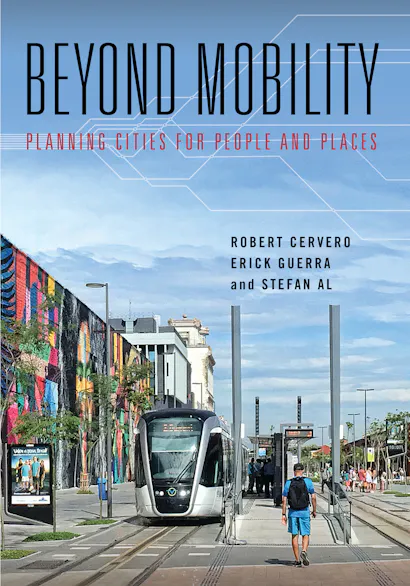
Cities across the globe have been designed with a primary goal of moving people around quickly鈥攁nd the costs are becoming ever more apparent. The consequences are measured in smoggy air basins, sprawling suburbs, unsafe pedestrian environments, and despite hundreds of billions of dollars in investments, a failure to stem traffic congestion. Every year our current transportation paradigm generates more than 1.25 million fatalities directly through traffic collisions. Worldwide, 3.2 million people died prematurely in 2010 because of air pollution, four times as many as a decade earlier. Instead of planning primarily for mobility, our cities should focus on the safety, health, and access of the people in them.
Beyond Mobility is about prioritizing the needs and aspirations of people and the creation of great places. This is as important, if not more important, than expediting movement. A stronger focus on accessibility and place creates better communities, environments, and economies. Rethinking how projects are planned and designed in cities and suburbs needs to occur at multiple geographic scales, from micro-designs (such as parklets), corridors (such as road-diets), and city-regions (such as an urban growth boundary). It can involve both software (a shift in policy) and hardware (a physical transformation). Moving beyond mobility must also be socially inclusive, a significant challenge in light of the price increases that typically result from creating higher quality urban spaces.
There are many examples of communities across the globe working to create a seamless fit between transit and surrounding land uses, retrofit car-oriented suburbs, reclaim surplus or dangerous roadways for other activities, and revitalize neglected urban spaces like abandoned railways in urban centers.
The authors draw on experiences and data from a range of cities and countries around the globe in making the case for moving beyond mobility. Throughout the book, they provide an optimistic outlook about the potential to transform places for the better. Beyond Mobility celebrates the growing demand for a shift in global thinking around place and mobility in creating better communities, environments, and economies.
Robert Cervero is Professor Emeritus of City and Regional Planning at the University of California, Berkeley. He is the author of six books in the urban transportation field as well as numerous articles and research publications. He was a contributing author to the recent IPCC (International Panel on Climate Change) Fifth Assessment and UN-Habitat's Global Report on Sustainable Mobility and in 2013 was ranked among the top 100 City Innovators Worldwide by UMB's Futures Cities.
Erick Guerra is Assistant Professor of City and Regional Planning at the University of Pennsylvania, where he teaches courses in transportation planning and quantitative planning methods. He has published a dozen articles on the relationship between transportation infrastructure, land use, urban development, and travel behavior.
Stefan Al is Associate Professor of Urban Design at the University of Pennsylvania. He has published several books, including Factory Towns of South China: An Illustrated Guidebook and The Strip: Las Vegas and the Architecture of the American Dream. As a practicing architect and urban designer, he has worked on renowned projects such as the Canton Tower in Guangzhou.
"Updates the argument that planning should focus less on motorized movement and more on the 'needs and aspirations of people and the places they want to go.'"鈥�Planning
"A remarkable contribution to the literature that establishes a comprehensive perspective on community building, built environment design, and economic development. The chapters in this volume establish a new urban planning and design framework to meet the needs of the new century."鈥�Journal of Planning Education and Research
"Overall, this book explains conflicts and challenges of transportation and land use planning and provides practical examples for overcoming these challenges. Beyond Mobility is a worthy addition for transportation and urban planning and should prove useful for researchers as well as practitioners.The practical cases provide a pool that can be used for teaching transportation and land use planning courses."鈥�Journal of Urban Affairs
"Including color illustrations and a few graphics to illustrate critical points, this fantastic book should be required reading."鈥�CHOICE
"Beyond Mobility: Planning Cities for People and Places does a great job of explaining each of these trends and urban issues at large. It’s very easy to read and will fill you with plenty of urbanist dinner table conversation!"鈥�Spacing Vancouver
"How do we plan our cities for people instead of cars? This book shows how urban designers, transportation engineers, and policy makers can work together to connect and create places that people want to be in while assuring that they can travel around without a fuss. The authors link theory with practice, backing up their argument with ample data and real-life case studies. This veritable tour de force will be an inspiration for anyone who cares about the future of cities."鈥擩an Gehl, Founder and Senior Advisor of Gehl Architects
"Robert Cervero and his colleagues have produced what may become the most influential book of this generation on land use and transportation, providing an elegant conceptual framework, excellent case studies, and cutting-edge thinking."鈥擱eid Ewing, Chair and Professor of the City & Metropolitan Planning Program at the University of Utah
"With a grand vision, this book clearly articulates the crucial importance of transportation in creating better communities, environments, and economies. Beyond Mobility is a must-read for urban geographers, planners, designers, and engineers seeking ways to make future cities more sustainable."鈥擝ecky Loo, Professor of Geography and Director of the Institute of Transport Studies at the University of Hong Kong
Accessibility Features
-
Unknown accessibility
-
Table of contents navigation
-
Single logical reading order
-
Landmark navigation
-
Index navigation
-
All non-decorative content supports reading without sight
-
No known hazards or warnings