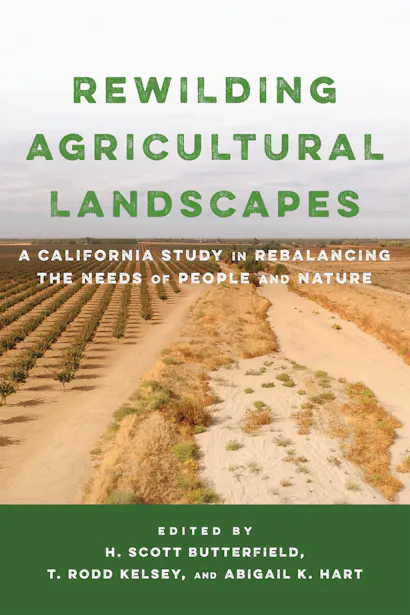
As the world population grows, so does the demand for food, putting unprecedented pressure on agricultural lands. At the same time, climate change, soil degradation, and water scarcity mean that productivity of many of these lands is deteriorating. In many desert dryland regions, drinking wells are drying up and the land above them is sinking, soil salinity is increasing, and poor air quality is contributing to health problems in farm communities. 鈥淩ewilding鈥� the least productive of these cultivated landscapes offers a sensible way to reverse the damage from intensive agriculture. These ecological restoration efforts can recover natural diversity while guaranteeing the long-term sustainability of the remaining farms and the communities they support.
This accessibly written, groundbreaking contributed volume is the first to examine in detail what it would take to retire eligible farmland and restore functioning natural ecosystems. Rewilding Agricultural Landscapes uses the southern Central Valley of California, which is one of the most productive and important agricultural regions in the world, as a case study for returning a balance to agricultural lands and natural ecosystems. This project鈥攐ne of the largest rewilding studies of its kind in dryland ecosystems鈥攈as shown that rewilding can slow desertification and provide ecosystem services, such as recharged aquifers, cleaner air, and stabilized soils, to nearby farms and communities. Chapters examine what scientists have learned about the natural history of this dryland area, how retired farmland can be successfully restored to its natural wild state, and the socioeconomic and political benefits of doing so. The book concludes with a vision of a region restored to ecological balance and equipped for inevitable climate change, allowing nature and people to prosper. The editors position the book as a case study with a programmatic approach and straightforward lessons that can be applied in similar regions around the world.
The lessons in Rewilding Agricultural Landscapes will be useful to conservation leaders, policymakers, groundwater agencies, and water managers looking for inspiration and practical advice solving the complicated issues of agricultural sustainability and water management.
Scott Butterfield is a Senior Scientist for The Nature Conservancy, where he is the Lead Scientist for the Strategic Restoration Strategy and Program Lead for the Managing Partnership at the Carrizo Plain National Monument. Butterfield holds a Ph.D. from Michigan State University.
Rodd Kelsey is Associate Director of the Water Program at The Nature Conservancy California. He helps lead the Conservancy’s strategy focused on developing and expanding water management solutions to meet nature’s and people’s needs.
Abigail Hart is a project director in The Nature Conservancy’s California Water Program. Her work and research focus on stakeholder engagement and collaborative management of working landscapes.
"This book is refreshing in examining how agricultural loss can provide important opportunities to enhance ecological health …. readers will gain a greater appreciative of the importance of working holistically to transform degraded agricultural areas into wildlands, and obtain important information about how to proceed in implementing such transformations."鈥�Journal of Environmental Studies and Sciences
"A unique and seminal study that is exceptionally well written, organized and presented, Rewilding Agricultural Landscapes: A California Study in Rebalancing the Needs of People and Nature must be considered an essential and core addition to community, governmental, college and university library Environmental, Natural Resource Restoration, and Nature Conservation collections and supplemental studies curriculum lists."鈥�California Bookwatch
"No conservation or agricultural collection (particularly those in California) should be without this important survey of specifics on revitalizing the land and restoring ecological balance."鈥�Donovan's Literary Services
"The rewilding of the San Joaquin Valley is just at its beginning. If the advice in the book is widely adopted by practitioners and policymakers in the area, there is a good chance the proposed plans will succeed. For those who do not work in that area, it provides a model of how to engage a wide range of people to plan a landscape scale project and illustrates the need to know the ecological, social, and legal structure well in order to ensure success of any project."鈥�Restoration Ecology
"The result is an excellent, timely resource that would be equally valuable in a range of undergraduate and graduate ecology and environmental studies/science courses or for those looking to explore subjects relating to freshwater scarcity, restoration, rewilding, and both biological and social/ sociological aspects of conservation biology."鈥�Quarterly Review of Biology
"These experiences show the challenges and opportunities of rewilding from a broad perspective. There are no magic bullets that will help us replicate a successful habitat restoration elsewhere, but stories like the one from the San Joaquin Valley can give us a good idea of what must be considered for such an indispensable endeavor."鈥�Community Ecology
"California leads the nation in agricultural food production despite recent historical droughts. Rewilding Agricultural Landscapes provides valuable guidance on climate change, water availability, farmland diversification, and community engagement in dryland ecosystems. Meeting this challenge requires new relationships and partnerships, but by working together, farmers, agencies, and conservationists can plan for a new future before it’s too late."鈥擪aren Ross, Secretary, California Department of Food and Agriculture
"As the climate warms, farmers in dry regions like the San Joaquin Valley must adapt to using less water while keeping their farms productive and profitable. Rewilding Agricultural Landscapes is a scientific guide to how that process might unfold, providing lessons from the past and offering a vision for how nature and agriculture can benefit each other. For farmers like me, this will be a once-in-an-era opportunity for a sustainable future."鈥擬as Masumoto, organic farmer and author of "Epitaph for a Peach"
"Rewilding Agricultural Landscapes shows how the Sustainable Groundwater Management Act will drive new approaches to sustain an agricultural economy of global importance in California’s San Joaquin Valley. Conserving and restoring targeted habitats will ensure healthy ecosystems so that local water agencies can balance their long-term water needs."鈥擬ike Chrisman, former Secretary, California Natural Resources Agency and fourth-generation farmer/rancher
Accessibility Features
-
Unknown accessibility
-
Table of contents navigation
-
Single logical reading order
-
Landmark navigation
-
Index navigation
-
All non-decorative content supports reading without sight
-
No known hazards or warnings