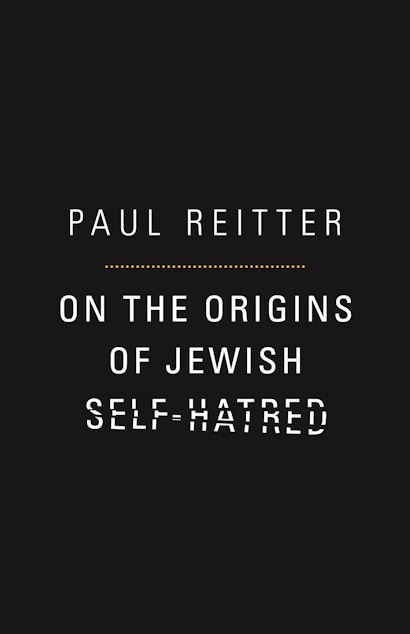
Today, the term 鈥淛ewish self-hatred鈥� often denotes a treasonous brand of Jewish self-loathing, and is frequently used as a smear, such as when it is applied to politically moderate Jews who are critical of Israel. In On the Origins of Jewish Self-Hatred, Paul Reitter demonstrates that the concept of Jewish self-hatred once had decidedly positive connotations. He traces the genesis of the term to Anton Kuh, a Viennese-Jewish journalist who coined it in the aftermath of World War I, and shows how the German-Jewish philosopher Theodor Lessing came, in 1930, to write a book that popularized 鈥淛ewish self-hatred.鈥� Reitter contends that, as Kuh and Lessing used it, the concept of Jewish self-hatred described a complex and possibly redemptive way of being Jewish. Paradoxically, Jews could show the world how to get past the blight of self-hatred only by embracing their own, singularly advanced self-critical tendencies鈥攖heir 鈥淛ewish self-hatred.鈥�
Provocative and elegantly argued, On the Origins of Jewish Self-Hatred challenges widely held notions about the history and meaning of this idea, and explains why its history is so badly misrepresented today.
"[T]he author does a fine job of placing Kuh and Lessing in personal and historical contexts, and he clearly contrasts their ideological notions of Jewish self-hatred with the more psychological slant of such contemporary thinkers as Peter Gay, Sander Gilman, and Shulamit Volkov."鈥�Publishers Weekly
"[S]hort and ambitious. . . . Of particular interest is Reitter's analysis of the impact of World War I: it gave renewed focus to the so-called Jewish question in Europe and spurred Koh's and Lessing's work. . . . [On the Origins of Jewish Self-Hatred] should be in every library with a serious Jewish studies collection."鈥�Library Journal
"His arguments are convincing; however, while the book is short, readable, and enlightening, it is a work of scholarship鈥擱eitter assumes the reader is familiar with the previous work on the topic. At times I felt like I was at a dinner party where everyone was gossiping about people I had never heard of. Reitter's excellent book is an inadvertent reminder of how the Germans pulverized their own intellectual life."鈥擥ordon Haber, Religion Dispatches
"With this book . . . Reitter has established himself as a leading authority on German-Jewish relations between the wars. Valuable."鈥�Choice
"On the Origins of Jewish Self-Hatred is a substantive and sophisticated work."鈥擥lenn C. Altschuler, Jerusalem Post
"[A] slim, intriguing volume."鈥擝en Cohen, Jewish Ideas Daily
"I highly recommend Reitter's essay both for the light it shines on interwar Jewish intellectual culture in Vienna and for its intervention in the study of Jewish self-hatred. From now on, any scholar interested in using or critiquing the term must reckon with Reitter's findings."鈥擜mos Bitzan, H-Net Reviews
"Paul Reitter . . . has an acutely sharp axe in his intellectual probing of the syndrome that surfaces so often in the contemporary debate on Jewish self-hate. . . . The troika of Jewish thinkers who inhabit Reitter's formidable study, tried to navigate the dangerous shoals of modern German history and its impact of German Jews. In resuscitating the complex arguments they offered in their explanation of Jewish self-hate, Reitter has performed a valuable exercise鈥攆or which we are in his debt."鈥擜rnold Ages, Jewish Tribune
"Paul Reitter's excavation of the phrase 'Jewish self-hatred' provides a fascinating lens through which to view the challenges faced by German Jews, whose integration had stalled by the early twentieth century. Since the phrase has become a casually used pejorative in today's debates over Zionism and the State of Israel, Reitter's genealogy of its origins has real contemporary relevance."鈥擠avid Biale, University of California, Davis
"A readable, sensible, well-researched conceptual history. Reitter's portraits of the secondary figures Anton Kuh and Otto Gross are especially fresh and apposite."鈥擩onathan Franzen
"On the Origins of Jewish Self-Hatred is an impressively fluent, deeply learned, and morally responsible treatment of what can be an incendiary label. Reitter's major revelation is that the concept of Jewish self-hatred emerged as part of an affirmative discourse rather than as a label of denunciation. This stylish essay should have a wide impact."鈥擲amuel Moyn, Columbia University
"This book is a short but intense piece of scholarship with an engaging polemical edge. Reitter makes a counterintuitive and somewhat jarring claim: that the term 'Jewish self-hatred' was originally understood as salvific and cleansing, more an antidote to a malady than the malady. On the Origins of Jewish Self-Hatred will stimulate impassioned debate."鈥擠avid N. Myers, University of California, Los Angeles