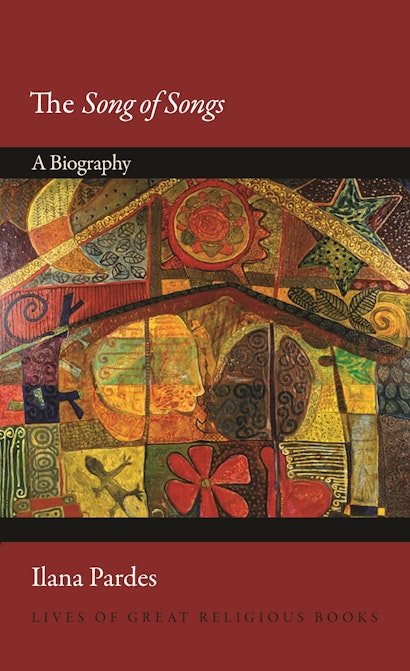
The Song of Songs has been embraced for centuries as the ultimate song of love. But the kind of love readers have found in this ancient poem is strikingly varied. Ilana Pardes invites us to explore the dramatic shift from readings of the Song as a poem on divine love to celebrations of its exuberant account of human love. With a refreshingly nuanced approach, she reveals how allegorical and literal interpretations are inextricably intertwined in the Song’s tumultuous life. The body in all its aspects鈥攑leasure and pain, even erotic fervor鈥攊s key to many allegorical commentaries. And although the literal, sensual Song thrives in modernity, allegory has not disappeared. New modes of allegory have emerged in modern settings, from the literary and the scholarly to the communal.
Offering rare insights into the story of this remarkable poem, Pardes traces a diverse line of passionate readers. She looks at Jewish and Christian interpreters of late antiquity who were engaged in disputes over the Song’s allegorical meaning, at medieval Hebrew poets who introduced it into the opulent world of courtly banquets, and at kabbalists who used it as a springboard to the celestial spheres. She shows how feminist critics have marveled at the Song’s egalitarian representation of courtship, and how it became a song of America for Walt Whitman, Herman Melville, and Toni Morrison. Throughout these explorations of the Song’s reception, Pardes highlights the unparalleled beauty of its audacious language of love.
"Pardes deftly demonstrates how the biblical past can furnish us with a common storehouse of images, to be rediscovered or recast."鈥擝enjamin Balint, Wall Street Journal
"The volume is to be commended . . . Pardes engages empathetically with the concerns of the readers in each chapter, seeking to explain why and how they read the Song as they did."鈥�Reading Religion
"Take this chance to refamiliarize yourself with one of the great curiosities of biblical exegesis. Ilana Pardes, a professor at the Hebrew University of Jerusalem, frames the issue thus in the opening pages: 'Why was a daringly sensual poem of love with no reference whatsoever to God or national history included in the Bible.'"鈥擱obert Erickson, New Criterion
"Pardes鈥檚 training as both biblicist and scholar of comparative literature gives her a much broader perch from which to survey the Song than the typical and tired history-of-exegesis overviews, which too often account only for learned commentaries by theologians and exegetes both Jewish and Christian. . . . I recommend this book for both academic and general readers. Pardes brings her reader into the heart of this textual garden, showing them how to eat of its choicest fruits."鈥擩onathan Homrighausen, Englewood Review of 快色直播
"Pardes deftly weaves her way through the interpretive transition from the allegorical to the literal and then shows how they are intertwined and inseparable. Pardes鈥� work is erudite and academic yet highly readable. She does not attach herself to any specific agenda and does not attempt to sway the reader to any definitive conclusion. Rather, she presents the Song鈥檚 interpretations through the millennia inside a well-crafted, historical overview."鈥擝rad Pruitt, Christian Chronicle
"Pardes does a wonderful job of shining a light into the many manifestations and understandings of this poem, while the clear expressive language of love and passion is not diminished in any way . . . it is a great pleasure to read."鈥擳he JC, Rabbi Sylvia Rothschild
"Pardes . . . skillfully guides readers through the many twists and turns in the Songs of Songs鈥� reception history. The most brilliant moments come when she challenges us to redraw the frontiers of allegory, metaphor, and conventional sense. 鈥楢re breasts innately more similar to fawns than to Moses and Aaron?"鈥擲hai Secunda, Jewish Review of 快色直播
"Pardes is able to travel through history, bringing diverse texts to the attention of a general readership who might otherwise not encounter texts of medieval Jewish mysticism and nineteenth-century biblical criticism at all, let alone in conversation with one another."鈥擡lsie R. Stern, Review of Biblical Literature
"In this brilliant and marvelously readable celebration of the Song of Songs, Ilana Pardes illuminates how, for thousands of years, mystics, poets, and writers from ancient rabbis to John of the Cross, from Teresa of 脕vila to Walt Whitman and Toni Morrison have loved this poem and transformed it in their own writings."鈥擡laine Pagels, author of Why Religion? A Personal Story
"This luminous study is a rare combination of finely perceptive literary readings with a sweeping historical overview. Perhaps the chief of the gifts it offers is the demonstration, by means of multiple examples throughout the book, that the distinction between literal and allegorical is intrinsically ambiguous. In lucid and lively prose, Ilana Pardes shows the remarkable life of a great work through the ages."鈥擱obert Alter, author of The Art of Bible Translation
"Pardes offers a beautiful exploration of the adventures of a single biblical book. The Song itself seems to open up in fuller glory in each chapter."鈥擭aomi Seidman, author of The Marriage Plot: Or, How Jews Fell in Love with Love, and with Literature
"Rabbi Akiva called the Song of Songs God's best gift to the Jewish people. Does it celebrate the erotic desires of a young man and woman? Delineate the love of God for the Jewish people? Or for the church? Or the longing of the mystic soul for union with God? All this and much more. This is not a book only for scholars. The clarity and charm of Pardes's writing make it a book all readers will enjoy."鈥擜licia Suskin Ostriker, author of For the Love of God: The Bible as an Open Book
"Ilana Pardes鈥檚 erudite and lyrical book is a marvelous entry into the imaginative world of the Song of Songs, beginning with its biblical origins and continuing through the panorama of its interpretive life."鈥擱onald Hendel, author of The Book of "Genesis": A Biography