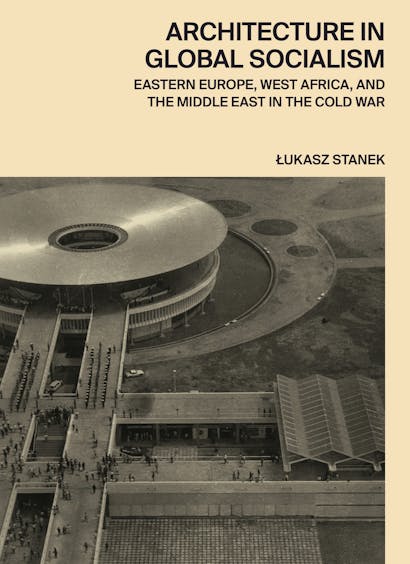
In the course of the Cold War, architects, planners, and construction companies from socialist Eastern Europe engaged in a vibrant collaboration with those in West Africa and the Middle East in order to bring modernization to the developing world. Architecture in Global Socialism shows how their collaboration reshaped five cities in the Global South: Accra, Lagos, Baghdad, Abu Dhabi, and Kuwait City.
艁ukasz Stanek describes how local authorities and professionals in these cities drew on Soviet prefabrication systems, Hungarian and Polish planning methods, Yugoslav and Bulgarian construction materials, Romanian and East German standard designs, and manual laborers from across Eastern Europe. He explores how the socialist development path was adapted to tropical conditions in Ghana in the 1960s, and how Eastern European architectural traditions were given new life in 1970s Nigeria. He looks at how the differences between socialist foreign trade and the emerging global construction market were exploited in the Middle East in the closing decades of the Cold War. Stanek demonstrates how these and other practices of global cooperation by socialist countries鈥攚hat he calls socialist worldmaking鈥攍eft their enduring mark on urban landscapes in the postcolonial world.
Featuring an extensive collection of previously unpublished images, Architecture in Global Socialism draws on original archival research on four continents and a wealth of in-depth interviews. This incisive book presents a new understanding of global urbanization and its architecture through the lens of socialist internationalism, challenging long-held notions about modernization and development in the Global South.
Awards and Recognition
- Winner of the Alice Davis Hitchcock Medallion, Society of Architectural Historians of Great Britain
- Winner of the President鈥檚 Award for Research in History and Theory, Royal Institute of British Architects
- One of the Financial Times' Summer 快色直播 of 2020: Architecture
- Winner of the First Book Prize, International Planning History Society
- Highly commended for the inaugural Architectural Book of the Year Award, History Category
"This is one of those books that turns a discipline upside down 鈥� the cold war, state socialism, eastern Europe and 20th-century architecture all look different in the light of its findings . . . [it is] a pioneering work of revisionist history that ought to be read far beyond the those already interested in architecture . . . what [Stanek] achieves here is enormous: a book that rewrites not only the history of the cold war, but also the history of globalisation and global urbanization."鈥擮wen Hatherly, The Guardian
"A fascinating snapshot of a historic moment in which the future was in flux."鈥擡dwin Heathcote, Financial Times
"Architecture in Global Socialism strikes a generally successful balance between theoretical exposition and historical analysis, liberally illustrated, suitably informed but accessible to the general reader."鈥擜lexander Adams, The Critic
"This incisive book presents a new understanding of global urbanization and its architecture through the lens of socialist internationalism, challenging long held notions about modernization and development in the global South."鈥擥eorgina Johnston, World Architecture News
"An epic, revisionist study many years in the making, centering on how Non-Aligned countries in the post-war era employed professionals from Eastern and Central Europe to plan and build their post-colonial urban spaces."鈥擮wen Hatherley, Tribune
"[Stanek鈥檚] omniscience is impressive."鈥擩onathan Meades, Literary Review
"[Architecture in Global Socialism] challenges cold-war preconceptions of the roles played by those from Eastern European socialist countries who worked collectively to urbanise and develop the Global South during the Soviet era."鈥擬ichael Boncza, Morning Star
"Rather than describing global urbanisation as a process that was visited upon societies in the developing world by western consultants, Stanek鈥檚 history reveals the role played by socialist architects in constructing a negotiated future in which local rulers, authorities and communities took an active interest in shaping their own destinies. Free from big-name architects and landmarks, Architecture in Global Socialism also gives voice to a largely forgotten body of professionals who travelled to the non-aligned world 鈥� neither communist nor pro-West 鈥� during the Cold War and whose lives and careers were enriched and globalised in the process."鈥擭ick Leech, The National
"Architecture in Global Socialism is not only a book that successfully lifts the curtain on the importance of the 鈥渇orgotten鈥� socialist network with its backdrop and real effects on the life and environment of millions of people. It is also a refreshing point of view that allows you to look with valid optimism at the complex reality that surrounds us and the possibilities of understanding and describing it."鈥擜licja Gzowska, Polish History
"Stanek鈥檚 book is extraordinarily well researched, clearly written and convincing in its conclusions. Being the first comprehensive presentation of an important chapter in recent architectural history, there is no doubt that it will soon become a classic in the field."鈥擣lorian Urban, Planning Perspectives
"An important correction to architectural history鈥檚 neglect of detailed studies into West Africa and the Middle East."鈥擝en Tosland, Architectural Histories
"Beautifully illustrated, extremely well researched, and extensively documented, this is a fascinating examination of the role played by architects, planners, and sometimes builders from the communist countries of Eastern Europe in the architecture of newly independent countries in Africa and the Middle East in the post鈥揥W II era. . . . The large format of the volume does justice to the numerous illustrations, including drawings and buildings, a great many in color; these are accompanied by Stanek's perceptive comments, a host of endnotes, and an extensive bibliography. The result is an impressive investigation of an overlooked topic in 20th-century architectural history."鈥�Choice
"The book will be a milestone, not just because of the almost encyclopaedic completeness of the contents but because it offers a repeatable research methodology, capable of communicating multiple dialogues between different cultures and identities."鈥擣abrizio Gallanti, Arbitare
"Architecture in Global Socialism provides important lessons on many levels. It is not only groundbreaking in terms of filling an enormous 鈥渂lind spot鈥� in historiography, or through its development of a methodology that is not simply postulated but works in practice 鈥� it also proves to be relevant in discussions about the current urban condition."鈥擜licja Gzowska, View: Theories and Practices of Visual Culture
"Architecture in Global Socialism is a much needed revisionist account of architectural practice and urbanism in the second half of the twentieth century."鈥擧annah Neate, Eurasian Geography and Economics
"A welcome addition to the growing body of scholarship reassessing socialist architecture and urban design within the Cold War鈥檚 myriad economic and diplomatic networks . . . this book sets an undoubtedly strong precedent for further research on socialist architecture in a global context. . . . Architecture in Global Socialism [is] a truly compelling study."鈥擧olly Bushman, Art Margins
"A book about architecture, modernity and the world system of 'actually existing socialism' in the Soviet bloc and its allies. With rare photographs and designs, Stanek takes a tour through the forgotten world of the future society and cities architects planned and built."鈥擥erry Hassan, Scottish Review
"Architecture in Global Socialism constitutes a significant contribution to the historiography of modern architecture in Eastern Europe, West Africa, and the Middle East. It is the kind of book we need more of: expansive in scope, specific in analysis, and rigorous in argumentation. It recognizes the pluralism of actors and contexts in the Global South, which further dismantles the myth of a monolithic modernism and demands additional scholarship that both revises and builds. Stanek鈥檚 book promises to remain an essential reference for scholars and students well into the future."鈥擠avid Rifkind, Art Bulletin
"[In Architecture in Global Socialisms,] 艁ukasz Stanek shifts the lens to the so-called weak actors of Eastern European socialist states, as well as to professional groups that 鈥榖uilt鈥� modernity鈥攁rchitects, but also contractors, building supervisors, and foreign trade representatives. This excellent study thus shows, convincingly, that global processes鈥攊n this case urbanization鈥攚ere not monolithic and one cannot talk of exceptions to an existing rule of 鈥榞lobalization.鈥� 鈥擵ictor Petrov, H-Net Reviews"
"Architecture in Global Socialism is an indispensable contribution to our understanding of the multifaceted process of globalization. . . . [The book is] the first study of its kind in architectural history. Ambitious in scope and breadth, it compellingly conveys the sheer scale and magnitude of the presence and work of architects from the socialist bloc in West Africa and the Middle East from 1957 (the year of Ghana鈥檚 independence) to the end of the Cold War. . . . The importance of [this book] cannot be overestimated."鈥擜yala Levin, Journal of the Society of Architectural Historians
"Architectural historians have recently discovered the outsize role that the former socialist world played in the Global South in the postwar decolonization process. 艁ukasz Stanek鈥檚 book Architecture in Global Socialism . . . was a signal achievement in this respect, as it mapped for the first time the astonishing extent of architectural exports from Eastern Europe to Africa and the Middle East."鈥擵ladimir Kuli膰, The Architect鈥檚 Newspaper聽
"Architecture in Global Socialism provides much-needed cornerstones to advance spatial political economy."鈥擣ranklin Obeng-Odoom, Housing Studies
"Architecture in Global Socialism is a major contribution. This is a brilliantly original book that fundamentally recasts our understanding of architecture in a worldwide frame. It will become a canonical reference point for scholars and students of postwar global architecture."鈥擭eil Brenner, professor of urban theory, Harvard University
"An indispensable resource for scholars that goes beyond architecture and urban planning to engage with broader historical and political issues."鈥擩ean-Louis Cohen, author of Architecture in Uniform and The Future of Architecture Since 1889