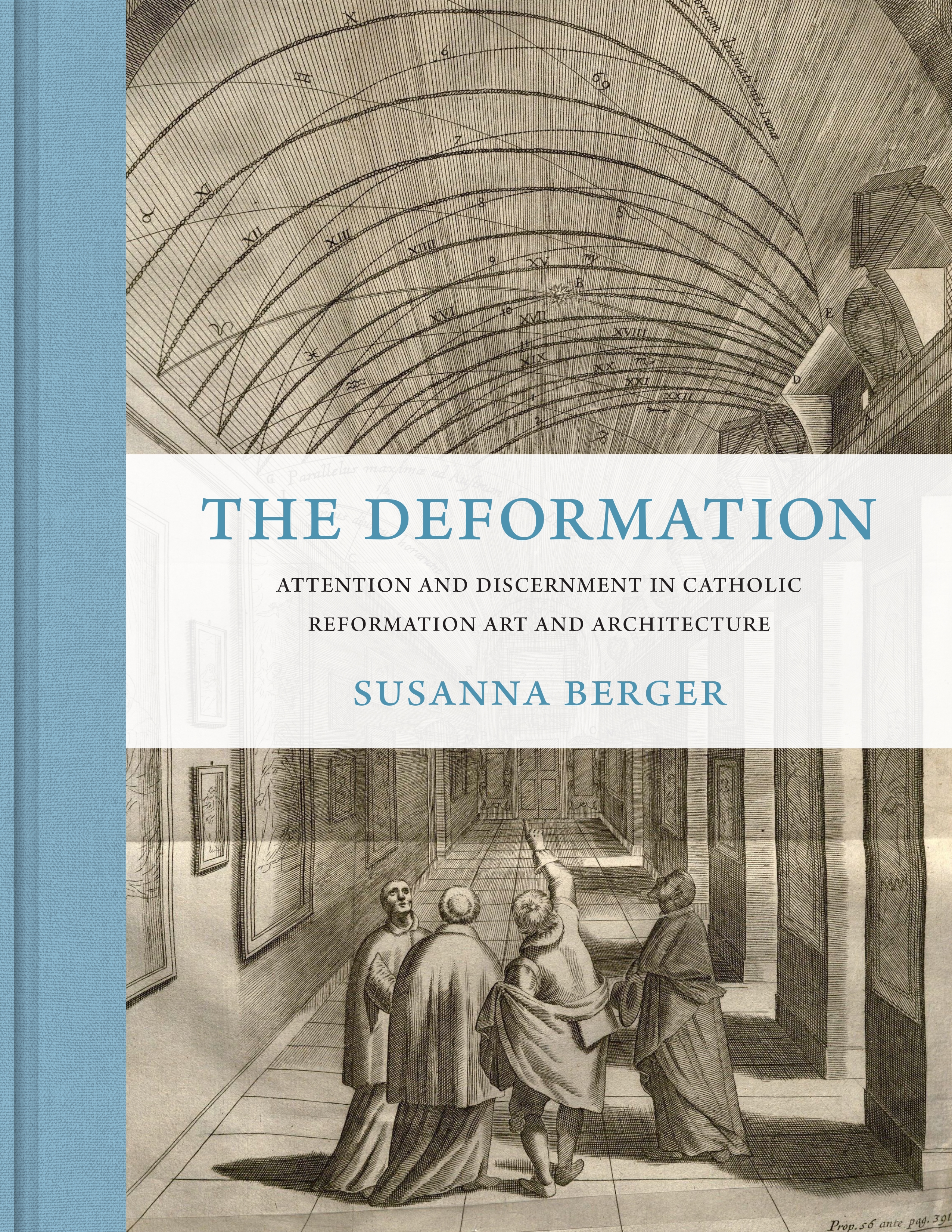
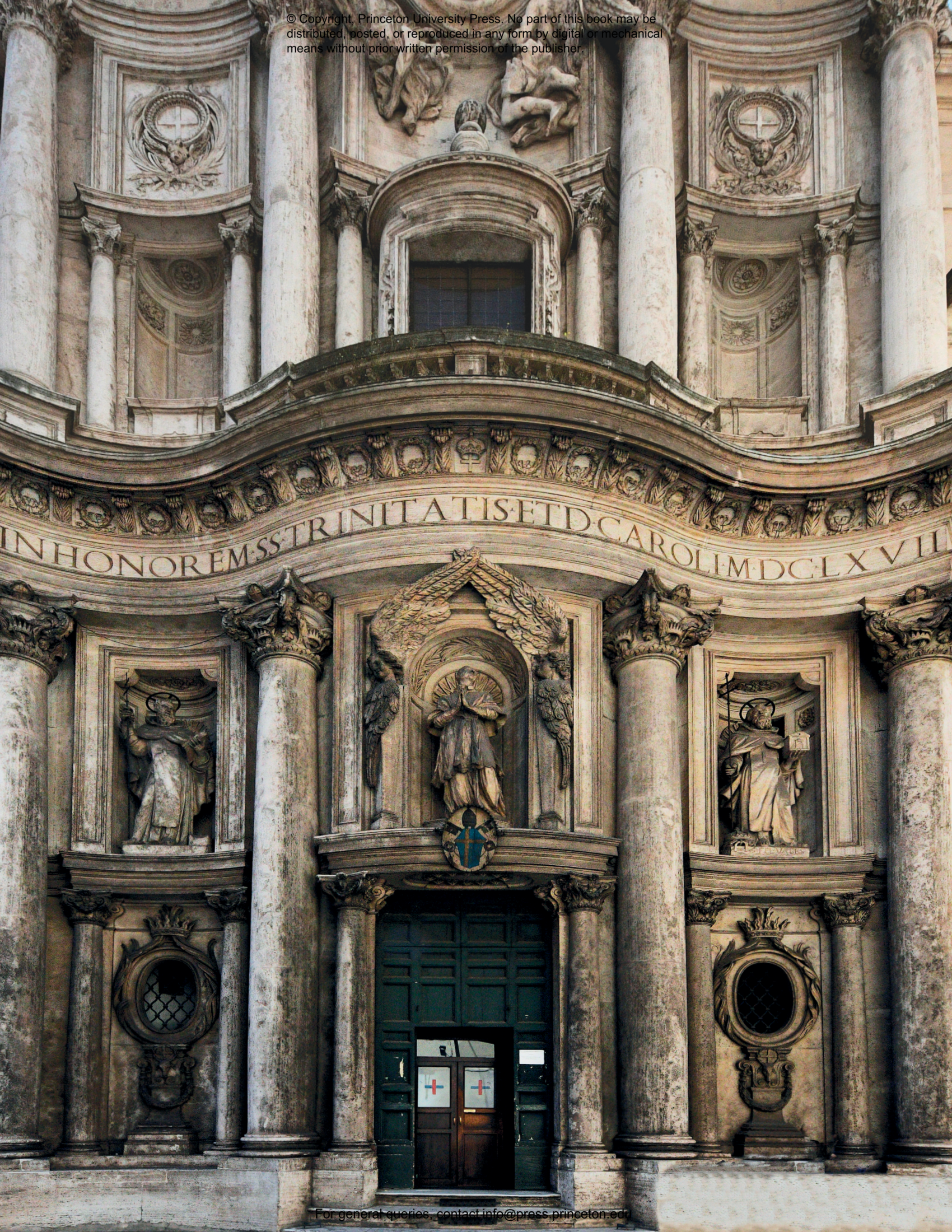
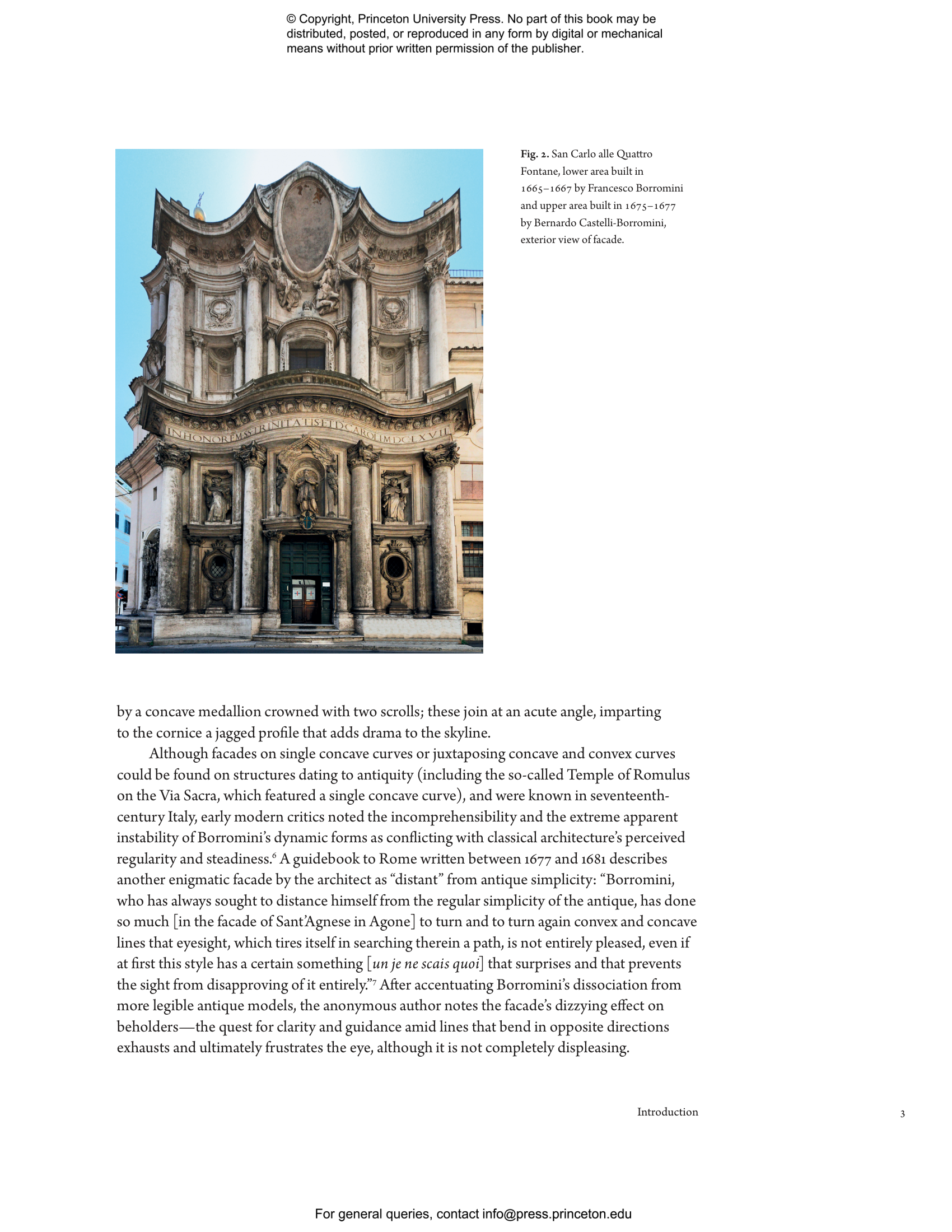
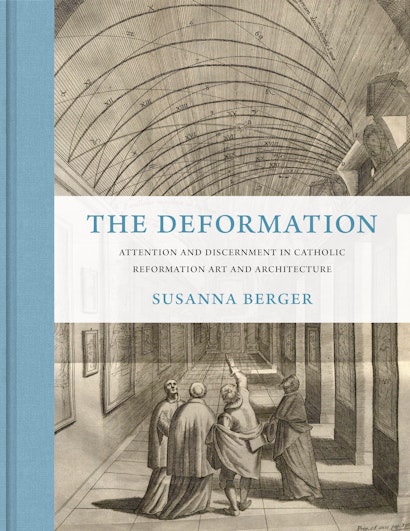
During the Catholic Reformation, patrons, artists, architects, and viewers, especially in Rome, were strongly drawn to visual and spatial distortions or 鈥渄eformations鈥濃�攚orks of art and architecture that were designed to be visually incomprehensible, at least initially. From Borromini鈥檚 San Carlo alle Quattro Fontane in Rome to the attention-grabbing prospettiva in the city鈥檚 Palazzo Spada and the anamorphoses that define the corridors and walls of Minim and Jesuit buildings, The Deformation explores what this intriguing phenomenon reveals about contemporary religious belief, optics, and the natural sciences, as well as wider questions about attention and discernment.
Failing to conform to an established ideal, deformations required a 鈥渞eformation鈥� to achieve that ideal. Anamorphic deformations, for example, could only be reformed into clarity when viewed from a particular angle or through a special mirror. Susanna Berger examines how deformations were experienced by beholders, and how they were embraced or opposed by critics. The book shows how deformations and related works鈥攚hether altar tabernacles, ephemeral religious architecture, churches, monumental sundials, colonnades with accelerated perspective, illusionistic frescoes, turned ivories, or painted anamorphoses鈥攆ocused observers鈥� attention on theological mysteries and the social power and sophistication of patrons. The book鈥檚 rich illustrations include two gatefolds and some anamorphic images that can be seen without distortion by using an included reflective insert as a mirror.
Looking at writings as well as visual works in multiple artistic media not typically considered in relation to each other, The Deformation offers a new interpretation of deformation that highlights the delay between perception and discernment.
Awards and Recognition
- Longlisted for the Art and Christianity Book Award
- Longlisted for the Pickstone Prize, British Society for the History of Science
- Honorable Mention for the American Association for Italian Studies Book Award, Visual Studies Category
- Winner of the Susanne K. Langer Award, Media Ecology Association
- Winner of the Jacques Barzun Prize in Cultural History, American Philosophical Society
"Central to The Deformation is the question of how religious elites wielded anamorphosis as a means of gatekeeping the divine. That is precisely what makes Berger’s argument fresh. . . . [The] book is lavishly illustrated, with crisp, thoughtfully arranged images, and that matters more than you might think, given how closely she analyzes the layouts of the treatises she studies. . . . Berger’s book compels you to see differently . . . it makes a historical moment snap into focus, more faceted, more sharply edged than it looked from a distance—history rendered newly legible through the same uncanny recalibration that anamorphosis demands."鈥擡manuele Lugli, Los Angeles Review of 快色直播
"By recovering how the sensation of incomprehensibility could be a positive aesthetic experience, Berger helps us better understand what an architect like Borromini was trying to achieve. And in doing this she loses nothing of the sense of wonder that was so clearly delighted in by the artists and patrons she studies."鈥擶illiam Aslet, Apollo
"Berger’s book offers a significant new framework for understanding works of art, architectural projects and the ‘period eye’ of seventeenth-century Rome. . . . [The Deformation] offers a transformative way of understanding optical illusions produced by artists working within that context – and one that can reform their interpretation today."鈥擡lizabeth Savage, Burlington Magazine
"A startlingly interesting book that is at once surprising, informative, and at the same time, quite entertaining. . . . [H]ighly recommended."鈥擠aniel L. Smith-Christopher, Catholic 快色直播 Review
"Susanna Berger has written an important book that gives essential insight into late Renaissance and Baroque religious art and architecture. It is a commonplace that illusionism as a variant of perspective enters the scene in the early seventeenth century, but we have had, until now, no convincing explanation of why or of its meaning. . . . Berger’s study of Italian and French artists and architects practicing in seventeenth-century Italy should become required reading in every course on early modern art."鈥擬arcia Hall, The Catholic Historical Review
"Berger’s book illustrates how deformations were the fruit of a profoundly learned creative climate and the ways in which the artworks surveyed were invested with layers of meaning are often skillfully revealed. The key achievement of the volume lies in its interdisciplinary sweep which incorporates insights from 铿乪lds including optics, the natural sciences and philosophy to explain the genesis and meaning of works of art that confound our visual expectations. Deeply intellectual. . . . [and] elegantly produced."鈥擬arie-Louise Lillywhite, Journal of Religious History
"An absolute gem. . . . Berger has crafted a beautifully lucid interdisciplinary journey at the intersections of the histories of science, theology, philosophy, art, architecture, and the Catholic Church."鈥擜natole Upart, Sixteenth Century Journal
"One of the most stimulating books I’ve read in a long, long time. Weaving together visual theory, literature, intellectual history, and much, much more, The Deformation describes in compelling detail how many deeply sophisticated, often illusionistic works of 17th-century art and architecture were explicitly constructed in accordance with an overarching religious philosophy that required them to be actively 'reformed' into clarity by the discerning viewer."鈥擧oward Burton, Exploring Art History
"[Berger] explores how 17th-century art does not always adhere to the ideal but often creates a state of visual confusion, challenging the viewer. This is achieved by abandoning the previous era’s clarity and resorting to distortion, deformity, the corruption of form, and a unique use of perspective. . . . Recommended."鈥�Choice
“At a time when attention is ever more dispersed, Susanna Berger has written a gloriously vivid history of how attention was cultivated and practiced across Baroque Europe. Her erudite and engaging book teaches us to understand the histories of religion, art, and architecture in new and surprising ways.”—Anthony Grafton, author of Magus: The Art of Magic from Faustus to Agrippa
“In this very ambitious book, Berger examines discernment as a tool for navigating a world of possible deceptions experienced through fallible senses, especially vision. It is a mammoth job, and she does it very well. The interdisciplinarity of her research is breathtaking.”—Evelyn Lincoln, author of Brilliant Discourse: Pictures and Readers in Early Modern Rome