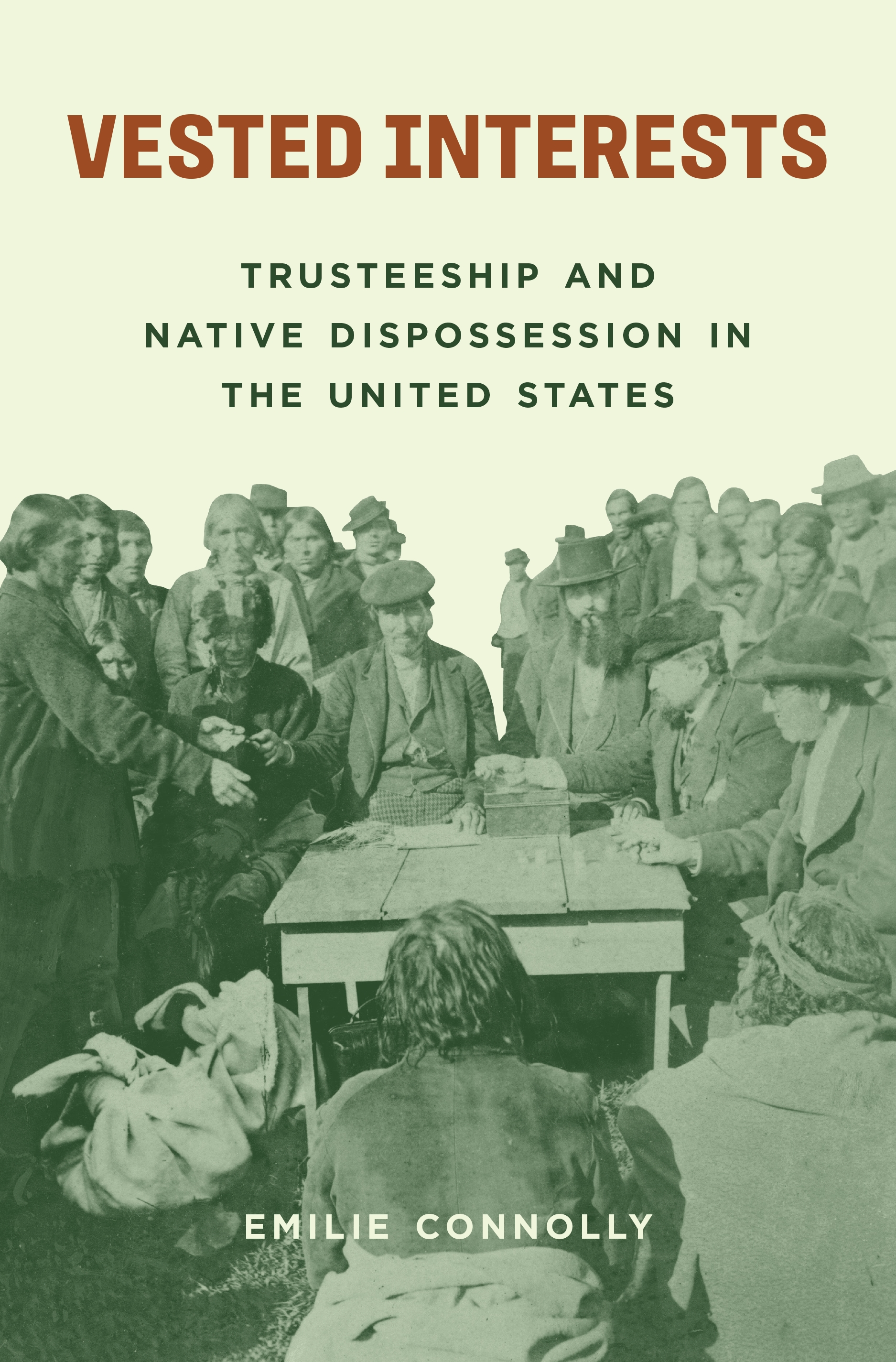
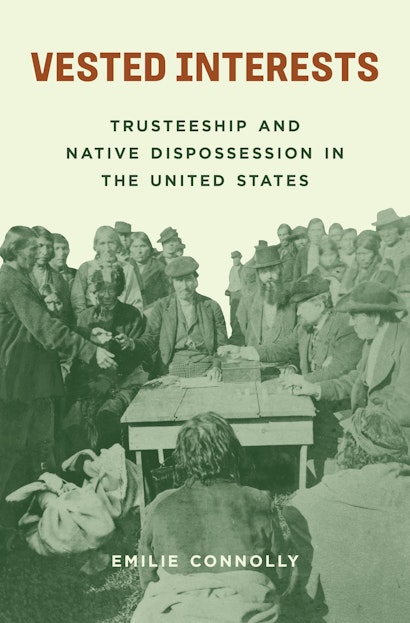
From the earliest days of its founding, the United States set its sights on Native territory. Amid better-known 鈥淚ndian wars,鈥� the federal government quietly built an empire by treaty, offering payments to Native peoples for their land. Routinely inadequate, these payments were nonetheless pivotal because federal officials chose not to deliver them as a lump sum. Instead, the government kept the bulk of payments owed to Native nations under its own control as a trustee, and made access to future installments contingent on Native compliance. In Vested Interests, Emilie Connolly describes how a system of 鈥渇iduciary colonialism鈥� seized a continent from its original inhabitants鈥攁nd, ironically, furnished Native peoples with financial resources that sustained their nations.
Connolly documents two centuries of dispossession in the guise of fiduciary benevolence. Acting as both dispossessor and trustee, the federal government invested Native wealth in state bonds that financed banks, canals, and other infrastructural projects that enabled the country to expand further westward. Meanwhile, Native peoples protected the money they did receive for future generations, investing it in their own institutions and mounting legal challenges to hold their trustees accountable. Still, federal trusteeship placed tight constraints on Native economies with the aim of containing Native power, forcing nations to endure through sheer resilience and ingenuity. By chronicling the long history of Native land dispossession through financial paternalism, Vested Interests reveals the unequal dividends of colonialism in the United States.
Awards and Recognition
- Winner of the Bancroft Prize in American History
- Winner of the James A. Rawley Award, Organization of American Historians
- Finalist for the Hagley Prize, Business History Conference
- Winner of the Stuart L. Bernath Book Prize, Society for Historians of American Foreign Relations
Emilie Connolly is assistant professor of history at Brandeis University.
"A landmark study that historians of Native American and U.S. history should read, discuss, and appreciate widely."鈥擱yan Hall, Journal of Imperial and Commonwealth History
“The United States built its wealth from Native American land—and, as Emilie Connolly brilliantly demonstrates—through stacks of Indian capital, monies held in trust by the federal government and mobilized to support American expansion. Rigorously researched and eloquently argued, Vested Interests is a once-in-a-generation book. Through a stunning forensic accounting, it shifts the paradigms of both Indigenous and American history, laying bare a new fiduciary mode of domination as well as Native economic visions that will continue to shape our future.”—Philip J. Deloria, author of Indians in Unexpected Places
“A revelatory history of the entanglement of Native dispossession with the rise of American finance, which will recast how historians understand a range of vital subjects, from the character of the early US fiscal state to the workings of US empire, the making of Native nationhood, and more. With this wholly original contribution, Connolly has written nothing short of a new history of wealth in the nineteenth-century United States.”—Jonathan Levy, author of Ages of American Capitalism: A History of the United States
“Vested Interests is one of the most important works of American history published over the past decade. In this highly original and deeply researched study, Emilie Connolly examines how and why the United States developed trusteeship and other financial tools to force Indigenous dispossession. Federal and state governments, Connolly demonstrates, used Native wealth to build infrastructure, finance capitalist development, and propel colonialism. Powerful and harrowing, Vested Interests chronicles the deep and ongoing history of fiscal entanglement between the United States and Native nations.”—Christina Snyder, author of Great Crossings: Indians, Settlers, and Slaves in the Age of Jackson
“A powerful indictment of how the United States wielded economic violence—in conjunction with military violence—to achieve its ultimate continental goals. The scholarly contribution of this book is enormous. Connolly is bringing together two fields (history of capitalism and Indigenous studies) that have—for the most part—remained completely distinct, and she expertly engages with a wide range of scholarship related to the relevant fields. This is absolutely a pathbreaking book.”—Sharon Ann Murphy, author of Banking on Slavery: Financing Southern Expansion in the Antebellum United States
“A rich and detailed history of Native American politics in the face of colonialism, this book makes an important contribution to the study of US colonialism, Indigenous history, the US composite state, and the role of the ‘developmental state’ in economic development. Connolly demonstrates an extraordinary grasp of both the historiography and the archival sources throughout. A deeply impressive achievement.”—Max Edling, author of A Revolution in Favor of Government: Origins of the U.S. Constitution and the Making of the American State