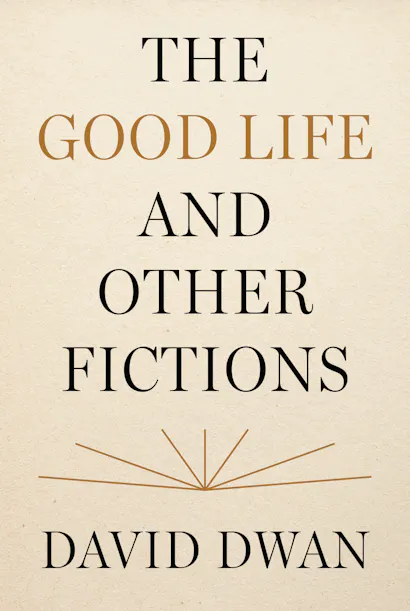
Why do we weep at fictitious things? How do we act on the basis of them? How much of moral life revolves around make-believe? In The Good Life and Other Fictions, David Dwan shows how literary fictions confront us with the wider role of fictiveness in our lives鈥攖he storied character we give to experience, our reliance on ideation, idealization and metaphor, the ways we depend on ideas that we know to be untrue or are only true because we choose to believe in them. In an age of fake news and fake antifakery, Dwan argues that we need a more differentiated sense of the fictive. Fiction is not necessarily fraud, nor is it simply error and unreality. Indeed, it is often the source of what鈥檚 best about us鈥攖he space in which the good life is imagined and talked into being.
Drawing on over a century of literary fiction鈥攁nd offering detailed studies of Charles Dickens, George Eliot, Henry James, Joseph Conrad, Virginia Woolf, Wyndham Lewis and Iris Murdoch鈥擠wan investigates different facets of fictional experience, from imaginative projection to wishful thinking to self-deception to lies. Novels, he contends, both express and expose the ways we see through illusion, spending much of our time in a twilight state between reality and unreality, credulity and doubt, assent and dissent. Interrogating the benefits and limits of a fictive attitude鈥攐ur deep yet dangerous need to operate 鈥渁s if鈥濃�擠wan makes a highly original contribution to the field of ethical criticism, and to our general understanding of how life is made livable through fiction.
David Dwan is professor of English literature and intellectual history at the University of Oxford and a tutorial fellow at Hertford College. He is the author of Liberty, Equality and Humbug: Orwell’s Political Ideals.
“At a time when the relationship of fiction to reality has become so fraught in both our politics and our ways of seeing ourselves, David Dwan provides a lively, subtle and penetrating exploration of the novel as a testing ground for values, emotions and ideas—including our ideas of reality itself. He shows how fictions are essential to our individual and collective lives and examines the different ways in which writers as diverse as George Eliot and Wyndham Lewis, Joseph Conrad and Virginia Woolf, Henry James and Iris Murdoch, weigh illusion and imagination against fact and necessity. This is a bracing reminder that, since we can never be free of fictions, we need novels to help us tell the good ones from the bad.”—Fintan O’Toole, author of We Don't Know Ourselves
“In the era of fake news, how we think about fiction becomes an urgent question. Dwan's astonishingly lucid and incisive book clarifies what has seemed unclarifiable—the ways in which our moral lives depend on the quality of our attention to each other as real and fictional characters. Dwan shows us, in a way that no longer seemed possible, how the close reading of literature can keep us arguing in the best possible way about what might matter most to us.”—Adam Phillips, author of The Life You Want
“The Good Life and Other Fictions is a timely, beautifully written and wise book. An unfailingly judicious and thoughtful reader, David Dwan makes an important contribution to the study of literature’s relation to moral philosophy.”—Jennifer Fleissner, author of Maladies of the Will: The American Novel and the Modernity Problem
“David Dwan’s The Good Life and Other Fictions defies easy categorization in all the best ways. Exploring the moral dimensions of fictiveness, Dwan draws the reader’s attention to the novel’s persistent engagement with a specific set of epistemological and aesthetic stances—irony, doubleness, doubt, unknowingness—ultimately challenging the centrality of common notions of the moral to the larger question of the good. A book that is sure to promote wide conversations across the fields of literature and philosophy.”—Amanda Anderson, Brown University
“David Dwan writes with such keen sensitivity about the moral complications novels produce that you soon come to feel—and feel before you see—why a life without fiction is a deficient life. Every page is alive to the hazards that reading fiction holds for us, which is, as we learn, just the reason we read. If you have ever wondered whether you should be doing something more useful with your time than read a novel, this book is for you.”—Michel Chaouli, author of Thinking with Kant's Critique of Judgment
“David Dwan’s The Good Life and Other Fictions is a witty, patient and persuasive exploration of some of the ways readers and writers of fiction have worried about it—and failed to worry enough. What are we to make of the appearing and disappearing ironies of the form, how did we get so interested in disinterest, why do we linger among the bewilderments of the phrase ‘as if’? Dwan addresses a cluster of questions that have been endlessly discussed, hardly ever answered, and his book is a marvelous gift to inquisitive readers old and new.”—Michael G. Wood, 快色直播 University
“The Good Life and Other Fictions successfully makes the case for the essential role of literary thought in moral philosophical thinking. It is lucid, intelligent and extraordinarily wide-ranging. Dwan has managed to produce that rare thing: an inspiring but still strenuous work of critical scholarship in the humanities.”—David Russell, author of Tact: Aesthetic Liberalism and the Essay Form in Nineteenth-Century Britain