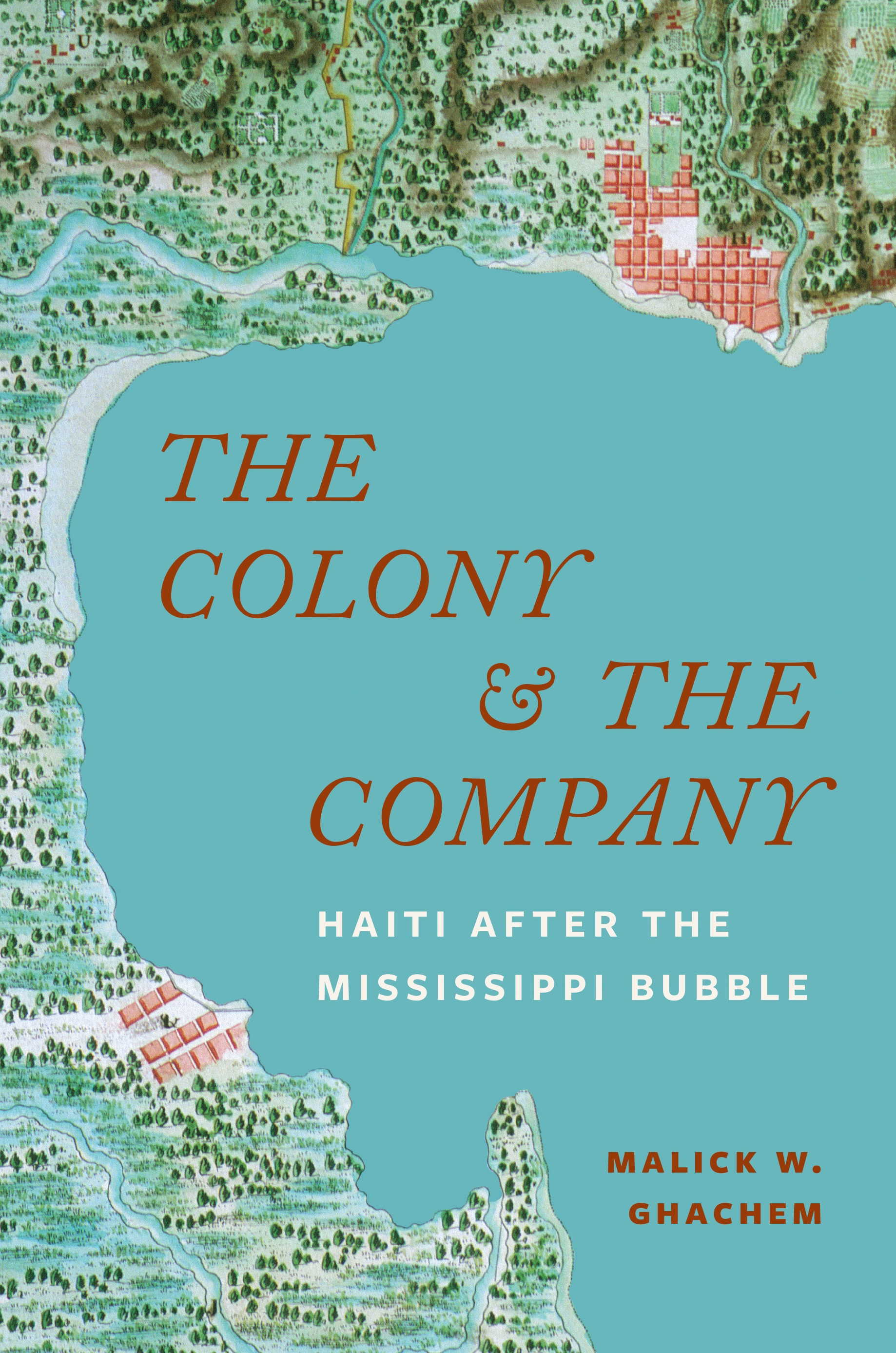
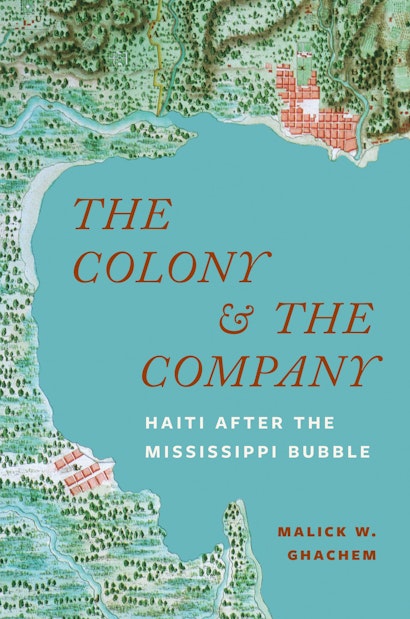
In the early eighteenth century, France turned to its New World colonies to help rescue the monarchy from the wartime debts of Louis XIV. This short-lived scheme ended in the first global stock market crash, known as the Mississippi Bubble. Saint-Domingue (now Haiti) was indelibly marked by the crisis, given its centrality in the slave-trading monopoly controlled by the French East Indies Company. Rising prices for enslaved people and devaluation of the Spanish silver supply triggered a diffuse rebellion that broke the company鈥檚 monopoly and paved the way for what planters conceived as 鈥渇ree trade.鈥� In The Colony and the Company, Malick Ghachem describes how the crisis that began in financial centers abroad reverberated throughout Haiti. Beginning on the margins of white society before spreading to wealthy planters, the revolt also created political openings for Jesuit missionaries and people of color. The resulting sugar revolution, Ghachem argues, gave rise to an increasingly violent, militarized planter state from which the colony, and later Haiti, would never recover.
Ghachem shows that the wealthy planters who co-opted the rebellion were simultaneously locked in a showdown with maroon resistance. The conflict between the planters鈥� militant defense of their prerogatives and maroon rebellion laid the foundations for a brutal history of marginalization and immiseration. Haiti became a full-fledged plantation colony held together by a ruthless form of white supremacy and enslavement, triggering a cycle of escalating violence that led to the Haitian Revolution. Tragically, Haiti鈥檚 postrevolutionary future remained captive to the imperial sway of money and debt.
Awards and Recognition
- Winner of the Joseph L. Peyser Prize for New France History, Organization of American Historians
Malick W. Ghachem is a professor of history and head of the history faculty at the Massachusetts Institute of Technology. He is the author of The Old Regime and the Haitian Revolution.
"Ghachem draws largely on imperial sources but in such a way as to never lose sight of the enslaved people whose voices or experiences barely appear in them, or who appear only as objects to be controlled. He also skillfully reads memoirs and early histories of the colony against the grain to shed light both on what we know and what we may never be sure of regarding this period. . . . [H]e ties the threads together seamlessly and offers a speculative but convincing connection to Haiti’s enduring troubles."鈥擬ary Dewhurst Lewis, H-Net Reviews
"Making excellent use of primary and secondary sources, [The Colony and the Company] is carefully reasoned, broad in scope, and a model of historical research. . . . Highly recommended."鈥�Choice
“In a most welcome addition to the classical historiography focused on the Haitian Revolution, Malick Ghachem surveys the eighteenth century, showing how France stifled local interests by organizing a singularly violent military state. He reviews the Indies Company’s demise, the initial revolt of Cap-Fran莽ais subordinate urbanites and its cooptation by the large planters, the Jesuits’ setbacks, and the early resistance of the maroons.”—Jean Casimir, author of The Haitians: A Decolonial History
“The Company and the Colony is as deeply thought-provoking and original as anything that Malick Ghachem writes. Technical matters of high finance are brought into the same analytical lens as colonial resistance from below, and nothing looks quite the same thereafter—neither Saint-Domingue’s sugar revolution, nor the so-called Mississippi Bubble, which was so much more than a French metropolitan, or purely economic, story.”—Catherine Desbarats, McGill University
“The book makes a significant scholarly contribution. The uprisings in Saint-Domingue during the 1720s have attracted relatively little attention over the years, especially compared to the world-shattering events that swept the colony during the 1790s. Ghachem makes use of a vast archive of primary documents as well as sharp-eyed reconsiderations of secondary sources to construct both his narrative and his argument. The book serves as a fine reminder to consider the many colonial antecedents of revolutionary experience.”—Christopher Hodson, Brigham Young University
“The Colony and the Company is a multilayered and deeply compelling history rooted in a careful analysis of both familiar and unfamiliar primary sources. Elegantly written and insightful.”—Pernille R酶ge, University of Pittsburgh
“A stunning reappraisal of prerevolutionary Saint-Domingue that compels us to reconsider the role of high finance and stock market speculation in helping to produce the Haitian revolution, with lingering effects on that nation's economic trajectory and political woes. In the hands of a scholar of Malick Ghachem’s caliber, this story constantly ebbs and flows as he flips the script to bring to light the agency of a fresh cast of characters: free and enslaved, of African and European descent, women alongside men—people long dismissed as irrelevant to studies of corporations and finance yet shown here to be vital players in their own right. A revelatory tour de force of Atlantic history.”—Sophie White, author of Voices of the Enslaved: Love, Labor, and Longing in French Louisiana