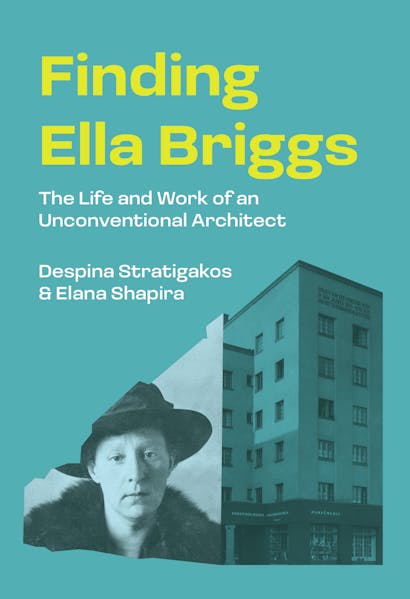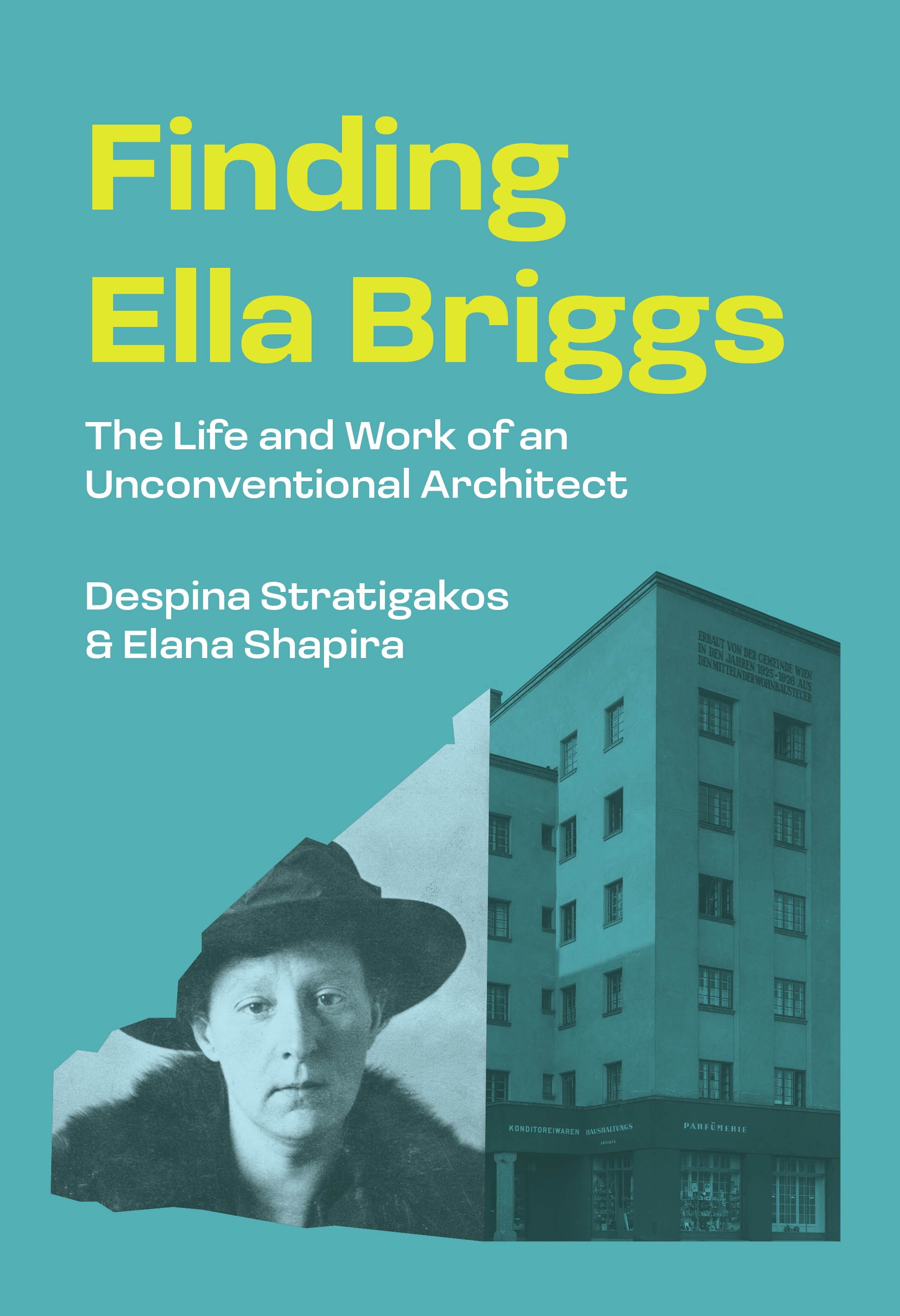
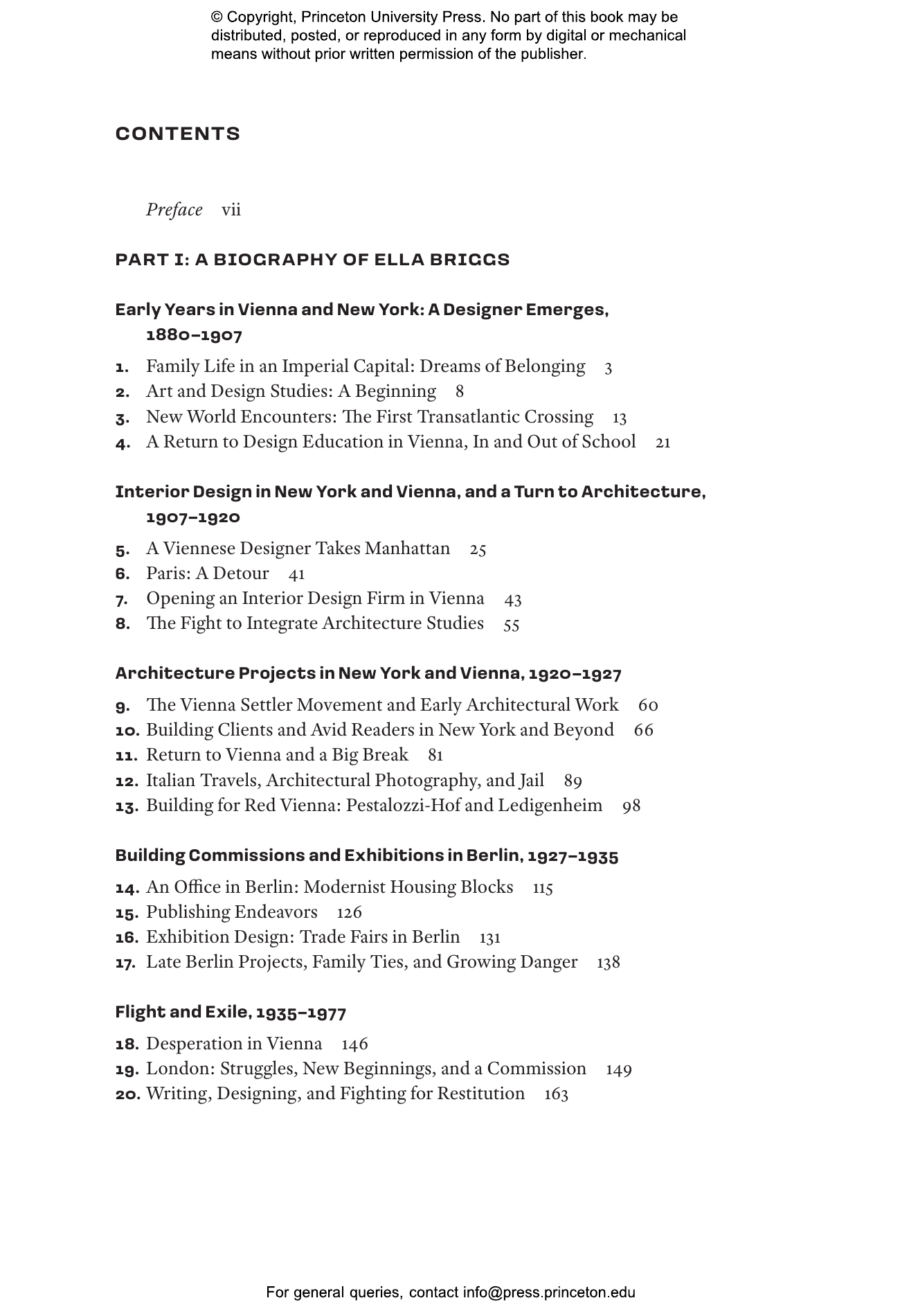
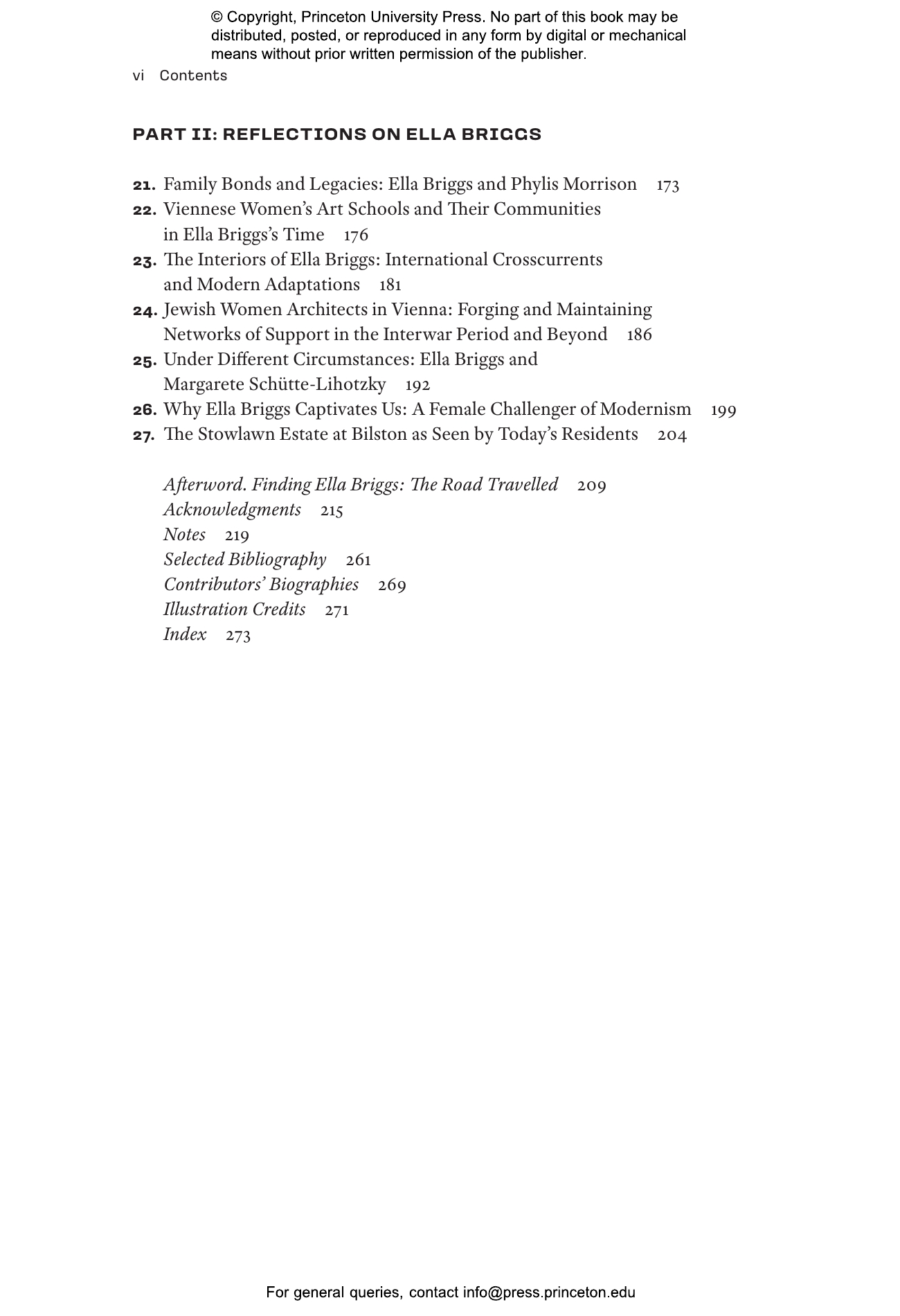
Ella Briggs (1880–1977) was a talented architect, designer, and writer whose influence was felt on both sides of the Atlantic. She trained with the Viennese Secessionists and brought their radical ideas to Gilded Age New York. She designed modernist housing for the masses in Austria, was jailed as a suspected spy in Mussolini’s Italy, and thrived in Weimar Germany before suffering persecution under the Nazis. Fleeing to London, she contributed to England’s postwar reconstruction. Yet despite a long and prolific career, her name is largely forgotten today. Finding Ella Briggs restores Briggs to her rightful place in the history of modernist design.
Despina Stratigakos and Elana Shapira bring together an international team of historians to provide the defining biography of this boldly unconventional designer. Whether she was fighting for integration at Europe’s architecture schools or writing about innovative houses for American women’s magazines like Good Housekeeping, Briggs embodied the transatlantic flow of modernism. This panoramic book uncovers new findings about Briggs, her networks, and projects, recovering the many facets of a life that spanned global borders and cultures.
Beautifully illustrated and drawing on a wealth of previously unpublished research from archives around the world, Finding Ella Briggs is the inspiring story of a woman who defied all obstacles to pursue her dream of designing for the modern client.
With contributions by Megan Brandow-Faller, Celina Kress, Dörte Kuhlmann, Ulrike Matzer, Christine Oertel, Eva B. Ottillinger, Barbara Penner, Sabine Plakolm-Forsthuber, Monika Platzer, Ursula Prokop, Sabrina Rahman, Katrin Stingl, Carmen Trifina, and Christine Zwingl.
Awards and Recognition
- A Financial Times Best Book of the Year
- Winner of the Architectural Book Award in Practice, Booklaunch

Despina Stratigakos is SUNY Distinguished Professor in the Department of Architecture at the University at Buffalo, State University of New York. Her books include Where Are the Women Architects? (¿ìɫֱ²¥) and A Women’s Berlin. Elana Shapira is lecturer in the Cultural Studies Department at the University of Applied Arts Vienna. She is the author of Style and Seduction and the editor of Design Dialogue and Designing Transformation and (with Anne-Katrin Rossberg) Gestalterinnen, among other books.
"One of the most remarkable stories in architecture."—Edwin Heathcote, Financial Times
"More than being an essential and overdue work on Ella Briggs, the book presents a model for research into other overlooked voices in the field. . . . This book places Ella Briggs firmly in focus and leaves a rich legacy in the newly created archive of gathered materials."—Michael Dring, Women’s History Today
"A noteworthy book, both as a biography of a woman architect and as a collaborative effort to accomplish a challenging research project."—³¢¾±²ú°ù²¹°ù²âÌý´³´Ç³Ü°ù²Ô²¹±ô
"Finding Ella Briggs is an ambitious and important attempt to restore a remarkable woman to the history of modern architecture. . . . What makes the book especially compelling is not simply Briggs’s unusual life, but the fact that her disappearance from architectural history is itself part of the story. Through extensive archival research and contributions from an international team of scholars, Finding Ella Briggs demonstrates how easily women’s achievements can be obscured—and how much can be recovered when historians are willing to look again."—Sean Ruthen, Spacing
“An enthralling book that brings long-overdue recognition to an architect whose transatlantic career profoundly intersected with key artistic and political developments of the twentieth century. This compelling rediscovery enriches our understanding of modern architecture and design.”—Stephanie Buhmann, author of Frederick Kiesler: Galaxies
“A fascinating and original examination of the life and work of Ella Briggs, a talented, deeply intelligent, and exceptionally enterprising woman architect and designer. Based on sustained archival research, Finding Ella Briggs is a monumental project of recovery and reevaluation that excavates the career and practice of Briggs, placing her at the center of major currents of modern architecture from Secessionist Vienna and Gilded Age New York to Red Vienna, Weimar Berlin, and postwar London.”—Eve Blau, author of The Architecture of Red Vienna, 1919–1934
“Ella Briggs was among the first women in Europe to study architecture and work professionally as an architect. Impeccably researched, this book offers a rich narrative of an important early modernist designer and architect who was well known in her time and then forgotten. In recounting her story, this team of authors laudably contextualize Briggs’s experience within the broader story of early modernism.”—Christopher Long, author of The New Space: Movement and Experience in Viennese Modern Architecture