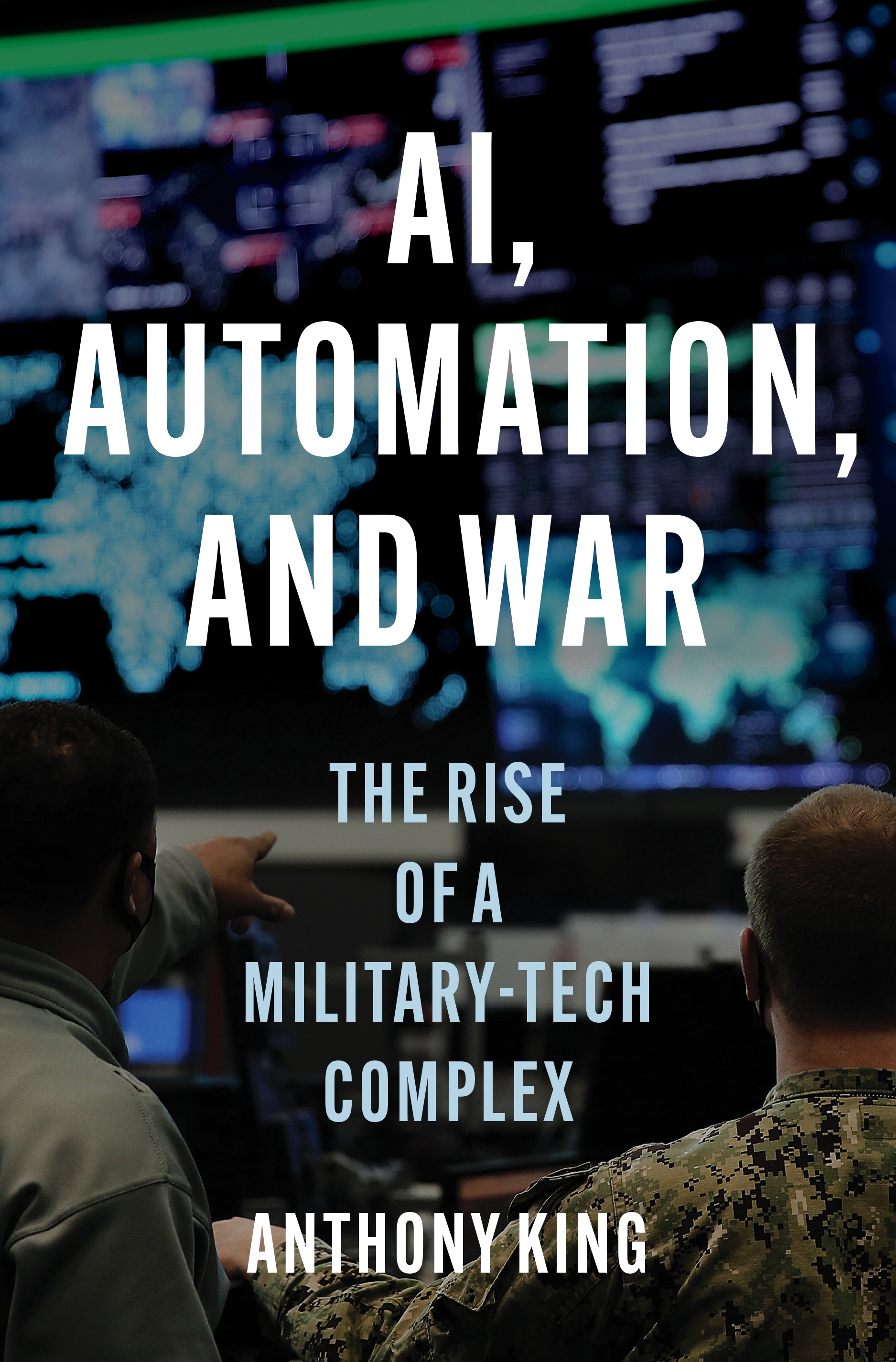
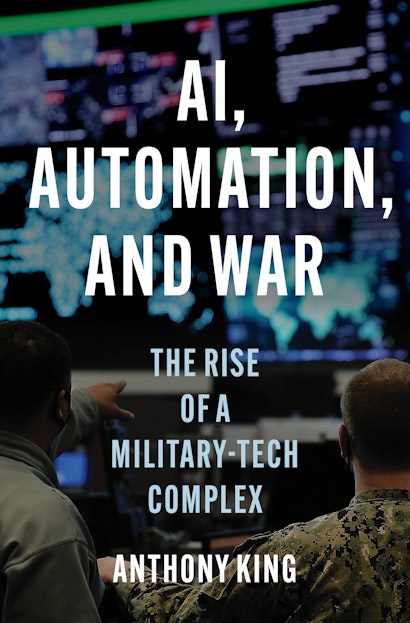
Is AI about to automate war? Will autonomous drone swarms and killer robots controlled by AI dominate the battlespace and determine the winner? In AI, Automation, and War, Anthony King debunks this science fiction鈥搕inged narrative of AI鈥檚 military potential, exploring instead the actual applications of AI by the armed forces over the last decade. He finds that AI is not going to replace human commanders and combatants; the machines are not about to take over. Rather, the military has used, and will continue to use, AI to process data at a scale and speed that exceeds the capacity of humans. AI will be used primarily to improve military understanding and intelligence.
King explains that military commanders, enabled by the data processing power of AI, will be able to see the battlespace at a previously unattainable depth, fidelity, and speed. AI will help the armed forces plan, target, and conduct cyber operations faster and more effectively. In order to harness AI in this way, however, a radical organisational transformation is taking place. The armed forces are integrating civilian technologists into operational headquarters to work alongside military staff. This partnership between the armed forces and the technology sector signals the emergence of a military-tech complex that promises to be as powerful in this century as the military-industrial complex was in the last.
"These days, much of what is written about the effect of artificial intelligence on war is hyperbolic and speculative. It is thus refreshing to come across a book that is grounded in current military practices. . . . [I]nformative and thoughtful."鈥擫awrence D. Freedman, Foreign Affairs
"A truly thought-provoking tour de force."鈥�War on the Rocks
"[AI, Automation, and War] reads like an illuminating intelligence briefing, rich in description and light on both jargon and normative positions. . . . His argument is clear: The fears (and hopes) of full autonomy are misplaced. AI is not 'replacing humans.' Nor is the idea of human-machine teaming — which places weapons or systems on an equal footing with human agents — accurate. What we are seeing instead are decision-support systems: tools, if transformational ones, that enable planning, targeting, and cyber operations."鈥擨oannis Kalpouzos, Jacobin
"King’s book succeeds in puncturing the techno-optimistic bubble that surrounds contemporary discussions of military AI, offering instead a framework grounded in organisational and sociological theory, as well as empirical case studies. For defence professionals navigating the hype cycle surrounding AI, this book represents essential reading – a rare work that insists that AI’s military utility be measured not by algorithmic sophistication, but by institutional capacity to harness it effectively."鈥擣ranz-Stefan Gady, Survival: Global Politics and Strategy
"By starting off with such an important counterargument about AI’s place in the human world, still allowing humans significance no matter how the technology evolves, this is a welcome addition to the body of knowledge. Accessible and well written. . . . Highly recommended."鈥�Choice
"King has assembled a case that is empirically grounded, theoretically sophisticated, and politically urgent in equal measure."鈥擧ammad Waleed, Stratheia
"King’s focus on the complex integration of commercial actors, military personnel and AI technologies within defence institutions is compelling."鈥擠r. Alexander Blanchard, LSE Review of 快色直播
“At last, a book about AI and war that is based on realities and not science fiction. Anthony King does not dispute that AI is affecting the conduct of war in significant ways, but it does so as an enabler—as a servant of those who fight, not as their putative master. AI analyses masses of data at speed, and the algorithms it generates inform commanders and can shape their decisions, but it is not taking those decisions, let alone automating warfare.”—Sir Hew Strachan, University of St Andrews
“This is an excellent book: sensible, well-researched and ultimately persuasive. King offers a convincing sociological caution about some of the unwarranted hype currently surrounding military AI. I think it will also generate spin-off research on the ‘military-tech complex’—it has certainly piqued my interest.”—Paul D. Williams, George Washington University
“The author writes well, in an engaging style yet with a rich theoretical grounding. It’s refreshing to see a theoretical take on technology, and the 126 interviews are impressive as a form of evidence. Readers will learn quite a bit.”—Sarah Kreps, Cornell University
“The use of artificial intelligence for military purposes has been a topic of fascinated speculation and debate among academics and practitioners for more than a decade. Most of these discussions have focused on the application of AI through specific platforms or against particular military problems. Anthony King falls on the conservative end regarding the extent to which he thinks AI will transform war. Many of his arguments about the limitations of AI are important caveats to its use by the military. But the true value of this book is in its wider perspective, examining how the industry that builds and enables AI intersects with the military to produce a new military industrial complex and alters civil-military relations. These are questions that have been understudied, and to that end Anthony King’s contribution to the debates surrounding artificial intelligence and its role in war advances the discussion in a timely and insightful manner.”—Jack Watling, the Royal United Services Institute for Defence and Security Studies