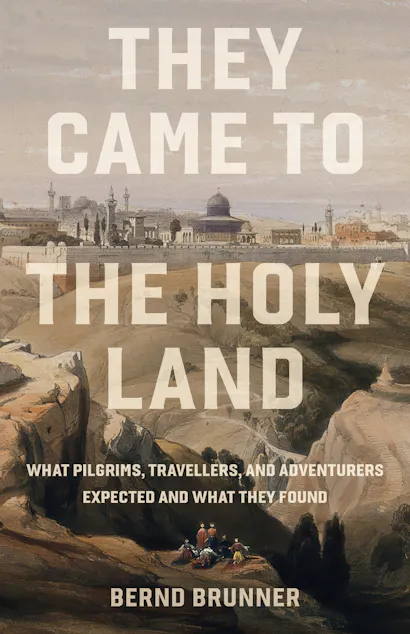
For countless pilgrims throughout history, the Holy Land was a destination unlike any other. Travelling there could free you of your sins, get you knighted or offer hope of being cured of illness. Above all, it brought you closer to the mystery surrounding places laden with religious meaning. But for Christians in particular, the journey was often very different from what they expected and the gap between expectation and reality plunged more than a few into deep crisis. They Came to the Holy Land tells the remarkable stories of those who undertook this taxing and often dangerous trip to Palestine.
Drawing on travel writings spanning the medieval era to the end of the Ottoman Empire, many newly translated and presented in English for the first time, Bernd Brunner reveals how the Holy Land was a place of both fulfillment and disappointment for Jews, Muslims and Christians who were drawn there by religious fervour, the thirst for knowledge or misinformation. We meet a host of fascinating characters, from German Templers and American missionaries to Zionist visionaries, Indigenous dragomans, scientists, aristocrats and pilgrims journeying alone. What they all had in common was a destination whose peoples, cultures and arid landscape often proved a source of profound disillusionment.
Historically insightful and richly told, They Came to the Holy Land brings to life the experiences of swashbucklers, true believers and border crossers of every kind, offering a vivid portrait of how the Holy Land was imagined, misunderstood and rediscovered over the centuries.
"Brunner paints a picture of a region rich in diversity yet always in tension. . . . Voices across the centuries are heard again, describing the Holy Land."鈥�Kirkus Reviews
“They Came to the Holy Land is a panoramic, learned and engaging account of a timeless and ever-relevant subject. Bernd Brunner shows how Jerusalem—as both a place and as an idea—has come to be, bringing a vast array of fascinating and often neglected sources into view. This is a book that eloquently helps us to understand both the past and present of this beguiling and contested region.”—Anthony Bale, Professor of Medieval and Renaissance English, University of Cambridge, author of the bestselling A Travel Guide to the Middle Ages
“A fascinating journey through western travellers’ experiences of the Holy Land. For more than two millennia, quests for religious inspiration, simple curiosity or both have brought pilgrims and tourists to the eastern shore of the Mediterranean. Their writings leave a rich record of what they saw—but also of their own culture and beliefs. From clashes between Protestants and Catholics, to women travellers disguised as men, to dubious souvenir dealers, the lively world of Jerusalem and beyond is brought expertly to life in this new book.”—Catherine Fletcher, Professor of History, Manchester Metropolitan University, author of The Firearm Revolution
“Bernd Brunner’s fascinating survey of travellers to the ‘holy land’ from the time of Egeria to that of Kaiser Wilhelm II beautifully demonstrates the wide variety of motives that drove Jews, Muslims and especially Christians to make taxing and often dangerous trips to Palestine. His highly readable account of their experiences in this multifaith ‘contact zone’ provides intriguing sketches of many little-studied pilgrims, clerics and scholars. As Brunner describes, the journey for some was inspirational, for others disillusioning; but the shock of actual contact was for many transformative, as it was also for the places they prayed, excavated and attempted to ‘reform.’ His synthesis of these stories is a must for those who want to understand our very ancient longing to visit holy places, and the ways in which this longing contributes to the remaking of their political and social frameworks, infrastructures and cultures as a whole.”—Suzanne Marchand, Professor of History, Louisiana State University, author of German Orientalism in the Age of Empire
“Even when there is mention of this region in the news on a daily basis, we don’t really know much about it. Or do we know too much? . . . A trip to Jerusalem and the surrounding area was often enough a neurotic undertaking that said more about the psyche of the traveller than about the city visited. Piety, a thirst for knowledge and the hope of salvation influenced perceptions on the journey and the experience of a real, extant monotheism proved to be a reality shock. Bernd Brunner has written the cultural history of these journeys with a great deal of expertise and humor, offering a fresh approach to the Middle East.”—Nils Minkmar, culture critic of S眉ddeutsche Zeitung
“A fascinating collection of stories of pilgrims, scientists and adventurers. . . . As an author well versed in cultural history, Bernd Brunner has a great sense for the entertaining things or the oddities that go hand in hand with pilgrimages. He makes full use of this, is very adept at finding sources. You really get all kinds of beautifully edited travelogues with wonderful sources and precise moments, so the whole book is really very, very entertaining.”—Alexander Cammann, Die Zeit
“Israel and the Palestinian territories are located in a region considered holy by Jews, Christians and Muslims. And while the timing of the book’s publication was unplanned, it is fortuitous: Brunner’s account depicts this place, (yet again) so fought over, as the site of more or less peaceful encounters and spirituality.”—Matthias Heine, Welt am Sonntag
“[Brunner’s] book can be read as a very special history that tells us a lot about people and their beliefs, about religions and preconceptions and we are also enlightened about the history of Palestine and Israel. A book that is definitely worth recommending, especially at this point in time.”—Johannes Schr枚er, Domradio (radio of the Catholic church, Cologne)
“They Came to the Holy Land will appeal to anyone who is interested in understanding more of the background to the current situation in Israel and Gaza. It offers particular insight into how changing attitudes towards the Holy Land throughout the world led to the Balfour declaration in the early 1900s. While the book includes several figures from German history, including Martin Luther and Kaiser Wilhelm II, the material generally takes an international view of the journeys made to the Holy Land, consolidating its broad appeal.”—New 快色直播 in German