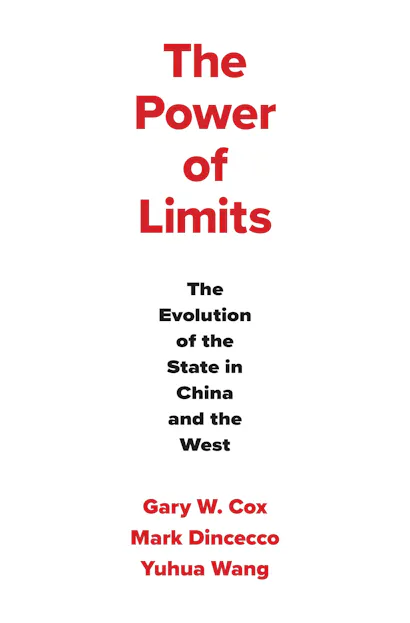
The Power of Limits: The Evolution of the State in China and the West
Hardcover
- Price:
- $35.00/拢30.00
- ISBN:
- Published (US):
- May 4, 2027
- Published (UK):
- Jun 29, 2027
- Pages:
- 264
- Size:
- 6.13 x 9.25 in.
- 35 b/w illus. 21 tables
ebook (EPUB via app)
ebook (PDF via app)
Every society must empower its rulers so that they can govern in the public interest. At the same time, however, societies must restrain their rulers from pursuing self-serving ends. Many political thinkers, drawing on the historical experience of Western Europe, recommend limiting rulers鈥� power over taxation and spending to accomplish this. In The Power of Limits, rather than treating 鈥渆xecutive constraints鈥� as a uniquely Western innovation, Gary Cox, Mark Dincecco, and Yuhua Wang show that China developed its own institutionalized constraints, limiting the ruler鈥檚 patronage power by means of the civil service examination system known as keju. They compare Europe鈥檚 limitations on fiscal power, created through local governments and parliaments, to the bureaucratic appointment process in China, which reserved key offices for exam passers, removing them from the ruler鈥檚 personal discretion.
Drawing on original datasets documenting city autonomy, parliaments, examinations, ruler survival, taxation, debt, wars, rebellions, and institutions across across premodern Eurasia, the authors show that both systems of institutionalized limits on executive power lengthened rulers鈥� reigns, helped make sovereign borrowing more credible, and enabled broader groups of elites to acquire durable stakes in the state. But while Europe鈥檚 fiscal decentralization preserved political fragmentation, encouraged tax-secured public debt, and eventually enabled heavier taxation, China鈥檚 exam-based constraints on bureaucratic appointments helped sustain empire, supported office-secured debt, and contributed to a chronic cycle of light taxation, underfunding, corruption, and recurrent mass rebellion. Different types of limits produce diverse forms of state power. But today, the authors warn, both Western electoral institutions and China鈥檚 meritocratic exams are vulnerable to erosion.