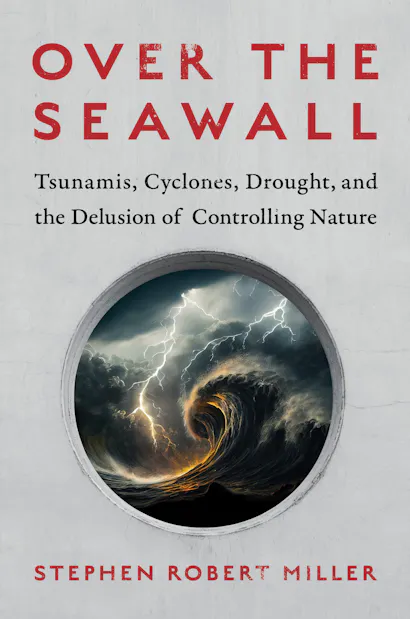
In March 2011, people in a coastal Japanese city stood atop a seawall watching the approach of the tsunami that would kill them. They believed鈥攏aively鈥攖hat the huge concrete barrier would save them. Instead they perished, betrayed by the very thing built to protect them. Erratic weather, blistering drought, rising seas, and ecosystem collapse now affect every inch of the globe. Increasingly, we no longer look to stop climate change, choosing instead to adapt to it.
Never have so many undertaken such a widespread, hurried attempt to remake the world. Predictably, our hubris has led to unintended鈥攁nd sometimes disastrous鈥攃onsequences. Academics call it maladaptation; in simple terms, it鈥檚 about solutions that backfire. Over the Seawall tells us the stories behind these unintended consequences and about the fixes that can do more harm than good. From seawalls in coastal Japan, to the reengineered waters in the Ganges River Delta, to the artificial ribbon of water supporting both farms and urban centers in parched Arizona, Stephen Robert Miller traces the histories of engineering marvels that were once deemed too smart and too big to fail. In each he takes us into the land and culture, seeking out locals and experts to better understand how complicated, grandiose schemes led instead to failure, and to find answers to the technologic holes we鈥檝e dug ourselves into.
Over the Seawall urges us to take a hard look at the fortifications we build and how they鈥檝e fared in the past. It embraces humanity鈥檚 penchant for problem-solving, but argues that if we are to adapt successfully to climate change, we must recognize that working with nature is not surrender but the only way to assure a secure future.
"Journalist Miller’s unsettling debut investigates three initiatives intended to protect humans from the ravages of nature that did 'more harm than good.'...The picture that emerges from his thorough reporting illuminates the hidden dangers in apparently easy solutions to climate problems. The result is a thought-provoking exploration of the 'unintended consequences' of climate policy."鈥�Publishers Weekly
"Speaking against short-term thinking, poor policy decisions, and the illusion of abundance, the book includes moving portraits of the local people who are most affected when fortifications fail…. Over the Seawall is a challenging, persuasive text that uses examples of infrastructure failures to urge people to adapt to a natural world that they cannot control."鈥�Foreword Reviews
"Over the Seawall is a book about highly technical events and projects, but I rarely found myself confused or bored. That’s part of Miller’s allure. He’s been covering climate change for about 15 years and teaches journalism at the University of Colorado, Boulder. He knows how to give the facts with ease, intention, and prose. If you haven’t read his work before, I urge you to take a look…Though the book touches on many topics—policy, activism, climate denial, and public health—it’s ultimately about human history. It paints a terrifying portrait of what we can expect for the future should we as a public allow our leaders to forget past mistakes."鈥�Atmos
"As the planet heats up, posing manifold risks to communities around the world, Over the Seawall is essential reading for anyone who wants to plan for a more resilient future by avoiding the mistakes of the past."鈥擩onathan Hahn, Sierra
"This is an honest book. It tells its tale with the tongues of the people who are living with the problems…. [Miller] does us all a service in pointing out the hubris of trying to control nature."鈥�International Journal of Environmental Studies
"Miller’s book can be important reading to those interested in learning more about how development decisions typically result in winners and losers, and how they often fully consider neither long-term consequences nor sporadically occurring or extreme events."鈥�Journal of Environmental Studies and Sciences
"The picture that emerges from [Miller’s] reporting illuminates the hidden dangers of engineering projects touted as adaptation solutions to the problems posed by extreme weather events and climate change. The result is a thought鈥恜rovoking warning about climate policy and its often severe and unintended consequences."鈥�Integrated Environmental Assessment and Management
"As the climate crisis escalates, so do the temptations of higher seawalls, longer pipelines, and other feats of engineering. But as Stephen Robert Miller documents in Over the Seawall, such schemes can create more problems than they solve. A powerful reminder that there is no substitute for living within our limits."鈥擬ichelle Nijhuis, author of "Beloved Beasts"
"A scathing tour of where human hubris has led us, from a clear-eyed chronicler."鈥擜lan Weisman, author of "The World Without Us" and "Countdown"
"Miller’s globe-spanning reporting provides a necessary note of caution in an age of unprecedented change. An authoritative and thoughtful meditation rendered in vital and vivid prose."鈥擯eter Brannen, author of "The Ends of the World"
"Stephen Robert Miller has written an essential guide to ‘maladaptation’—false climate solutions that repeat past mistakes. With deep investigative reporting and compassion, he reveals the toll of large-scale engineering follies in Japan, Bangladesh and Arizona—the kind we must resist to fix the climate crisis. Over the Seawall is the climate book we need now."鈥擟ynthia Barnett, author of "Rain: A Natural and Cultural History"
"This haunting, lyrical book on humanity's effort to adapt to the changing climate poses profound questions that keep many of us up at night. What happens when the folly of mankind's progress faces off against the unstoppable forces of the earth itself? Can we keep back the rising seas with increasingly colossal mega projects? Written with verve and exquisitely drawn characters, Over the Seawall shows us that the global struggle ultimately comes down to individual decisions."鈥擲cott Carney, New York Times bestselling author of "What Doesn鈥檛 Kill Us"
"Profound and clear-eyed, Over the Seawall, like John McPhee’s classic 'The Control of Nature,' shows that our culture’s fetish for technosolutions puts people at risk by steamrolling local knowledge and natural-carrying capacities, and pushing pseudo-security. Miller’s sensitive writing and striking metaphors lay bare the Western development machine’s arrogance, greed, and stubborn insistence on making the same mistakes again and again."鈥擡rica Gies, author of "Water Always Wins"