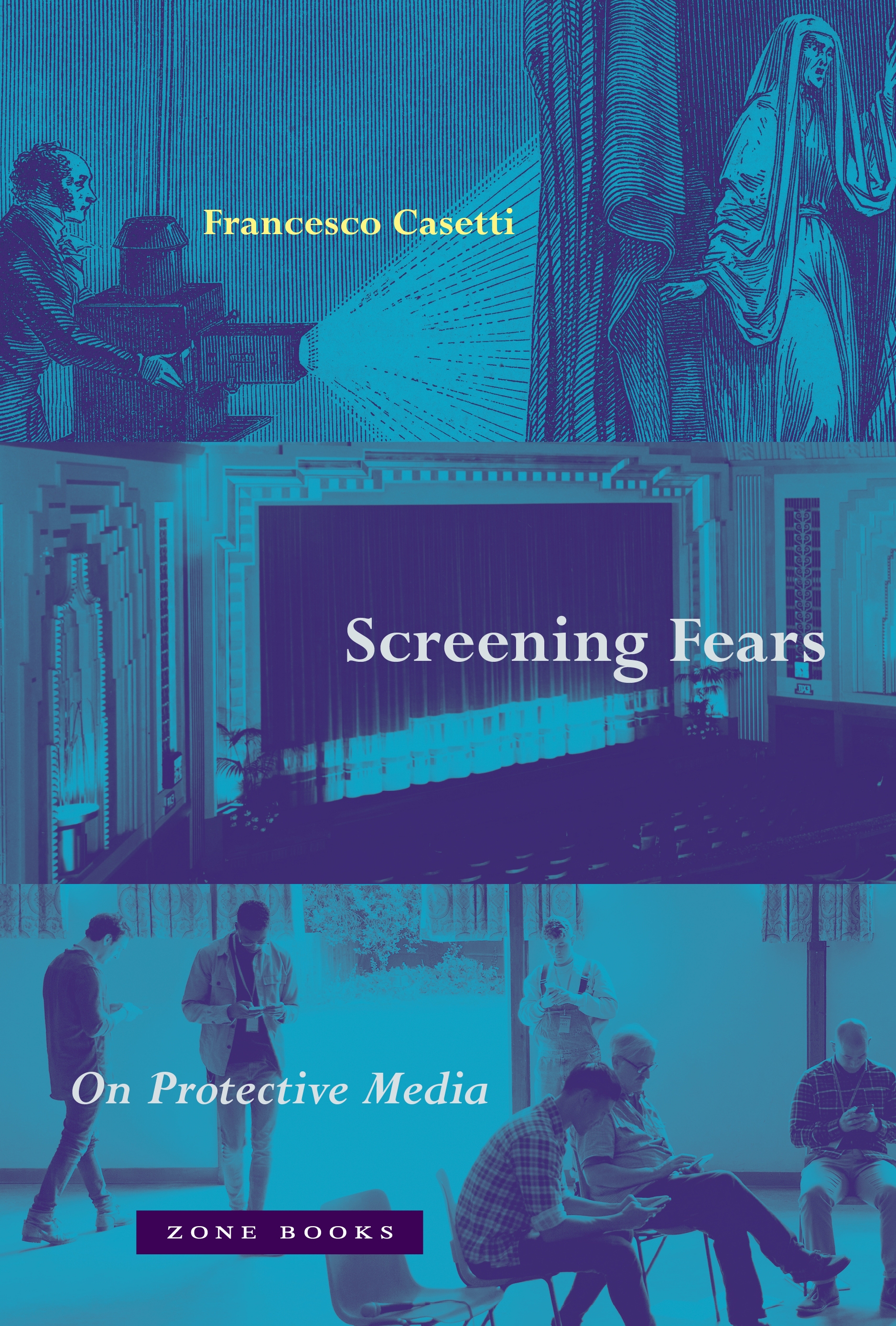
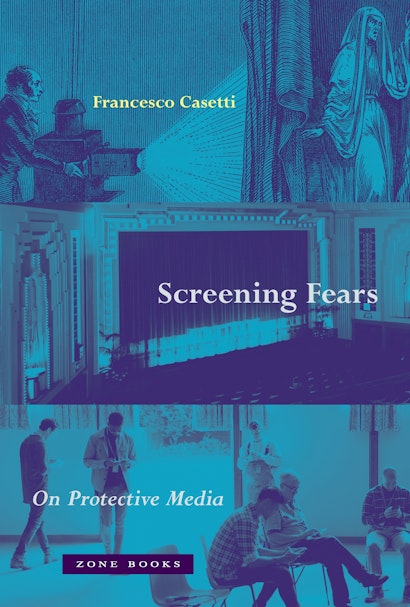
In this brilliant contribution to contemporary media studies, acclaimed theorist Francesco Casetti advances a provocative hypothesis: instead of being prostheses that expand or extend our perceptions, modern screen-based media are in fact apparatuses that shelter and protect us from exposure to the world. Rather than bringing us closer to external reality, dominant forms of visual media function as barriers or enclosures that defend against the apparent threats and dangers that seem increasingly to surround us. Working with an original historical overview that begins with the Phantasmagoria of the late eighteenth century, then the shared interior spaces of the movie theater in the early to mid-twentieth century, and finally the solitary digital milieus of the present, Casetti traces the outlines of the protective 鈥渂ubbles鈥� that disconnect us from our immediate surroundings. To be provided with a shield of immunity to the hazards and uncertainties of the world while experiencing them at a safe remove might seem a positive development. But, he asks, what if these media, instead of providing invulnerability, ensnare individuals in a suffocating enclosure? What if, in their effort to keep reality under control, they exercise a violence equal to that of the dangers they resist? In a dialectical exercise, and through a vivid range of cultural artifacts, Screening Fears traces the emergence of modern protective media and the way they changed our forms of mediation with the world in which we live.
Francesco Casetti is the Sterling Professor of Humanities and Film and Media Studies at Yale University. Among his books are Inside the Gaze; Theories of Cinema, 1945–1995; Eye of the Century: Film, Experience, Modernity; and The Lumi猫re Galaxy: Seven Key Words for the Cinema to Come.
"Powerful and provocative."鈥擱ichard Grusin, Critical Inquiry
"Screening Fears compellingly assesses the role of the screen in allowing people to retreat from reality and to negotiate absence through the presence of the medium. . . . It would be hard to find someone as lucid and well read as Francesco Casetti, who draws from diverse fields of study to analyze an often-overlooked element within film and media studies. Its import will not be lost on anyone who reads it, as the blend of historical analysis, philosophical inquiry and modern relevance bolsters the text as an engaging and thought-provoking investigation."鈥擳obijah Rogers, Film-Philosophy
"Sophisticated yet comprehensible . . . . [Screening Fears] offers a valuable and provocative contribution to media theory, inviting readers to reconsider not only how screens mediate reality but also why we increasingly turn to shield ourselves from it."鈥擲tephen Hickson, International Journal of Communication
“In this thoughtful and elegantly written work, Francesco Casetti discusses what he calls the 'projection/protection complex,' tracing its manifestations from Phantasmagoria to the cinema and on to the ‘imaginary electronic bubbles’ of smartphone use and the endless Zoom conversations of the COVID-19 era. By analyzing interconnections between screens and spaces, Casetti reveals how screen-based media induce fear and anxiety, but also provide protective cocoons.”—Erkki Huhtamo, author of Illusions in Motion: Media Archaeology of the Moving Panorama and Related Spectacles
“Screening Fears arrives at the end of the cinema century. But it is no eulogy for the big screen of the motion picture theater. Francesco Casetti rewards us with a genealogy—from the Phantasmagoria through cinema to the contemporary digital bubble—and, even more impressively, with a theory of what we need from moving images on screens, a theory so comprehensive that it helps us to imagine our place in the proposed multiverse of the future.”—Jane M. Gaines, author of Pink-Slipped: What Happened to Women in the Silent Film Industries?
“How does a simple question — to mask or not to mask — become an existential problem and theory of media? As the pandemic recedes from public consciousness, Screening Fears offers us timely reflections and a deeply engaging genealogy of screen-based media. Casetti reaches far back into media history, connecting the three dispositifs organizing our sense of threat and defense intrinsic to modern experience — the Phantasmagoria, cinema, and electronic bubbles — that manage our fear but indulge our brush with perils. A tour de force of media theory and history, this book reconnects cinema and media and mobilizes a fundamental rethinking of screen from a media object to a spatial-temporal assemblage. Bold and rigorous, exacting and poetic, Screening Fears is a joyful ride and a true adventure.”– Weihong Bao, author of Fiery Cinema: The Emergence of an Affective Medium