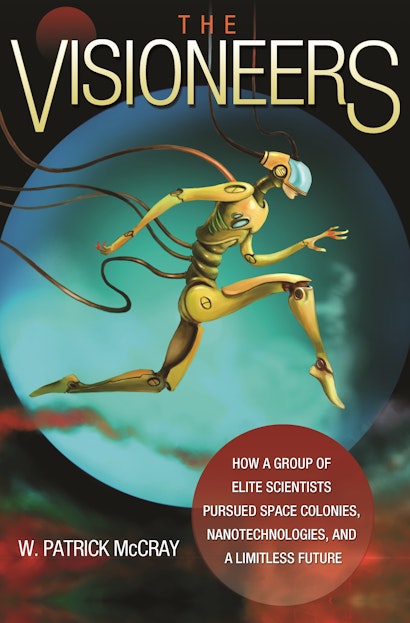
In 1969, 快色直播 physicist Gerard O’Neill began looking outward to space colonies as the new frontier for humanity’s expansion. A decade later, Eric Drexler, an MIT-trained engineer, turned his attention to the molecular world as the place where society’s future needs could be met using self-replicating nanoscale machines. These modern utopians predicted that their technologies could transform society as humans mastered the ability to create new worlds, undertook atomic-scale engineering, and, if truly successful, overcame their own biological limits. The Visioneers tells the story of how these scientists and the communities they fostered imagined, designed, and popularized speculative technologies such as space colonies and nanotechnologies.
Patrick McCray traces how these visioneers blended countercultural ideals with hard science, entrepreneurship, libertarianism, and unbridled optimism about the future. He shows how they built networks that communicated their ideas to writers, politicians, and corporate leaders. But the visioneers were not immune to failure鈥攐r to the lures of profit, celebrity, and hype. O’Neill and Drexler faced difficulty funding their work and overcoming colleagues鈥� skepticism, and saw their ideas co-opted and transformed by Timothy Leary, the scriptwriters of Star Trek, and many others. Ultimately, both men struggled to overcome stigma and ostracism as they tried to unshackle their visioneering from pejorative labels like 鈥渇ringe鈥� and 鈥減seudoscience.?
The Visioneers provides a balanced look at the successes and pitfalls they encountered. The book exposes the dangers of promotion鈥攐versimplification, misuse, and misunderstanding鈥攖hat can plague exploratory science. But above all, it highlights the importance of radical new ideas that inspire us to support cutting-edge research into tomorrow’s technologies.
Awards and Recognition
- Winner of the 2014 Watson Davis and Helen Miles Davis Prize, History of Science Society
- Winner of the 2012 Eugene E. Emme Award for Astronautical Literature, American Astronautical Society
"In his fascinating new book, McCray profiles the larger-than-life characters and ideas that changed science and technology in the second half of the 20th century and beyond. The author describes the titular visioneers as 'hybrids'鈥攃reative combinations of futurist, scientist, and charismatic promoter. At the center of this story are physicist Gerard O'Neill and biotech pioneer K. Eric Drexler. . . . McCray, a professor of history at UC Santa Barbara, discusses how O'Neill's vision of space as a tabula rasa for the human race spurred the formation of grassroots groups like the L5 Society and captured the imaginations of many young scientists and engineers like Drexler, as well as influential figures like Stewart Brand and Timothy Leary. Considered together, they 'took speculative ideas out of the hands of sci-fi writers' and had an enormous impact on generations of people, science, and political policy."鈥�Publishers Weekly
"McCray focuses on Gerard K. O'Neill, the 快色直播 physicist and designer of space colonies, and on his prot茅g茅, K. Eric Drexler, the 'speculative engineer' trained at the Massachusetts Institute of Technology in Cambridge who helped to put nanotechnology on political agendas in the early 1990s. Along the way, McCray introduces a large and colourful cast of others who, over four decades, promoted technological progress as the way to overcome every limit. . . . McCray's book is especially convincing in following the various movements that arose in reaction to the Club of Rome's 1972 book (The Limits of Growth). . . . McCray's argument that visioneers play an important part in the 'technological ecosystem' is also compelling."鈥擟yrus Mody, Nature
"The overarching narrative of The Visioneers鈥攖hat of humankind's struggle against limits real and imagined鈥攊s compelling, and no less so because of how effectively it reflects the questions of technology surrounding today's big fears like peak oil and global warming. . . . [The Visioneers] is an extremely edifying and well-researched history. Recommended for technology buffs, doomsayers, and anyone with an interest in the intersection of science, technology, and society."鈥�ForeWord
"[A] thoughtful, meticulous history."鈥擲imon Ings, New Scientist
"I recommend McCray's The Visioneers to all readers interested recent history of science in the making and, more generally, in the place of science in society. The marketing of science is entering a new era and many of the visioneers described by McCray may be seen as the first of a wave of new kind of figures in the history of science, both technoscientists and visionary promoters."鈥擱oger F Malina, Leonardo Journal
"McCray's narrative is often fascinating. He connects interest in space colonies with a pervasive fear in the 1970s that unchecked population growth would precipitate an apocalyptic environmental crisis on Planet Earth."鈥擥lenn C. Altschuler, Tulsa World
"Remember the late 20th century? When machines on the moon were spitting 10-pound spoonfuls of soil into orbit every few seconds, as raw material for space colonies and zero-gravity factories? When solar panels in orbit were beaming down the planet's power supply? When we were manufacturing everything we wanted, molecule by molecule, via machines smaller than the smallest objects we previously knew? In The Visioneers, the UC-Santa Barbara historian W. Patrick McCray revisits the birth and growth of those futures鈥攐r rather, those concepts of the future, which haven't (yet) come true. . . . [W]ell-detailed."鈥擝rian Doherty, Reason
"[M]cCray focuses on the public relations efforts of [Gerard O'Neil and Eric Drexler] and how their agenda helped shape the national agenda for science and technology research and reveals how these visionaries worked tirelessly to make their dreams a reality. Recommended for readers with an interest in the history of science, especially in the space exploration or nanotechnology fields."鈥�Library Journal
"McCray skilfully weaves a narrative between O'Neill and Drexler in what is a superb and important book."鈥擪eith Cooper, Astronomy Now
"[H]istorians of contemporary science, technology and popular culture鈥攊n addition to a wide non-academic audience鈥攚ill find much to savour in this rich and well-written book."鈥擯eder Roberts, British Journal for the History of Science
"In this engaging, highly detailed and meticulously researched account of late twentieth century technological dreaming and development, McCray . . . does an impressive job of assembling a wealth of information and analysis of a particular period of futures-making in America's recent past. . . . For those interested in the extensive early efforts to identify, consolidate and promote the nanotechnology field (or for that matter, space settlement), this book will provide a treasure trove of information and insight."鈥擥eorgia Miller, Nanoethics
"The book is a worthy contribution to a growing historiography of the sprawling intellectual and cultural spaces that have existed around the edges of mainstream science and technology."鈥擶illiam Thomas, Technology & Culture
"Brilliantly researched."鈥擝rian Jirout, Oral History Review
"In The Visioneers, Patrick McCray introduces us to a host of innovators who pushed back against the language of limits. Their techno-enthusiast ventures, unfolding in the closing decades of the twentieth century, combined technical skill, bold speculation, and public-relations savvy. By tracing their inspirations, missteps, and unconventional networks, McCray offers a rich and fascinating cultural history of technological aspirations at a critical turning point in American history."鈥擠avid Kaiser, Massachusetts Institute of Technology
"This wonderful and unique book uncovers the complex array of activities scientific dreamers undertake in convincing the world that their visions of technological utopias can, and should, become realities. McCray tells a masterful story about how 'visioneers' rely on their scientific expertise and detailed engineering plans to legitimate their evocative tales of technological salvation in the face of ecological disasters."鈥擠avid A. Kirby, author of Lab Coats in Hollywood
"In this compulsively readable history, Patrick McCray tells the remarkable, intertwined story of the 'visioneers,' improbable dreamers whose aspirations for a transformative future surprisingly helped create the world of today. His American panorama sweeps us from the malaise of the 1970s through the go-go 1980s and the technocratic 1990s. We end up in our present, richer for the journey."鈥擬ichael Gordin, 快色直播 University
"The Visioneers is an enthralling tale of visionaries fighting against the gravity of habit and convention, cajoling the rest of us to create a new and better future. It is at once compelling history and a reminder that if one aims high and far enough, even failures can lead to unintended society-changing successes."鈥擯aul Saffo, managing director, Discern
"Having been a cheerleader for the grand schemes recounted in this book, I'm happy to be a cheerleader for the book itself. It is accurate, thorough, and insightful. Since this century is certain to produce many new cadres of visioneers, the book will lend perspective on how best to critique and harness their dreams."鈥擲tewart Brand, author of Whole Earth Discipline
"McCray presents a fast-moving, compelling, and highly readable account of scientific movements in space colonization and nanotech. In each case, he argues that a single individual鈥攁 visioneer鈥攂rought the movement into existence and drove its rise to popularity through a mix of networking, promotion, and engineering."鈥擣red Turner, author of From Counterculture to Cyberculture
"McCray tells the engaging story of Gerard O'Neill and K. Eric Drexler and the people they knew and worked with as they launched scientific, technological, and social movements in space exploration and nanotechnology. He has mined most if not all of the available sources and interviewed many of the key players. The Visioneers is a major contribution."鈥擯eter Bishop, coeditor of Thinking about the Future
"This is the foremost study of its kind in terms of detail, depth, and intellectual significance. McCray illuminates the challenges these visioneers faced in conceiving of their respective visions, defending them against critics and rivals, and learning to balance partial victories and partial defeats. Readers come to understand these figures as human beings beyond coming to understand their ideas, projects, and crusades."鈥擧oward P. Segal, author of Technological Utopianism in American Culture