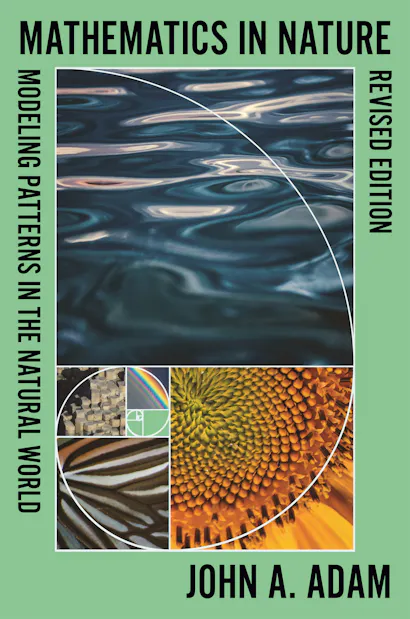
Mathematics in Nature reveals how mathematics provides a unifying language for understanding the hidden order of nature. In this richly illustrated book, John Adam guides readers from basic models using everyday arithmetic to the modeling of intricate, ever-evolving patterns, showing how even simple equations can illuminate the structure and behavior of complex systems.
Adam introduces arithmetic and algebraic models that capture essential ideas of population growth, resource consumption, and environmental feedbacks. Through discussions of shape, size, and scale, he explains why proportions and dimensions matter across biology and physics. He delves into the physics of light and air to reveal the mathematical patterns behind atmospheric beauty鈥攆rom rainbows, halos, and glories to mirages and cloud formations鈥攁nd demonstrates how equations can be used to describe ripples on water, sound in air, and the dramatic surges of tidal bores. Adam progresses from Fibonacci sequences, metallic ratios, and natural spirals to pattern formation and self-organization in living and nonliving systems.
With new chapters on the dynamics of climate change and pandemics, this fully revised edition reveals how mathematical modeling brings coherence and clarity to our understanding of nature鈥檚 complexity and the forces that shape our environment.
"Mathematics in Nature is an excellent resource for bringing a greater variety of patterns into the mathematical study of nature, as well as for teaching students to think about describing natural phenomena mathematically. . . . The breadth of patterns studied is phenomenal."鈥擶ill Wilson, American Scientist
"John Adam has combined his interest in the great outdoors and applied mathematics to compile one surprising example after another of how mathematics can be used to explain natural phenomena. And what examples! . . . [He] has done a great deal of reading and exposition, indulging his passions to create this compilation of mathematical models of natural phenomena, and the sheer number of examples he manages to cram into this book is testament to his efforts. There are other texts on the market which explore the connection between mathematics and nature . . . but none this wide-ranging."鈥擲teven Morics, MAA Online
"Adam has laced his mathematical models with popular descriptions of the phenomena selected. . . . Mathematics in Nature can accordingly be read for pleasure and instruction by the select laity who are not afraid of reading between the lines of equations."鈥擯hilip J. Davis, SIAM News
"John Adam's quest is a very simple one: that is, to invite one to look around and observe the wonders of nature, both natural and biological; to ponder them; and to try to explain them at various levels with, for the most part, quite elementary mathematical concepts and techniques."鈥擝rian D. Sleeman, Notices of the American Mathematical Association
"Reading this book progressively creates a course in mathematical modeling built around familiar, tangible, human-scale examples, with a trajectory that takes readers from dimensional estimates through geometrical modeling, linear and nonlinear dynamics, to pattern formation."鈥�Choice
"John Adam's Mathematics in Nature illustrates how, in a friendly and lucid manner, mathematicians think about nature. Adam lets us see how mathematics is not only an ally, but is perhaps the very language that nature uses to express the beautiful. . . . This is a book that will challenge while it intrigues and excites."鈥擲tanley David Gedzelman, Weatherwise
"Although Mathematics in Nature has not been written as a textbook, availability of such a manual shall help instructors who choose this delightful book for teaching a course in applied mathematics or mathematical modeling."鈥擸uri V. Rogovchenko, Zentralblatt Math
"Spanning a range of mathematical levels, this book can be used as an undergraduate textbook, a source of high school math enrichment, or can be read for pleasure by folks with an appreciation of nature but without advanced mathematical background."鈥�Southeastern Naturalist
"Have you wondered how rainbows or sand dunes form? Does it puzzle you why drying mud forms polygonally shaped cracks? Can you explain the patterns on a butterfly's wings or how birds fly? In this delightful book, John Adam invites us to question and to share his enthusiasm for developing mathematical models to explore a wide range of everyday natural phenomena. Mathematics in Nature can be used as a text on mathematical modeling or as a book to dip into and encourage us to observe and wonder at the beauty of nature. It has the potential of becoming a classic."—Brian Sleeman, University of Leeds
"This is a book that I will want to keep close to hand so that I will not be stumped by all those seemingly simple yet subtle questions about nature: Why can fleas jump so high? Why is visibility better in rain than in fog? Why does a river meander? How high can trees grow? But it is much more than a compendium of useful facts and explanations. It is the clearest guide I have seen to the art of conceptualizing, simplifying, and modeling natural phenomena—no less than an exegesis on how good quantitative science is done."—Philip Ball, author of How Life Works: A User’s Guide to the New Biology
"Mathematics in Nature leads the calculus-literate reader on a vigorous tour of nature's visible patterns—from the radiator-sailed dinosaur Dimetrodon to fracturing of dried mud and ceramic glazes, from the dispersion of rainbows and iridescence of beetles to the pearling of spider silk. Eschewing phenomena that are too small to see or too large to grasp, Adam shows how elementary college mathematics, rigorously applied, can give precise expression to everyday natural phenomena. His extraordinary range of examples and meticulous explanations document mathematics' wonderful capacity to describe and explain nature's patterns."—Lynn Arthur Steen, St. Olaf College
"This is a unique, even great book. It is in the spirit of a number of books on topics like symmetry and chaos that look at mathematics in the context of visually striking natural and other phenomena but is more broadly based. The author leads with the phenomena and follows with the math, making the book accessible to a wider audience while still appealing to math students and faculty."—Frank Wattenberg