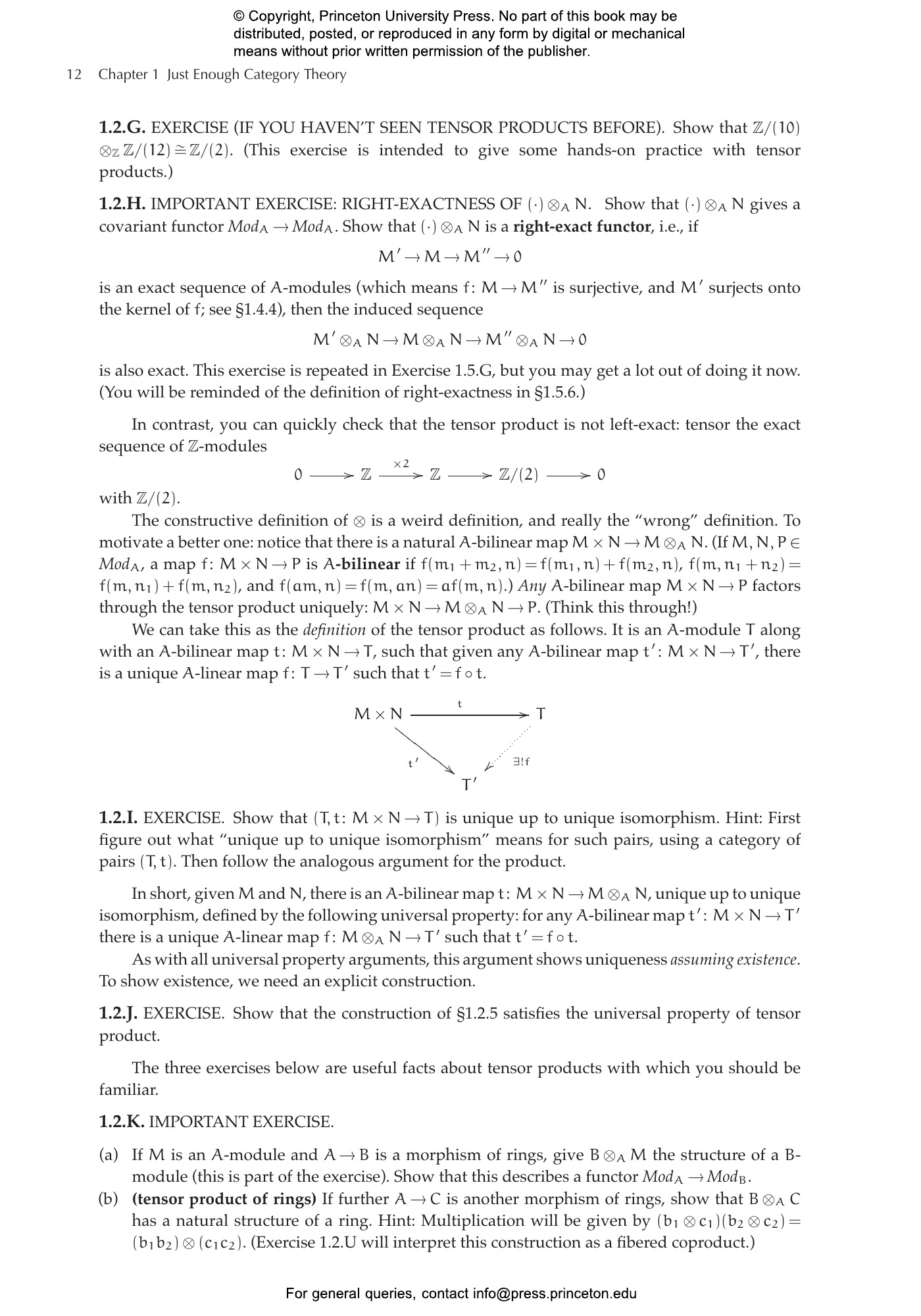
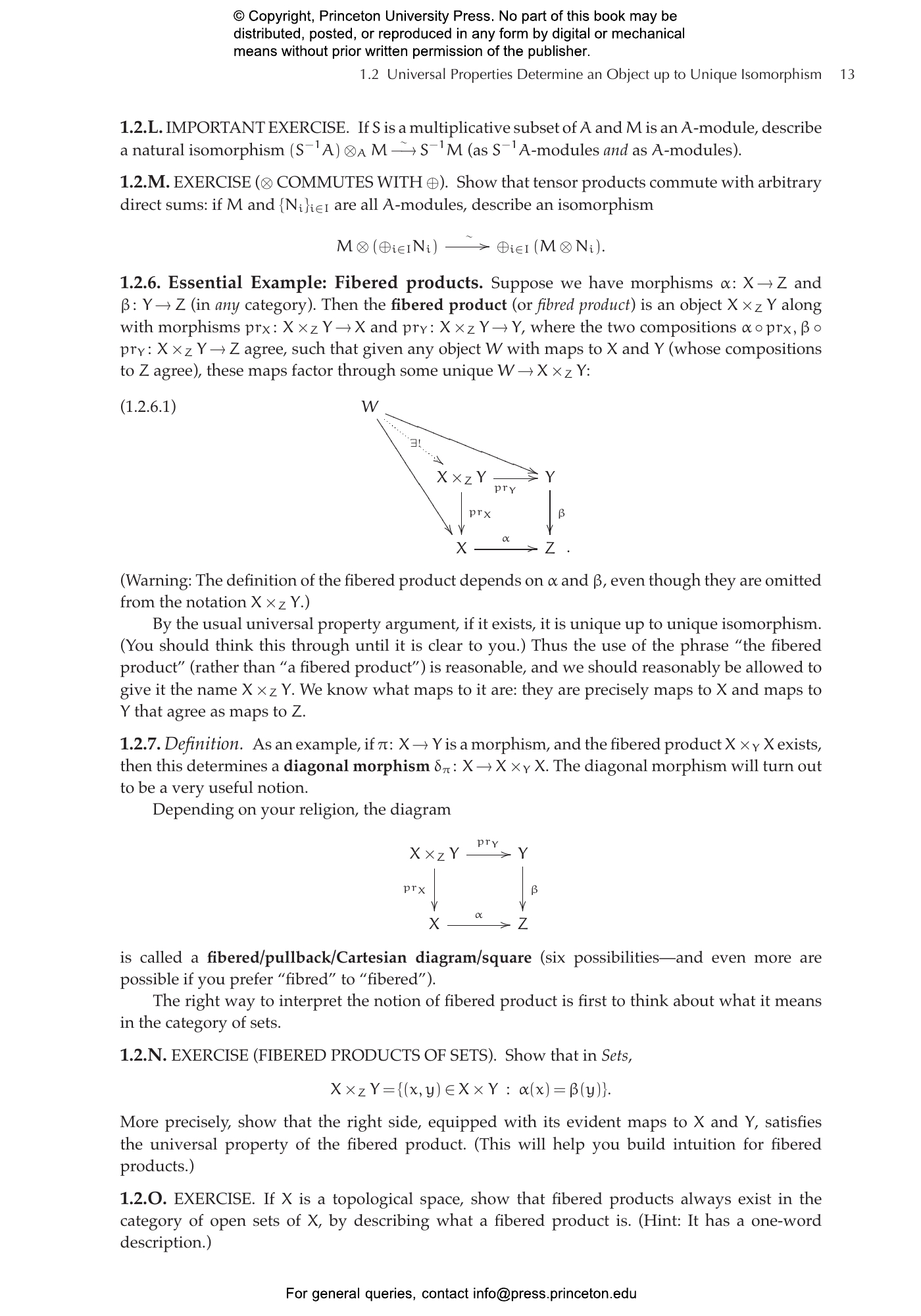
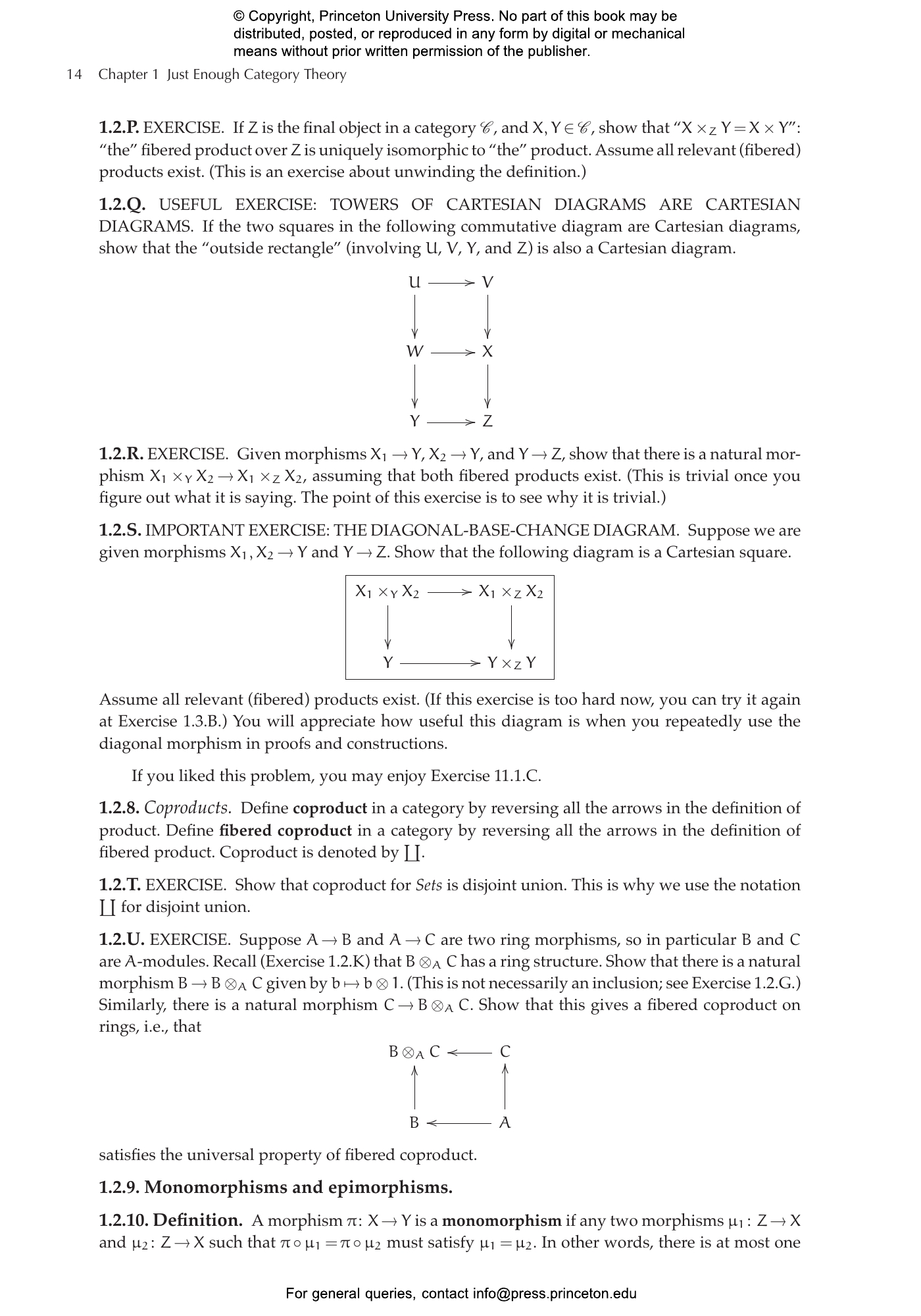
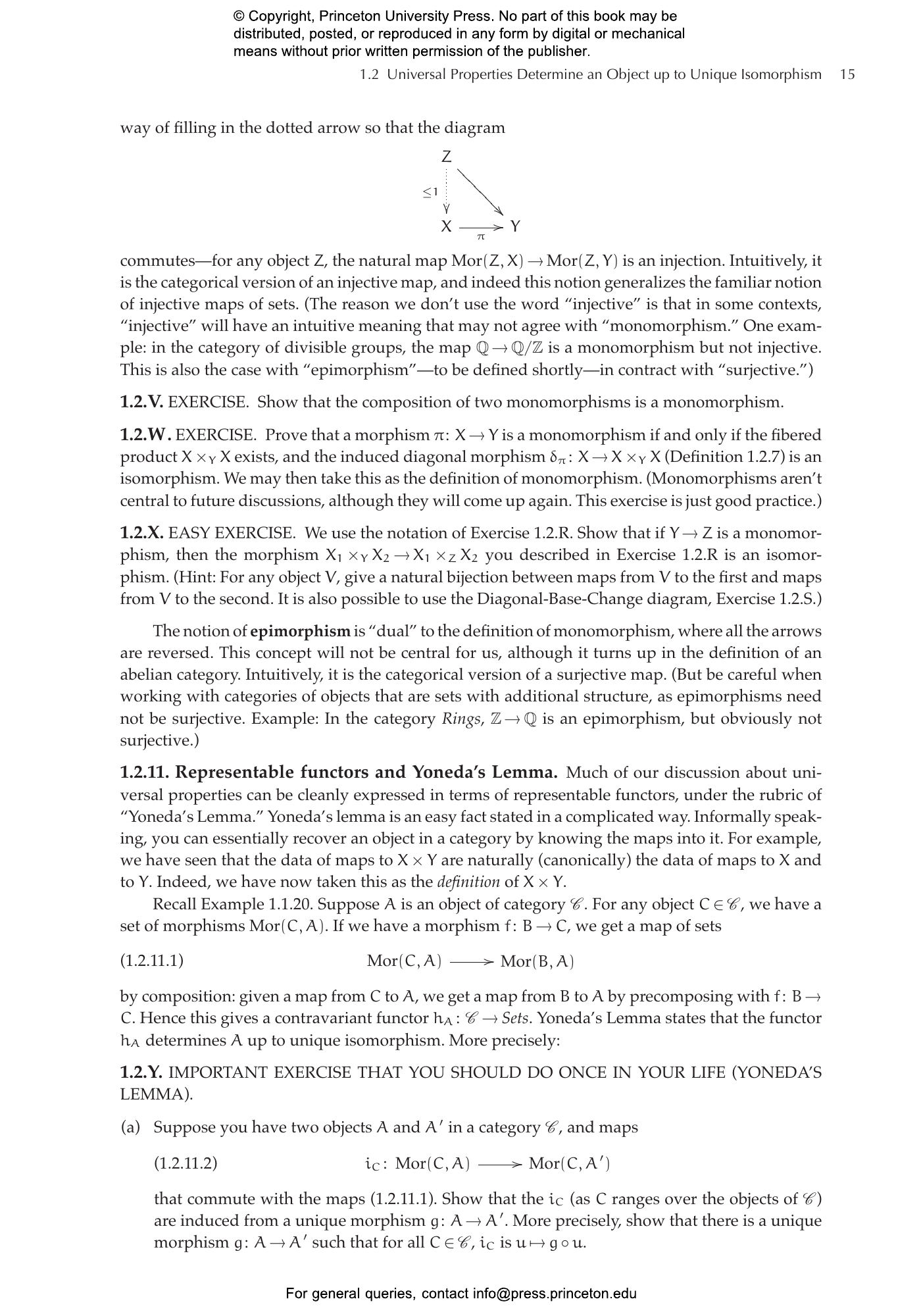
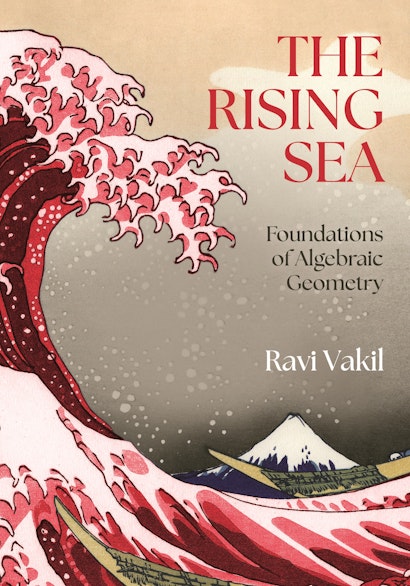
Decades ago, Mumford wrote that algebraic geometry 鈥渟eems to have acquired the reputation of being esoteric, exclusive, and very abstract, with adherents who are secretly plotting to take over all the rest of mathematics.鈥� The revolution has now fully come to pass and has fundamentally changed how we think about many fields of mathematics. This book provides a thorough foundation in the powerful ideas that now shape the landscape, with an informal yet rigorous exposition that builds intuition for understanding the formidable machinery. It begins with a discussion of categorical thinking and sheaves and then develops the notion of schemes and varieties as examples of 鈥済eometric spaces鈥� before discussing their specific aspects. The book goes on to cover topics such as dimension and smoothness, vector bundles and their natural generalizations, and important cohomological tools and their applications. Important optional topics are included in starred sections.
- Provides a comprehensive introduction certain to become the standard on the subject
- Features a wealth of exercises that enable students to learn by doing
- Requires few prerequisites, developing the tools students need to succeed, from category theory and sheaf theory to commutative and homological algebra
- Uses an example-driven approach that builds mathematical intuition
- Is a self-contained textbook for graduate students and an essential reference for researchers
Awards and Recognition
- Winner of the PROSE Award in Mathematics and Statistics, Association of American Publishers
Ravi Vakil is the Robert Grimmett Professor of Mathematics at Stanford University and president of the American Mathematical Society. He is the author of A Mathematical Mosaic: Patterns and Problem Solving.
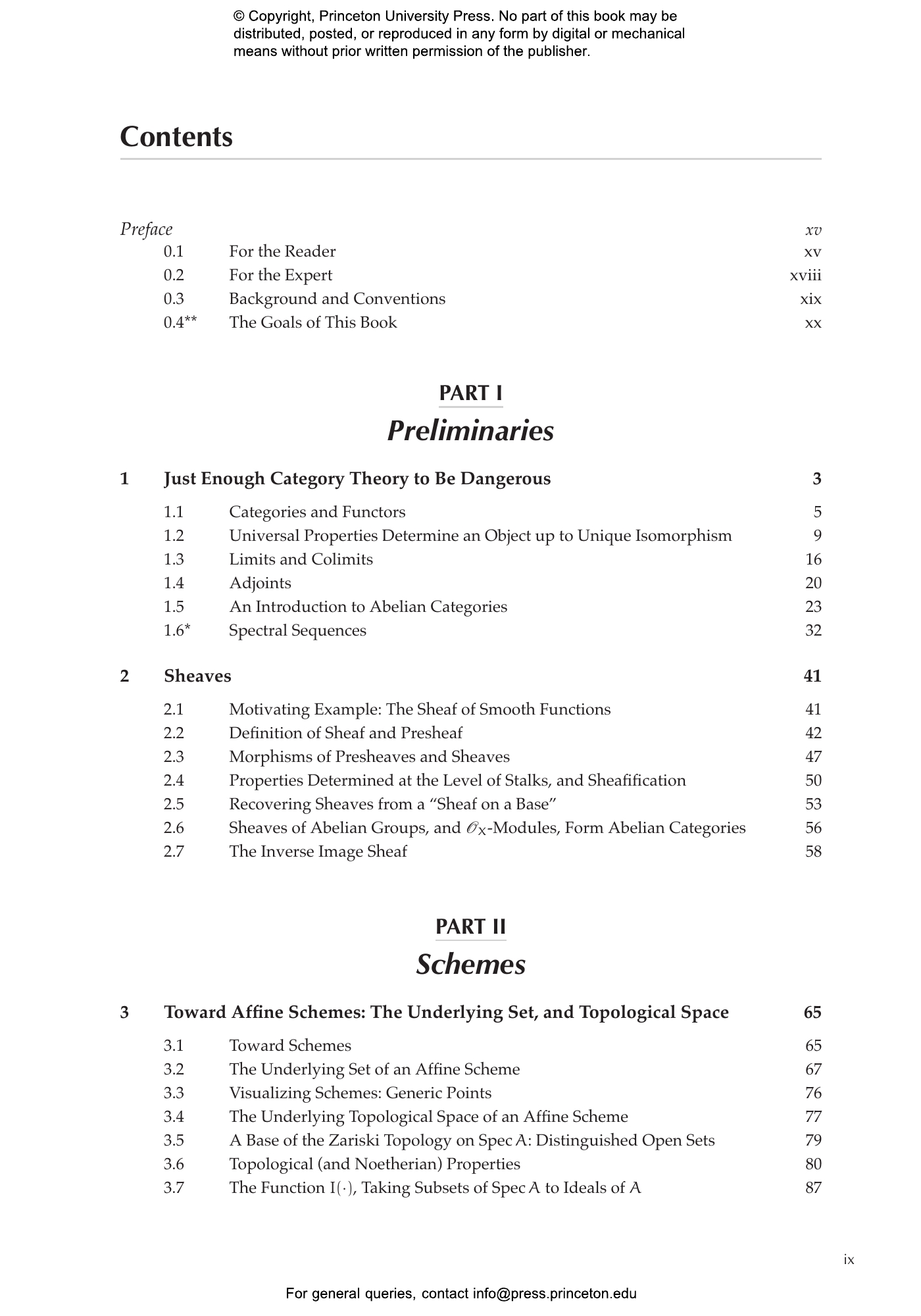
- 0.1 For the Reader
- 0.2 For the Expert
- 0.3 Background and Conventions
- 0.4** The Goals of This Book
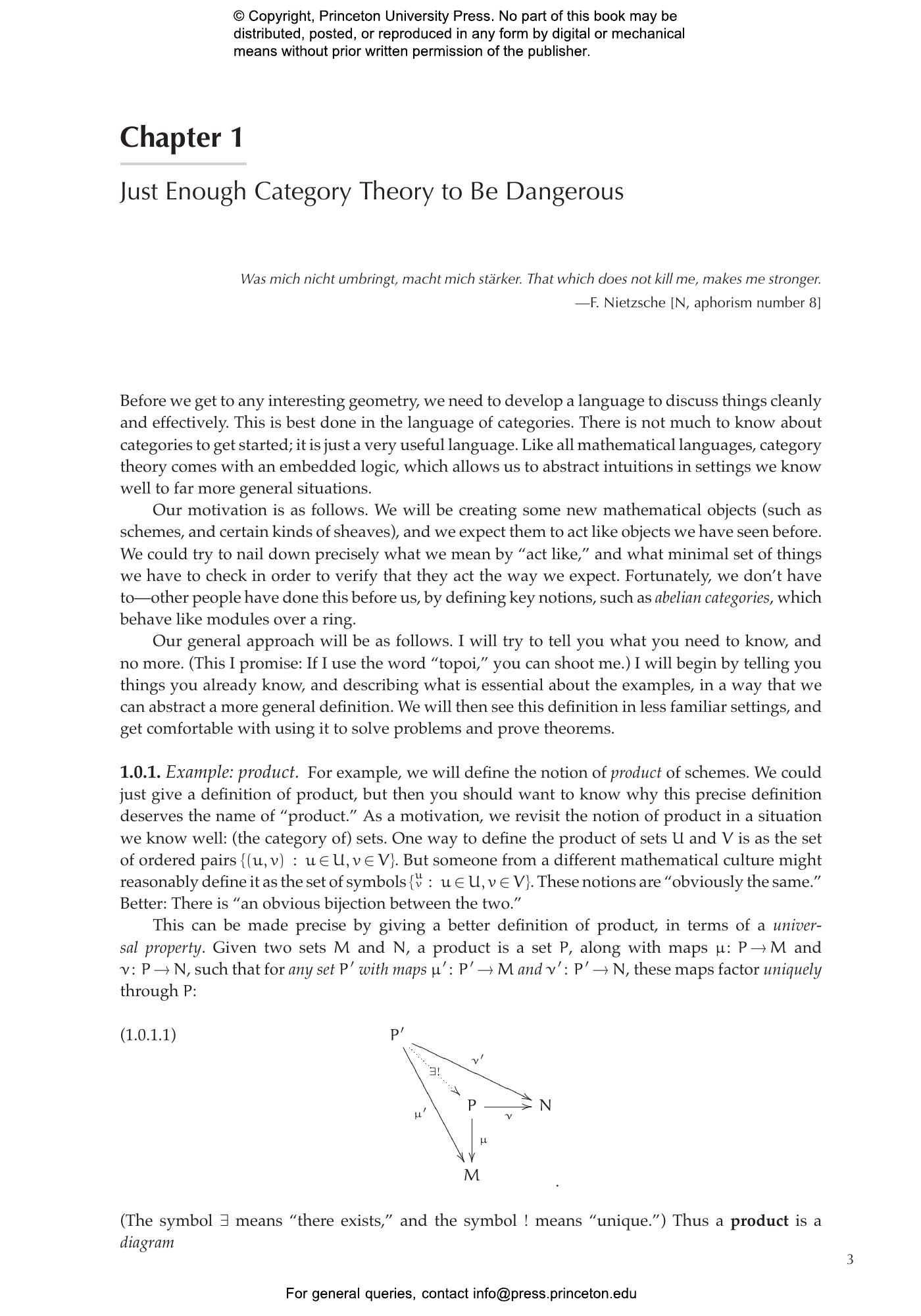
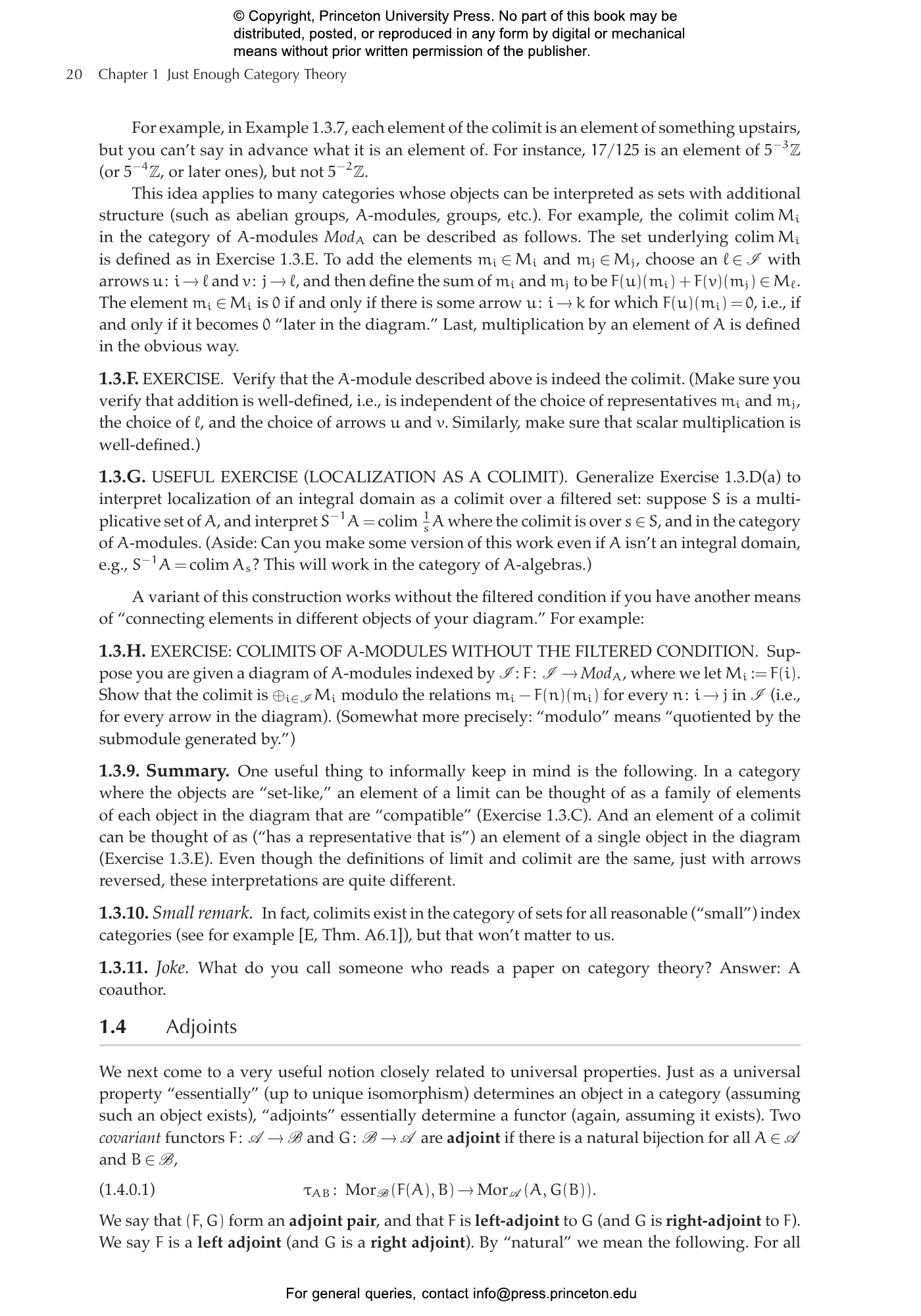
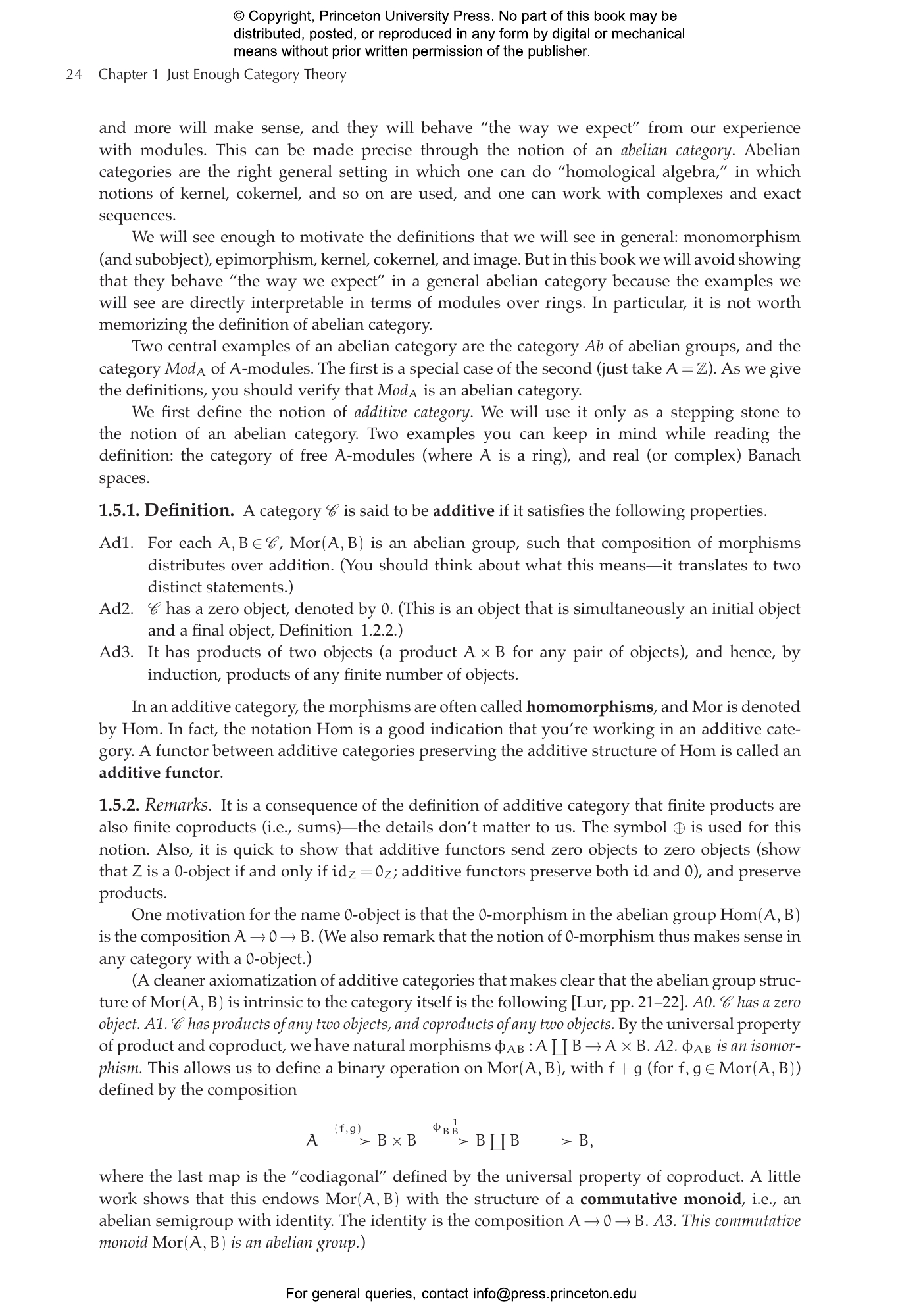
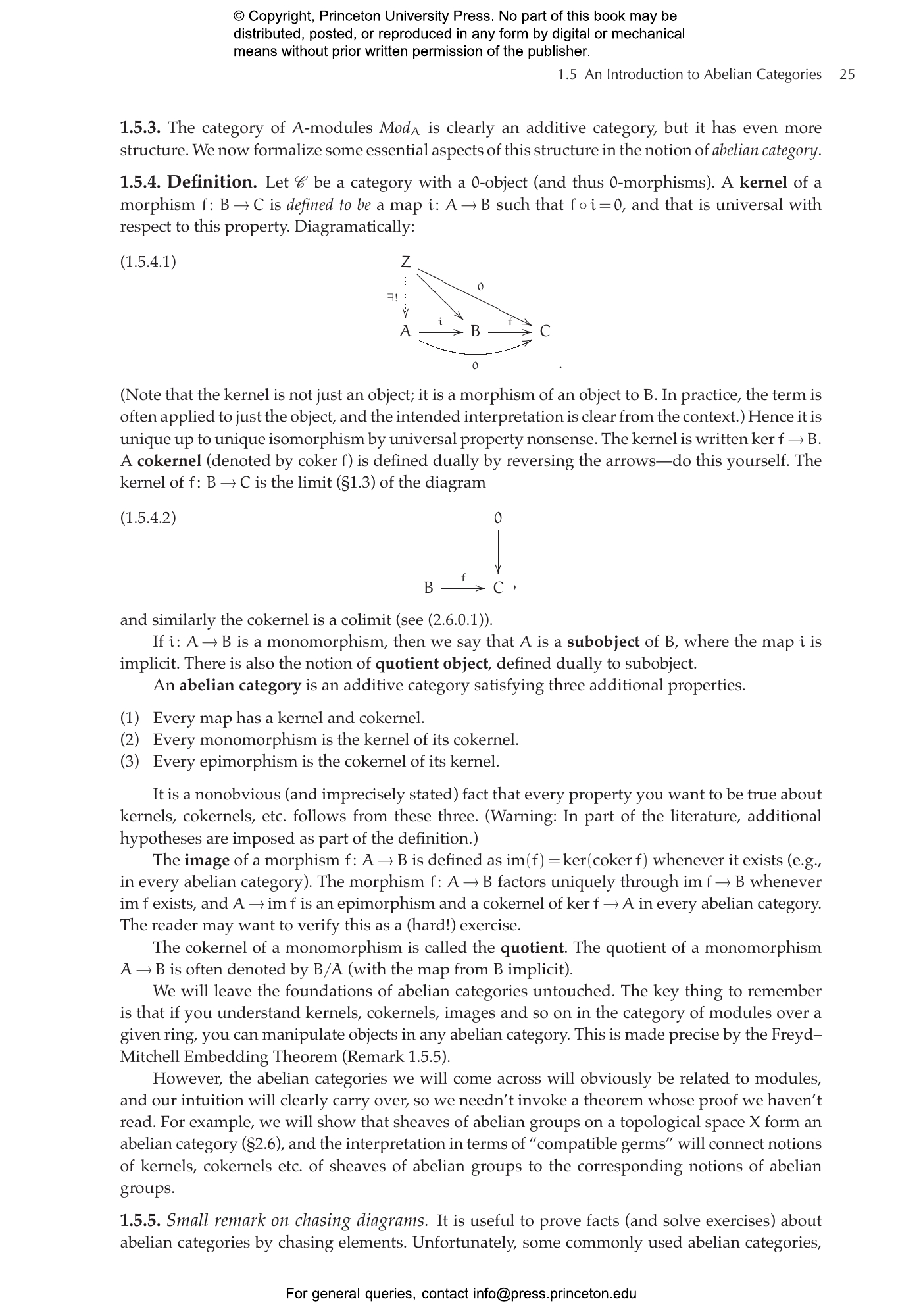
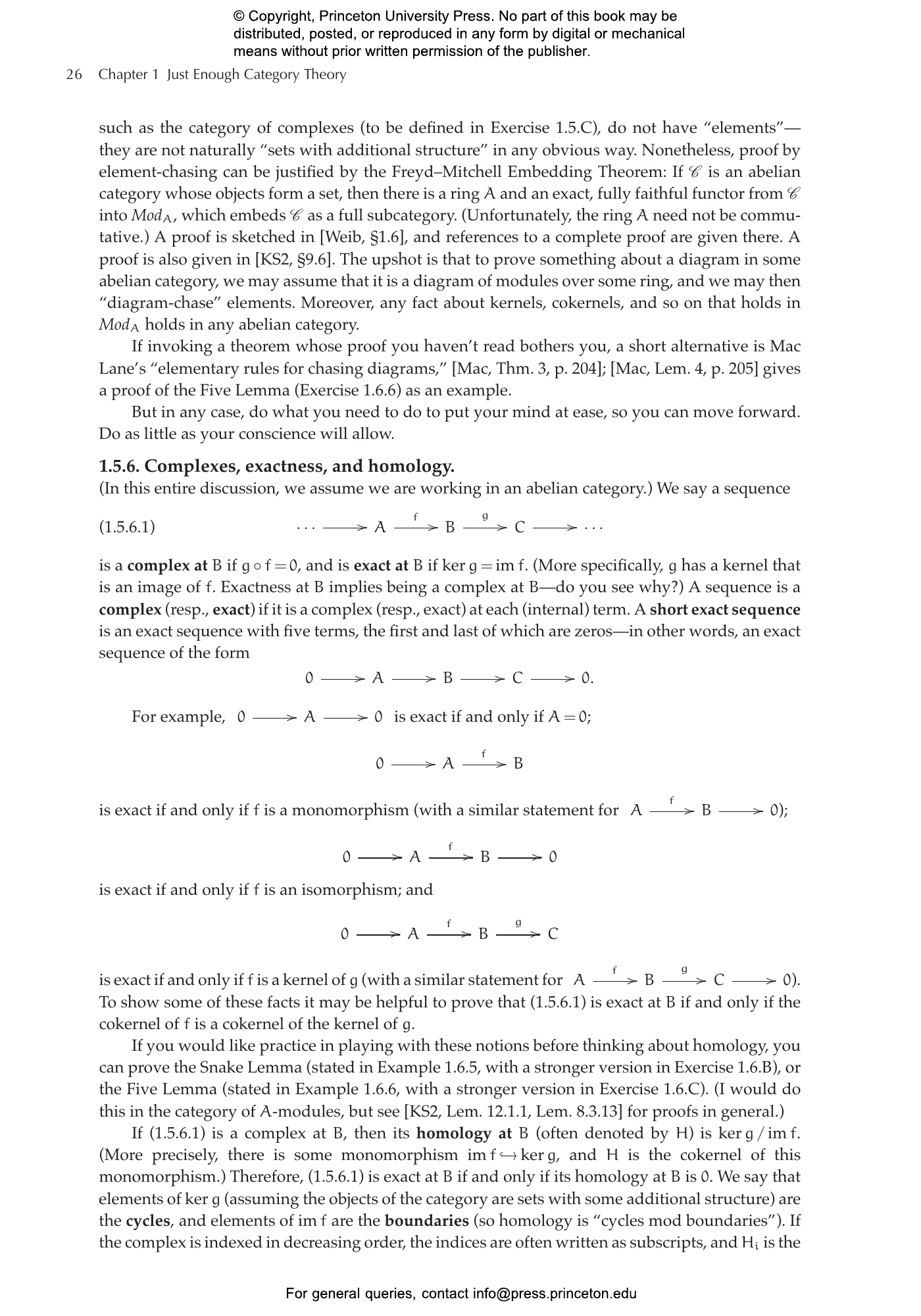
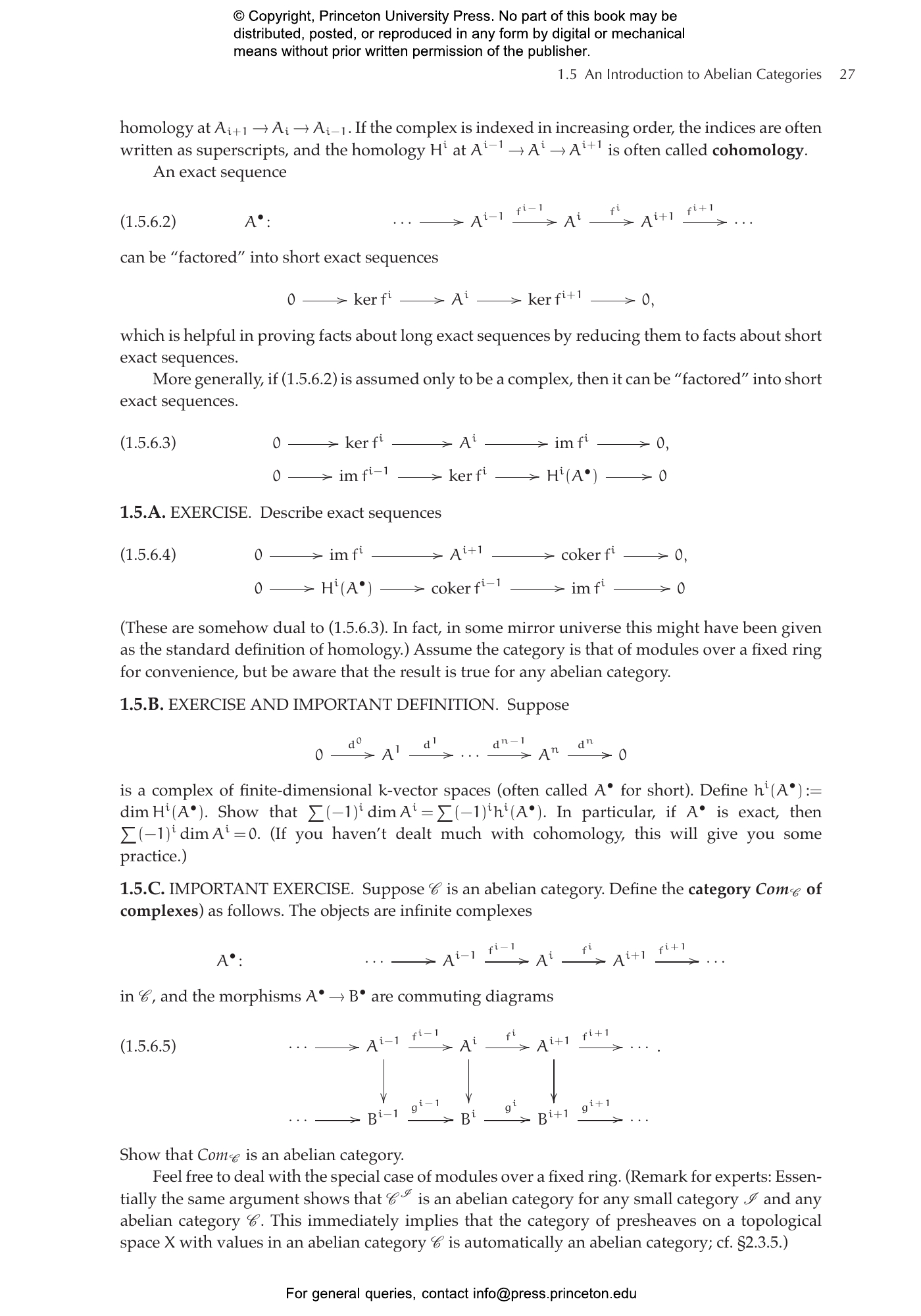
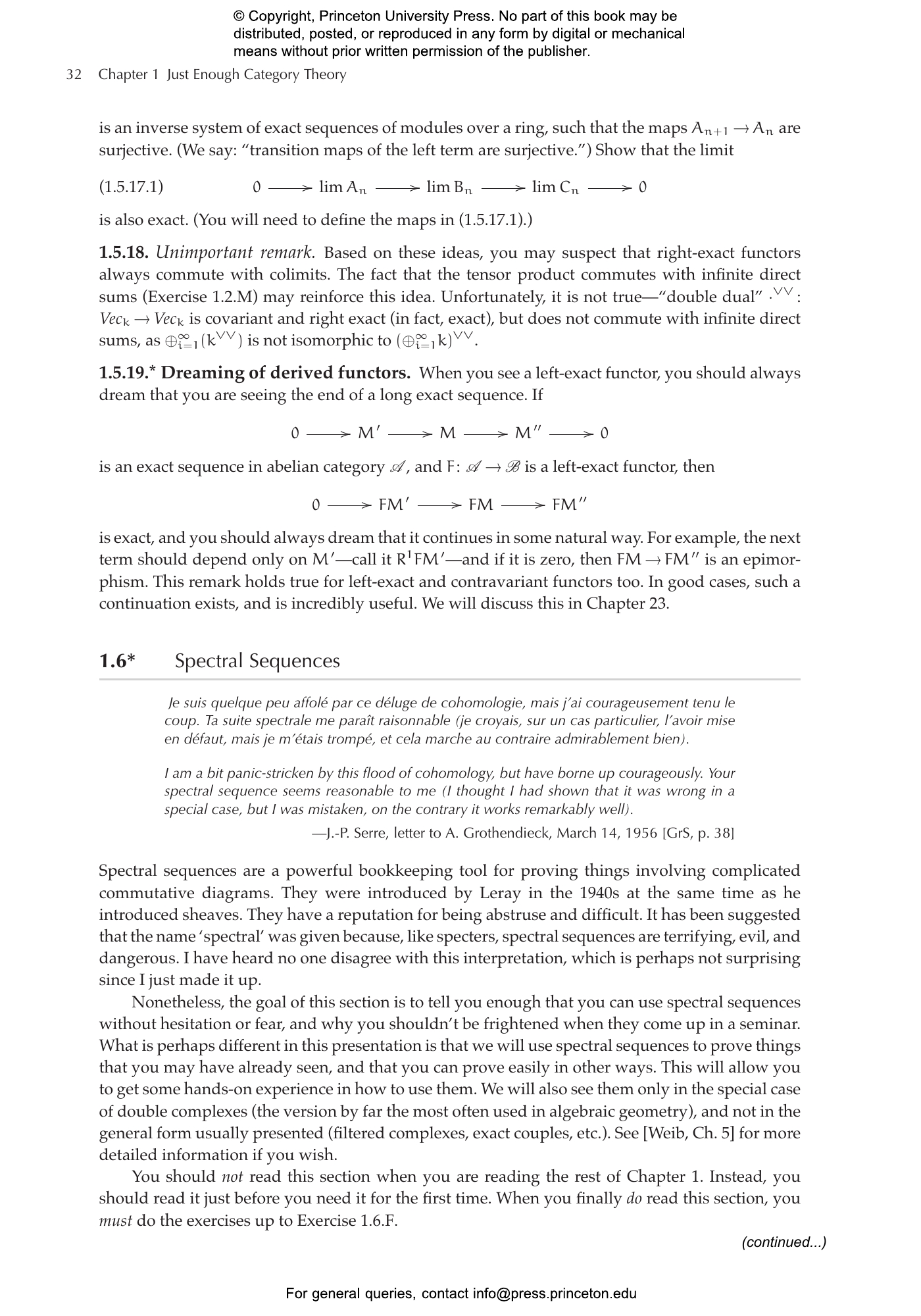
- 1 Just Enough Category Theory to Be Dangerous
- 1.1 Categories and Functors
- 1.2 Universal Properties Determine an Object up to Unique Isomorphism
- 1.3 Limits and Colimits
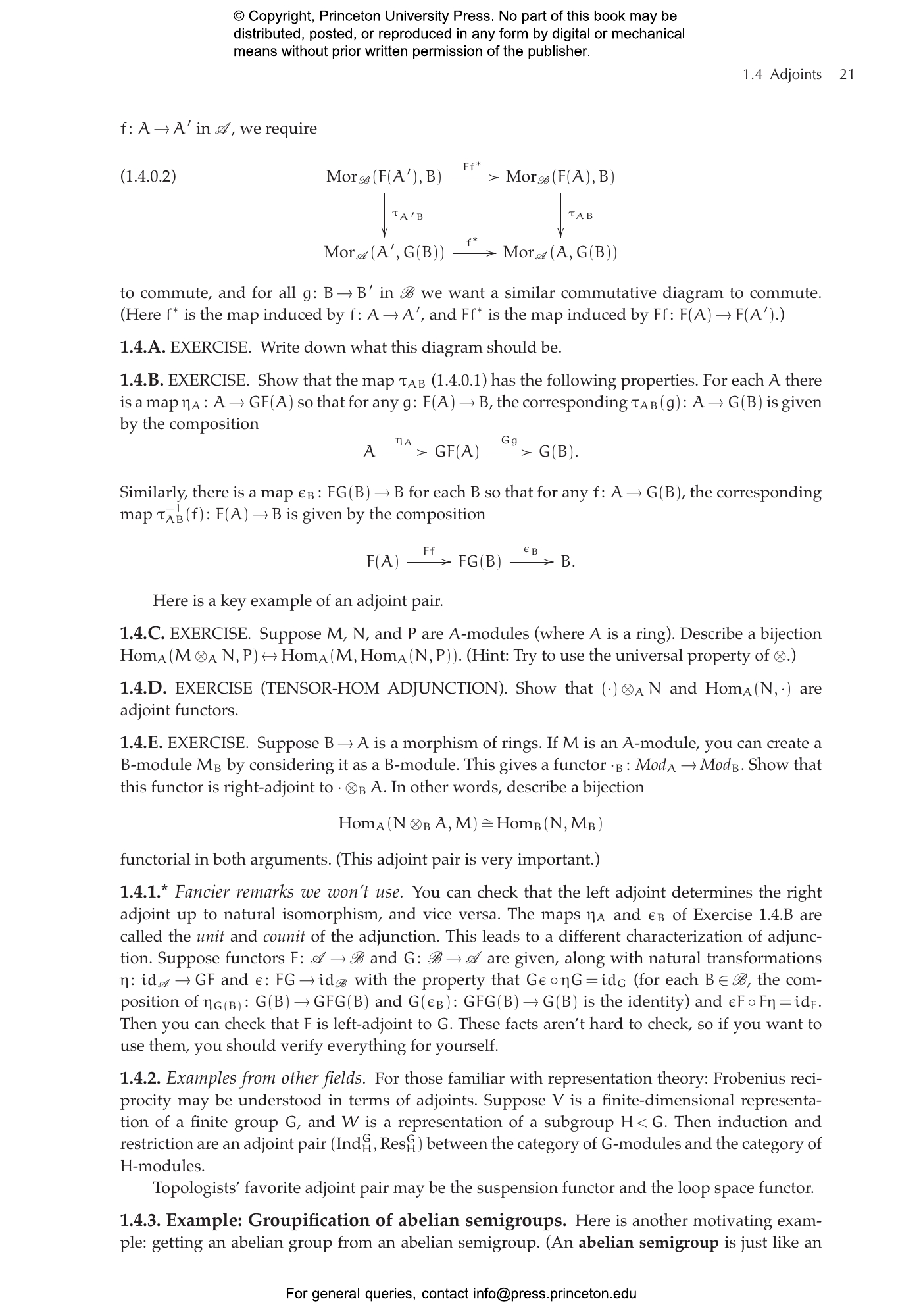
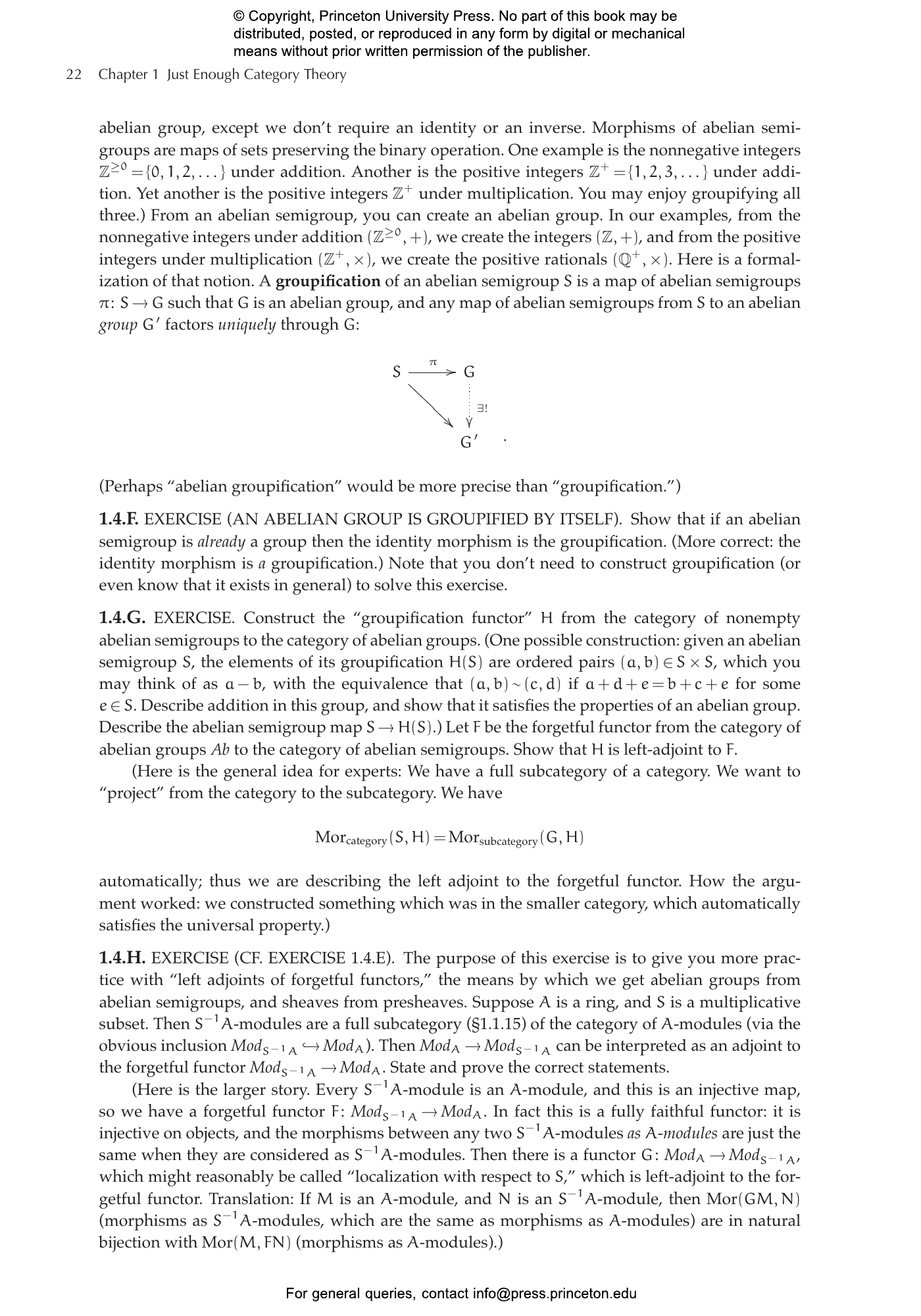
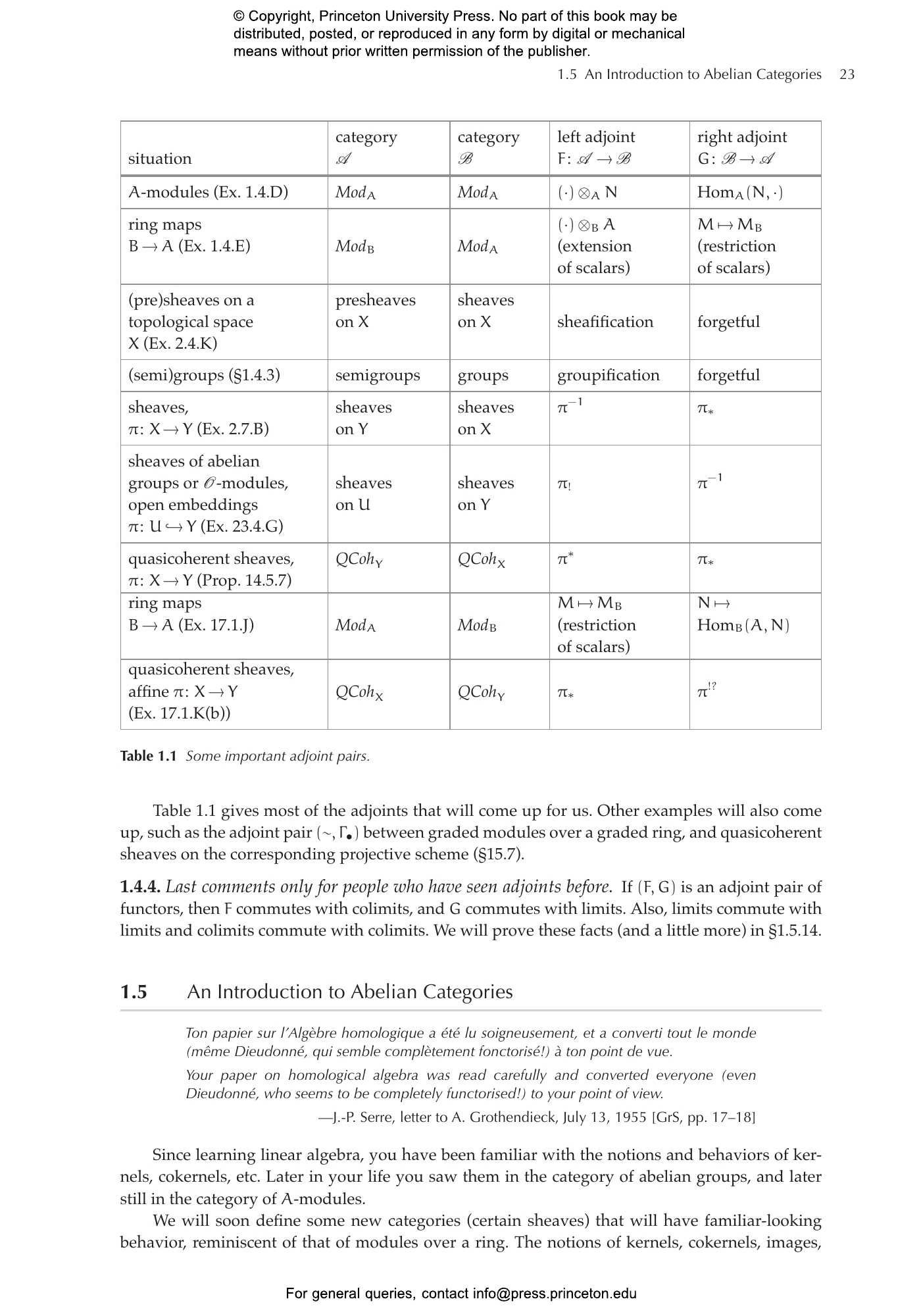
- 1.4 Adjoints
- 1.5 An Introduction to Abelian Categories
- 1.6* Spectral Sequences
- 2 Sheaves
- 2.1 Motivating Example: The Sheaf of Smooth Functions
- 2.2 De铿乶ition of Sheaf and Presheaf
- 2.3 Morphisms of Presheaves and Sheaves
- 2.4 Properties Determined at the Level of Stalks, and Shea铿侊瑏cation
- 2.5 Recovering Sheaves from a 鈥淪heaf on a Base鈥�
- 2.6 Sheaves of Abelian Groups, and 饾挭X-Modules, Form Abelian Categories
- 2.7 The Inverse Image Sheaf
- 3 Toward A铿僴e Schemes: The Underlying Set, and Topological Space
- 3.1 Toward Schemes
- 3.2 The Underlying Set of an A铿僴e Scheme
- 3.3 Visualizing Schemes: Generic Points
- 3.4 The Underlying Topological Space of an A铿僴e Scheme
- 3.5 A Base of the Zariski Topology on SpecA: Distinguished Open Sets
- 3.6 Topological (and Noetherian) Properties
- 3.7 The Function I(鈰�), Taking Subsets of SpecA to Ideals of A
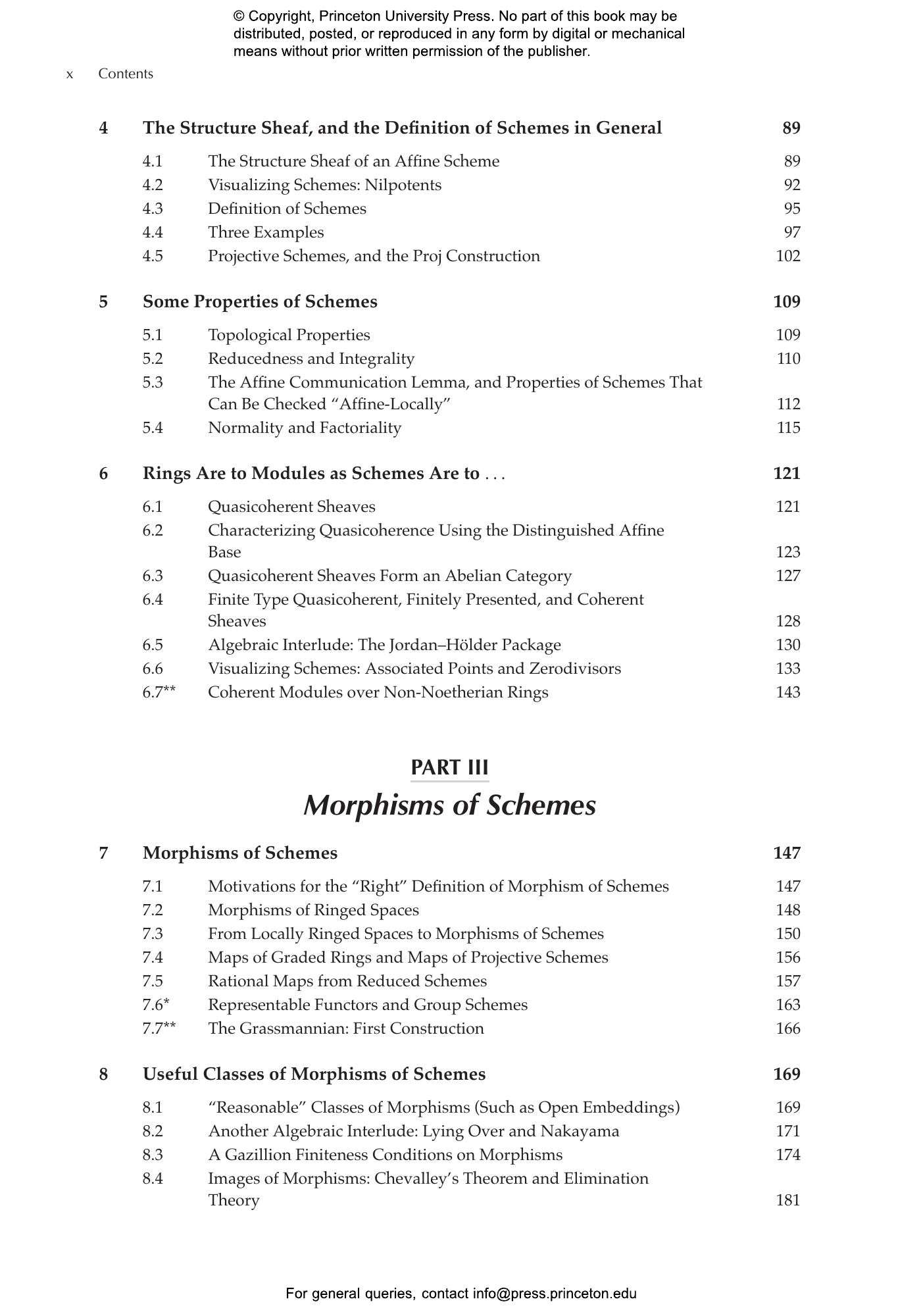
- 4 The Structure Sheaf, and the De铿乶ition of Schemes in General
- 4.1 The Structure Sheaf of an A铿僴e Scheme
- 4.2 Visualizing Schemes: Nilpotents
- 4.3 De铿乶ition of Schemes
- 4.4 Three Examples
- 4.5 Projective Schemes, and the Proj Construction
- 5 Some Properties of Schemes
- 5.1 Topological Properties
- 5.2 Reducedness and Integrality
- 5.3 The A铿僴e Communication Lemma, and Properties of Schemes That Can Be Checked 鈥淎铿僴e-Locally鈥�
- 5.4 Normality and Factoriality
- 6 Rings Are to Modules as Schemes Are to 鈥�
- 6.1 Quasicoherent Sheaves
- 6.2 Characterizing Quasicoherence Using the Distinguished A铿僴e Base
- 6.3 Quasicoherent Sheaves Form an Abelian Category
- 6.4 Finite Type Quasicoherent, Finitely Presented, and Coherent Sheaves
- 6.5 Algebraic Interlude: The Jordan鈥揌枚lder Package
- 6.6 Visualizing Schemes: Associated Points and Zerodivisors
- 6.7** Coherent Modules over Non-Noetherian Rings
- Part III Morphisms of Schemes
- 7 Morphisms of Schemes
- 7.1 Motivations for the 鈥淩ight鈥� De铿乶ition of Morphism of Schemes
- 7.2 Morphisms of Ringed Spaces
- 7.3 From Locally Ringed Spaces to Morphisms of Schemes
- 7.4 Maps of Graded Rings and Maps of Projective Schemes
- 7.5 Rational Maps from Reduced Schemes
- 7.6* Representable Functors and Group Schemes
- 7.7** The Grassmannian: First Construction
- 8 Useful Classes of Morphisms of Schemes
- 8.1 鈥淩easonable鈥� Classes of Morphisms (Such as Open Embeddings)
- 8.2 Another Algebraic Interlude: Lying Over and Nakayama
- 8.3 A Gazillion Finiteness Conditions on Morphisms
- 8.4 Images of Morphisms: Chevalley鈥檚 Theorem and Elimination Theory
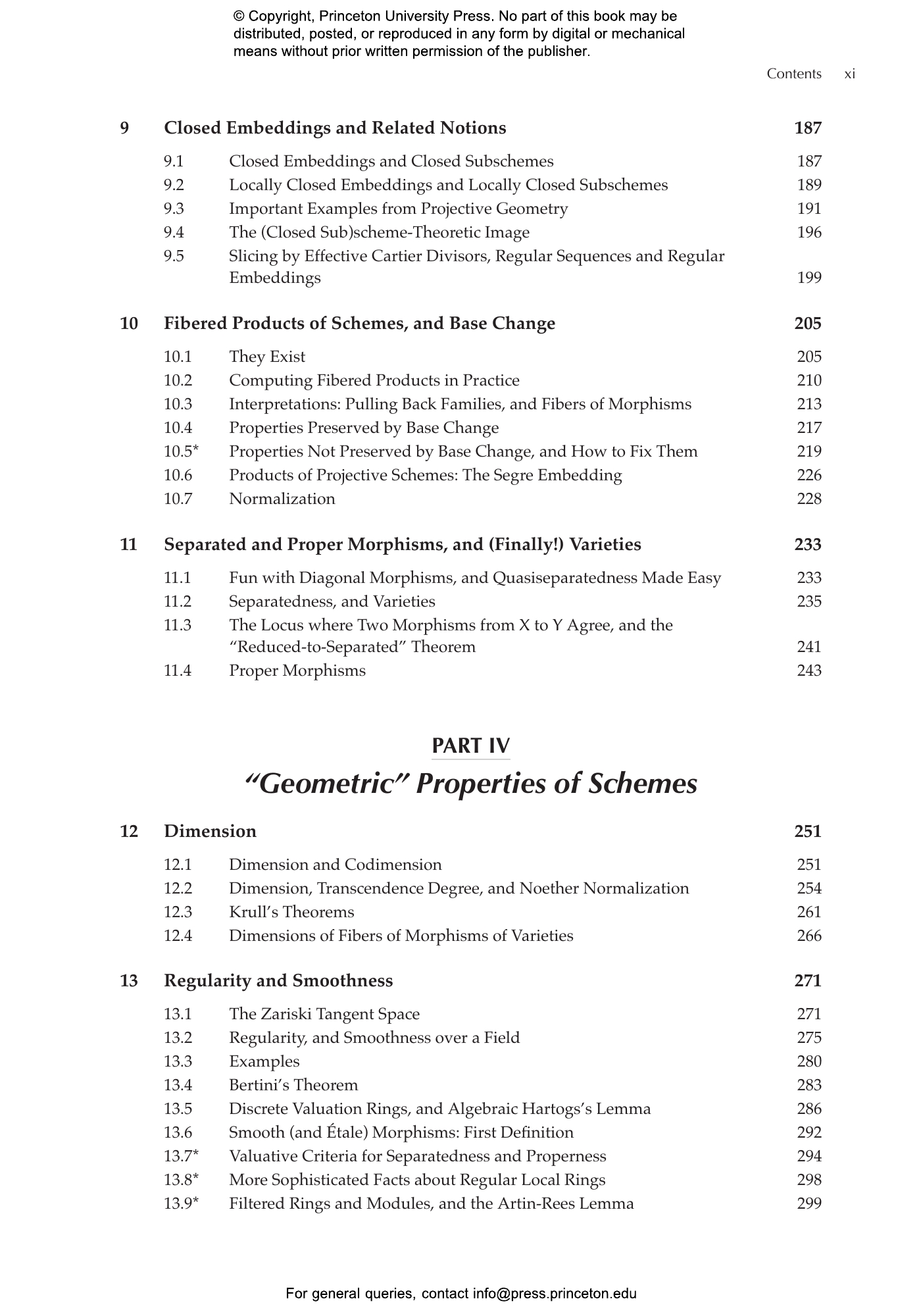
- 9 Closed Embeddings and Related Notions
- 9.1 Closed Embeddings and Closed Subschemes
- 9.2 Locally Closed Embeddings and Locally Closed Subschemes
- 9.3 Important Examples from Projective Geometry
- 9.4 The (Closed Sub)scheme-Theoretic Image
- 9.5 Slicing by E铿�ective Cartier Divisors, Regular Sequences and Regular Embeddings
- 10 Fibered Products of Schemes, and Base Change
- 10.1 They Exist
- 10.2 Computing Fibered Products in Practice
- 10.3 Interpretations: Pulling Back Families, and Fibers of Morphisms
- 10.4 Properties Preserved by Base Change
- 10.5* Properties Not Preserved by Base Change, and How to Fix Them
- 10.6 Products of Projective Schemes: The Segre Embedding
- 10.7 Normalization
- 11 Separated and Proper Morphisms, and (Finally!) Varieties
- 11.1 Fun with Diagonal Morphisms, and Quasiseparatedness Made Easy
- 11.2 Separatedness, and Varieties
- 11.3 The Locus where Two Morphisms from X to Y Agree, and the 鈥淩educed-to-Separated鈥� Theorem
- 11.4 Proper Morphisms
- Part IV 鈥淕eometric鈥� Properties of Schemes
- 12 Dimension
- 12.1 Dimension and Codimension
- 12.2 Dimension, Transcendence Degree, and Noether Normalization
- 12.3 Krull鈥檚 Theorems
- 12.4 Dimensions of Fibers of Morphisms of Varieties
- 13 Regularity and Smoothness
- 13.1 The Zariski Tangent Space
- 13.2 Regularity, and Smoothness over a Field
- 13.3 Examples
- 13.4 Bertini鈥檚 Theorem
- 13.5 Discrete Valuation Rings, and Algebraic Hartogs鈥檚 Lemma
- 13.6 Smooth (and 脡tale) Morphisms: First De铿乶ition
- 13.7* Valuative Criteria for Separatedness and Properness
- 13.8* More Sophisticated Facts about Regular Local Rings
- 13.9* Filtered Rings and Modules, and the Artin-Rees Lemma
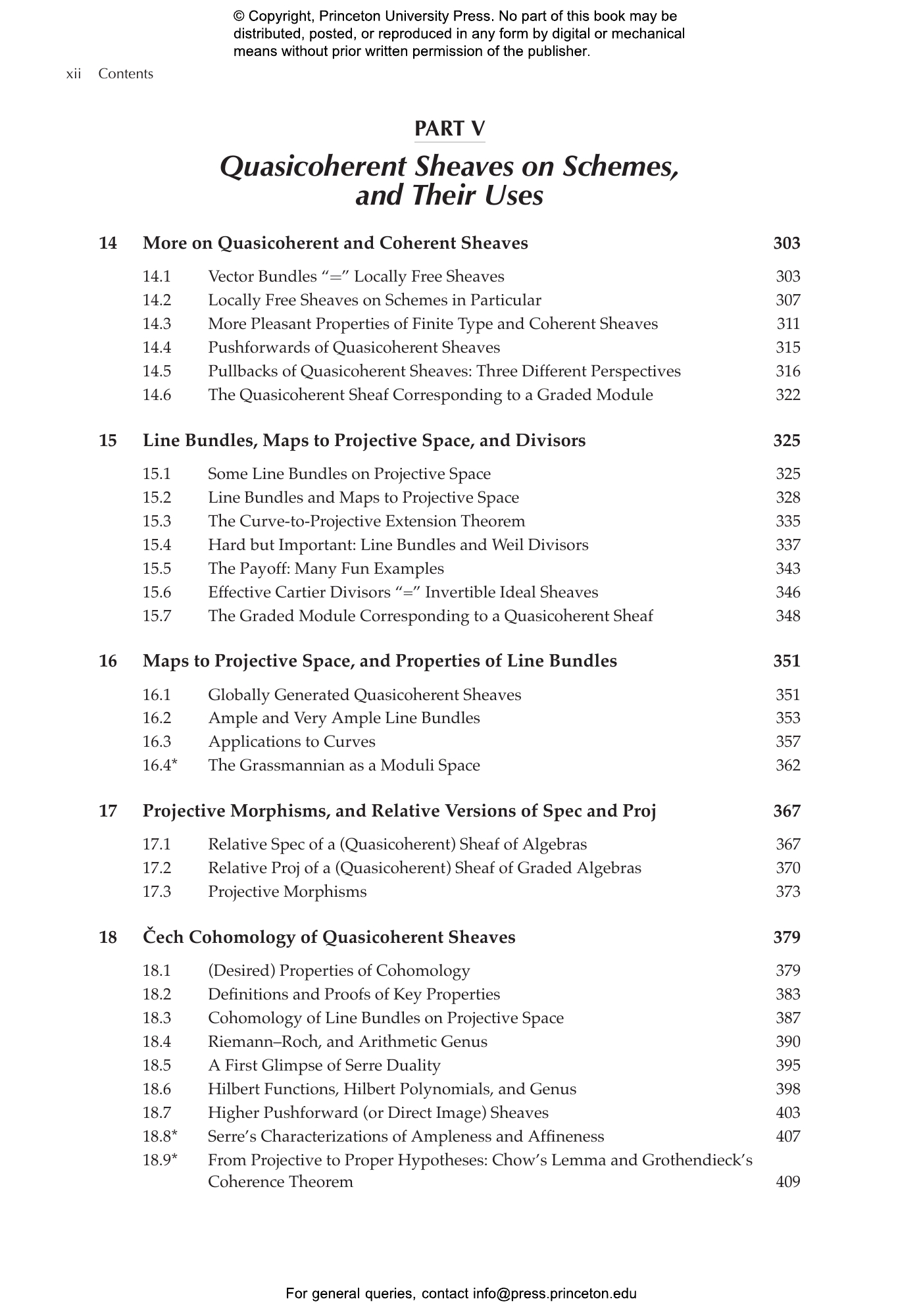
- Part V Quasicoherent Sheaves on Schemes, and Their Uses
- 14 More on Quasicoherent and Coherent Sheaves
- 14.1 Vector Bundles 鈥�=鈥� Locally Free Sheaves
- 14.2 Locally Free Sheaves on Schemes in Particular
- 14.3 More Pleasant Properties of Finite Type and Coherent Sheaves
- 14.4 Pushforwards of Quasicoherent Sheaves
- 14.5 Pullbacks of Quasicoherent Sheaves: Three Di铿�erent Perspectives
- 14.6 The Quasicoherent Sheaf Corresponding to a Graded Module
- 15 Line Bundles, Maps to Projective Space, and Divisors
- 15.1 Some Line Bundles on Projective Space
- 15.2 Line Bundles and Maps to Projective Space
- 15.3 The Curve-to-Projective Extension Theorem
- 15.4 Hard but Important: Line Bundles and Weil Divisors
- 15.5 The Payo铿�: Many Fun Examples
- 15.6 E铿�ective Cartier Divisors 鈥�=鈥� Invertible Ideal Sheaves
- 15.7 The Graded Module Corresponding to a Quasicoherent Sheaf
- 16 Maps to Projective Space, and Properties of Line Bundles
- 16.1 Globally Generated Quasicoherent Sheaves
- 16.2 Ample and Very Ample Line Bundles
- 16.3 Applications to Curves
- 16.4* The Grassmannian as a Moduli Space
- 17 Projective Morphisms, and Relative Versions of Spec and Proj
- 17.1 Relative Spec of a (Quasicoherent) Sheaf of Algebras
- 17.2 Relative Proj of a (Quasicoherent) Sheaf of Graded Algebras
- 17.3 Projective Morphisms
- 18 膶ech Cohomology of Quasicoherent Sheaves
- 18.1 (Desired) Properties of Cohomology
- 18.2 De铿乶itions and Proofs of Key Properties
- 18.3 Cohomology of Line Bundles on Projective Space
- 18.4 Riemann鈥揜och, and Arithmetic Genus
- 18.5 A First Glimpse of Serre Duality
- 18.6 Hilbert Functions, Hilbert Polynomials, and Genus
- 18.7 Higher Pushforward (or Direct Image) Sheaves
- 18.8* Serre鈥檚 Characterizations of Ampleness and A铿僴eness
- 18.9* From Projective to Proper Hypotheses: Chow鈥檚 Lemma and Grothendieck鈥檚 Coherence Theorem
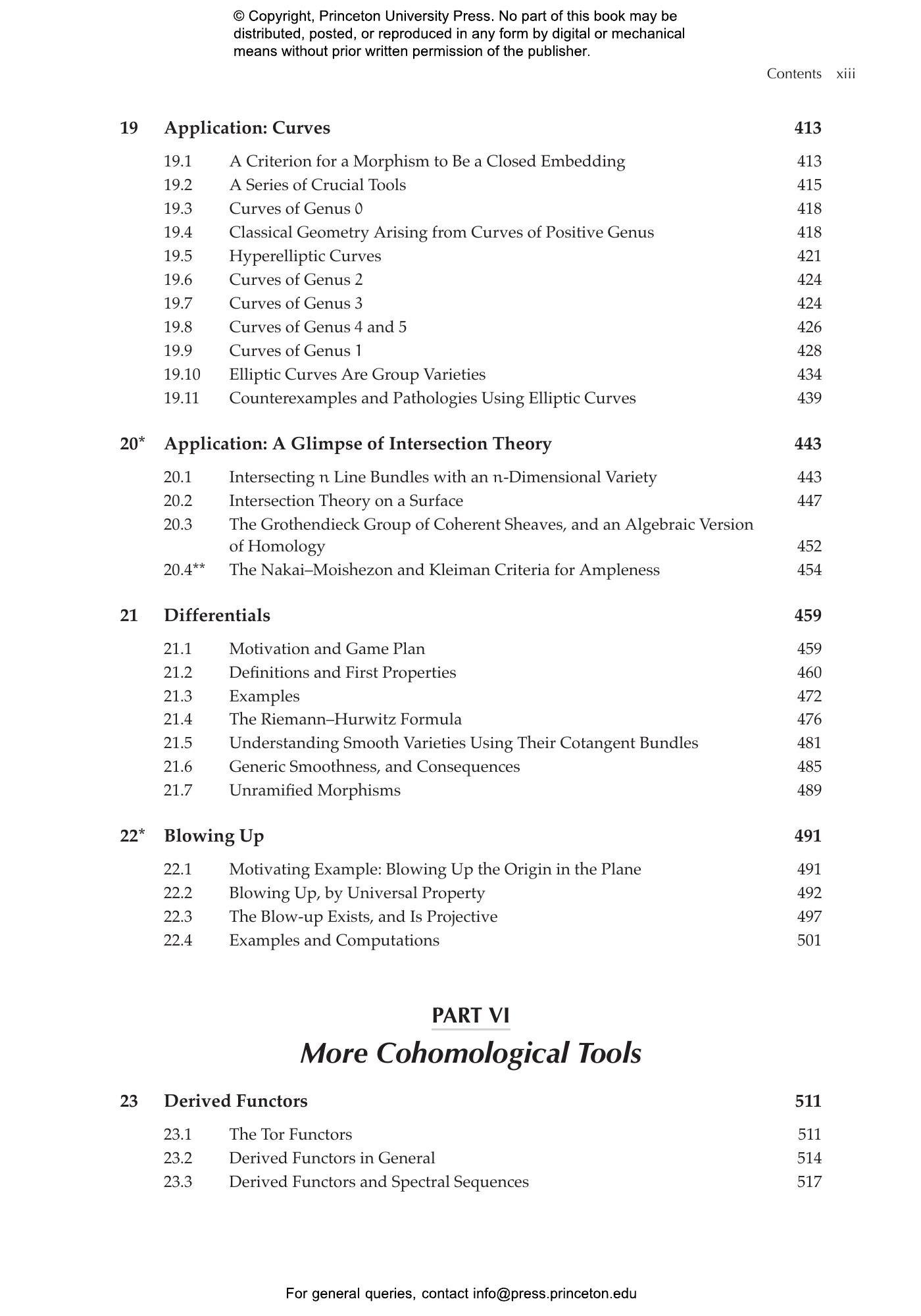
- 19 Application: Curves
- 19.1 A Criterion for a Morphism to Be a Closed Embedding
- 19.2 A Series of Crucial Tools
- 19.3 Curves of Genus 0
- 19.4 Classical Geometry Arising from Curves of Positive Genus
- 19.5 Hyperelliptic Curves
- 19.6 Curves of Genus 2
- 19.7 Curves of Genus 3
- 19.8 Curves of Genus 4 and 5
- 19.9 Curves of Genus 1
- 19.10 Elliptic Curves Are Group Varieties
- 19.11 Counterexamples and Pathologies Using Elliptic Curves
- 20* Application: A Glimpse of Intersection Theory
- 20.1 Intersecting n Line Bundles with an n-Dimensional Variety
- 20.2 Intersection Theory on a Surface
- 20.3 The Grothendieck Group of Coherent Sheaves, and an Algebraic Version of Homology
- 20.4** The Nakai鈥揗oishezon and Kleiman Criteria for Ampleness
- 21 Di铿�erentials
- 21.1 Motivation and Game Plan
- 21.2 De铿乶itions and First Properties
- 21.3 Examples
- 21.4 The Riemann鈥揌urwitz Formula
- 21.5 Understanding Smooth Varieties Using Their Cotangent Bundles
- 21.6 Generic Smoothness, and Consequences
- 21.7 Unrami铿乪d Morphisms
- 22* Blowing Up
- 22.1 Motivating Example: Blowing Up the Origin in the Plane
- 22.2 Blowing Up, by Universal Property
- 22.3 The Blow-up Exists, and Is Projective
- 22.4 Examples and Computations
- Part VI More Cohomological Tools
- 23 Derived Functors
- 23.1 The Tor Functors
- 23.2 Derived Functors in General
- 23.3 Derived Functors and Spectral Sequences
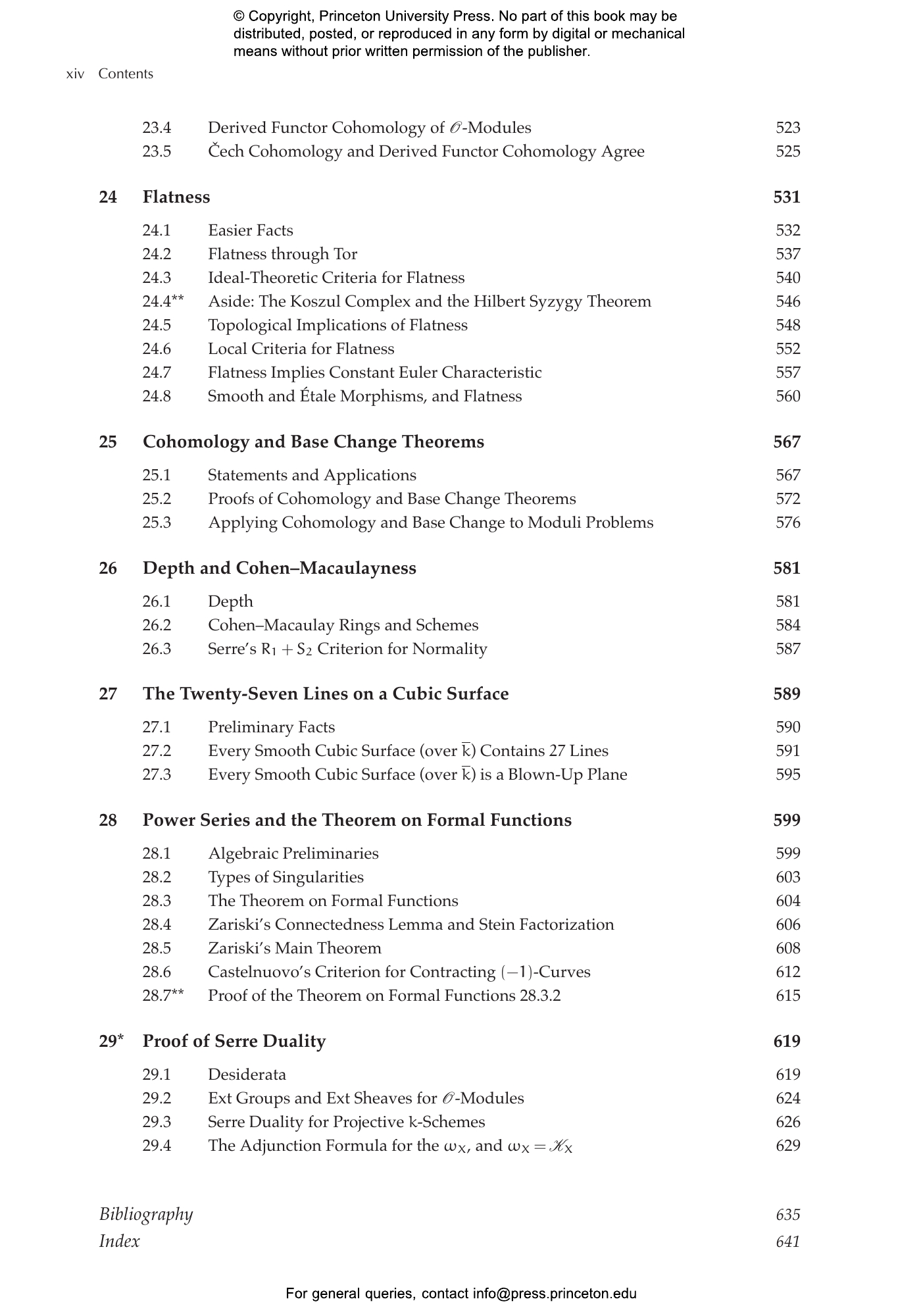
- 23.4 Derived Functor Cohomology of 饾挭-Modules
- 23.5 膶ech Cohomology and Derived Functor Cohomology Agree
- 24 Flatness
- 24.1 Easier Facts
- 24.2 Flatness through Tor
- 24.3 Ideal-Theoretic Criteria for Flatness
- 24.4** Aside: The Koszul Complex and the Hilbert Syzygy Theorem
- 24.5 Topological Implications of Flatness
- 24.6 Local Criteria for Flatness
- 24.7 Flatness Implies Constant Euler Characteristic
- 24.8 Smooth and 脡tale Morphisms, and Flatness
- 25 Cohomology and Base Change Theorems
- 25.1 Statements and Applications
- 25.2 Proofs of Cohomology and Base Change Theorems
- 25.3 Applying Cohomology and Base Change to Moduli Problems
- 26 Depth and Cohen鈥揗acaulayness
- 26.1 Depth
- 26.2 Cohen鈥揗acaulay Rings and Schemes
- 26.3 Serre鈥檚 R1 + S2 Criterion for Normality
- 27 The Twenty-Seven Lines on a Cubic Surface
- 27.1 Preliminary Facts
- 27.2 Every Smooth Cubic Surface (over k) Contains 27 Lines
- 27.3 Every Smooth Cubic Surface (over k) is a Blown-Up Plane
- 28 Power Series and the Theorem on Formal Functions
- 28.1 Algebraic Preliminaries
- 28.2 Types of Singularities
- 28.3 The Theorem on Formal Functions
- 28.4 Zariski鈥檚 Connectedness Lemma and Stein Factorization
- 28.5 Zariski鈥檚 Main Theorem
- 28.6 Castelnuovo鈥檚 Criterion for Contracting (鈭�1)-Curves
- 28.7** Proof of the Theorem on Formal Functions 28.3.2
- 29鈭� Proof of Serre Duality
- 29.1 Desiderata
- 29.2 Ext Groups and Ext Sheaves for 饾挭-Modules
- 29.3 Serre Duality for Projective k-Schemes
- 29.4 The Adjunction Formula for the 蠅X, and 蠅X = 饾挦X
"This is the book we all wished we had had when we first approached algebraic geometry. In a famous post about rigor in mathematics, Terry Tao suggests that we should periodically revisit our intuitions on our own subject and that one way to do this is to 'relearn your field.' If I could afford the luxury of relearning my field, The Rising Sea would be my chosen source."鈥擯aolo Aluffi, The Mathematical Intelligencer
"I can think of no better endorsement of the book than to say that I desperately wanted to drop everything and read [The Rising Sea] cover to cover. For any up-and-coming algebraic geometers with the privilege of that time, do not miss the opportunity to learn this field with the depth and generosity that only Ravi Vakil can provide."鈥擡mily Clader, The American Mathematical Monthly
“Vakil’s book is a thorough introduction to the foundations of modern algebraic geometry as conceived by Grothendieck, emphasizing the intuition of a scheme as a functor of points. It is written for the sophisticated learner, with plenty of advice, examples, wisdom, and exercises. My students love this book! I wish it were available when I was learning the subject.”—Karen E. Smith, coauthor of Rational and Nearly Rational Varieties
“Algebraic geometry has no shortage of excellent textbooks. But even among these, Vakil’s book distinguishes itself by its clear and thorough explanations and its modern coverage of important topics. Vakil, a leader in the field and a master of exposition, imparts insights valuable to both the beginner and the expert. Student-tested over fifteen years, the book is an excellent choice for the classroom or self-study. I expect to continue using it in my own classes.”—Bjorn Poonen, Massachusetts Institute of Technology
“When I was starting out, algebraic geometry was clearly a rich area of study but also hard to learn. Fortunately, the number of people who want to learn the subject continues to increase, and Vakil’s book smooths and speeds the way in. It speaks the modern language of schemes and is generous with proofs and explanations, from category theory to the geometry of curves and surfaces. I recommend the book whenever I teach algebraic geometry.”—Burt Totaro, University of California, Los Angeles
“In The Rising Sea, Ravi Vakil expertly guides readers through the intricate terrain of modern algebraic geometry with remarkable clarity and insight. With engaging commentary and thoughtfully designed exercises, Vakil makes complex ideas accessible, providing intuitive explanations rooted in geometric intuition. The book will serve as a valuable companion for anyone exploring the vast realm of algebraic geometry.”—June Huh, 快色直播 University