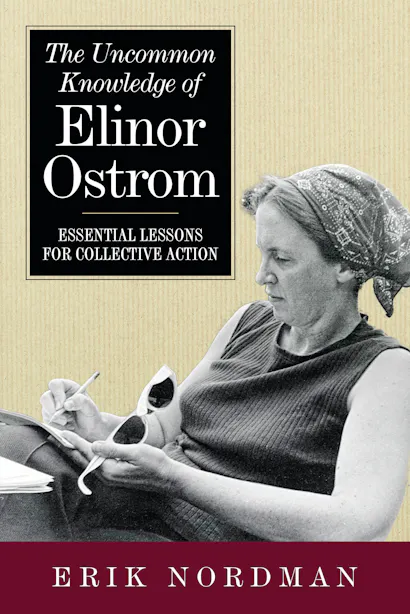
In the 1970s, the accepted environmental thinking was that overpopulation was destroying the earth. Prominent economists and environmentalists agreed that the only way to stem the tide was to impose restrictions on how we used resources, such as land, water, and fish, from either the free market or the government. This notion was upended by Elinor Ostrom, whose work to show that regular people could sustainably manage their community resources eventually won her the Nobel Prize. Ostrom鈥檚 revolutionary proposition fundamentally changed the way we think about environmental governance.
In The Uncommon Knowledge of Elinor Ostrom, author Erik Nordman brings to life Ostrom鈥檚 brilliant mind. Half a century ago, she was rejected from doctoral programs because she was a woman; in 2009, she became the first woman to win the Nobel Prize in Economics. Her research challenged the long-held dogma championed by Garrett Hardin in his famous 1968 essay, 鈥淭he Tragedy of the Commons,鈥� which argued that only market forces or government regulation can prevent the degradation of common pool resources. The concept of the 鈥淭ragedy of the Commons鈥� was built on scarcity and the assumption that individuals only act out of self-interest. Ostrom鈥檚 research proved that people can and do act in collective interest, coming from a place of shared abundance. Ostrom鈥檚 ideas about common resources have played out around the world, from Maine lobster fisheries, to ancient waterways in Spain, to taxicabs in Nairobi. In writing The Uncommon Knowledge of Elinor Ostrom, Nordman traveled extensively to interview community leaders and stakeholders who have spearheaded innovative resource-sharing systems, some new, some centuries old. Through expressing Ostrom鈥檚 ideas and research, he also reveals the remarkable story of her life.
Ostrom broke barriers at a time when women were regularly excluded from academia and her research challenged conventional thinking. Elinor Ostrom proved that regular people can come together to act sustainably鈥攊f we let them. This message of shared collective action is more relevant than ever for solving today鈥檚 most pressing environmental problems.
"An intriguing exploration of pioneering research in natural resource management and the economist who led it."鈥�Kirkus Reviews
"Erik Nordman’s book is a wonderful read. It explains a theory in simple words, which the author of this review understood (he believes) easily. It tells the story of how an idea came into being, and how it became a theory that can change the world. The book is a must-have for students and professors and scientists, and for citizens, too. It is an important text. It is beautiful."鈥�Food Security
"A fascinating overview of the groundbreaking ideas about the governance of the commons developed by Elinor Ostrom, interspersed with a subtle, but enlightening narrative of her life and career …. It would appeal to those seeking a basic introduction to this great scholar, her novel and enduring ideas and the continued relevance they have for the many pressing challenges of resource governance we face today."鈥�African Journal of Range and Forage Science
"Expertly researched and thoughtfully presented rendition of an intelligent, persevering, and insightful woman's contribution to economic studies and behavioral science. Highly recommended, especially for public and college library collections."鈥�Midwest Book Review
"Written for a general audience, Erik Nordman’s The Uncommon Knowledge of Elinor Ostrom is a conversational volume that is part biography, part undergraduate seminar supplement, and part panegyric. If the book can contribute to popularizing Elinor (Lin) Ostrom, this is no bad thing….Perhaps the most important takeaway from Nordman’s book is the ability—the drive—of creative thinkers like Ostrom to adapt theory to real-world problems and to engage with people in the ‘ordinary business of life.’"鈥�Journal of the History of Economic Thought
"Are humans destined to overrun our resources? Erik Nordman, channeling the work of the Nobel Prize-winner Elinor Ostrom, persuasively argues no. Nordman provides a framework for how we can overcome our encroaching environmental crises, and by drawing on real-world examples, he leaves the reader with an increasingly elusive attitude—optimism."鈥擪endra Pierre-Louis, climate reporter, Gimlet Media鈥檚 How to Save a Planet podcast
"Part biography and part theoretical exposition, this book is an accessible, richly nuanced, and yes, entertaining account of Lin Ostrom’s life and research programs."鈥擡della Schlager, professor, School of Government and Public Policy, University of Arizona
"A scholarly life like Elinor Ostrom’s is not easily distilled into a single volume, but Erik Nordman does so ably. Reviewing key lessons gleaned from her work around the world, he makes Lin’s journey leap off the page through interviews, field work, and engaging first-person encounters."鈥擲cott Shackelford, executive director, Ostrom Workshop Program on Cybersecurity and Internet Governance