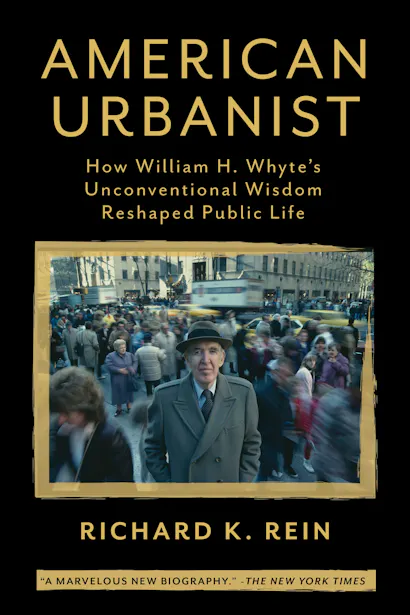
On an otherwise normal weekday in the 1980s, commuters on busy Route 1 in central New Jersey noticed an alarming sight: a man in a suit and tie dashing across four lanes of traffic, then scurrying through a narrow underpass as cars whizzed by within inches. The man was William 鈥淗olly鈥� Whyte, a pioneer of people-centered urban design. Decades before this perilous trek to a meeting in the suburbs, he had urged planners to look beyond their desks and drawings: 鈥淵ou have to get out and walk.鈥�
American Urbanist shares the life and wisdom of a man whose advocacy reshaped many of the places we know and love today鈥攆rom New York鈥檚 bustling Bryant Park to preserved forests and farmlands around the country. Holly鈥檚 experiences as a WWII intelligence officer and leader of the genre-defining reporters at Fortune Magazine in the 1950s shaped his razor-sharp assessments of how the world actually worked鈥攏ot how it was assumed to work. His 1956 bestseller, The Organization Man, catapulted the dangers of 鈥済roupthink鈥� and conformity into the national consciousness.
Over his five decades of research and writing, Holly鈥檚 wide-ranging work changed how people thought about careers and companies, cities and suburbs, urban planning, open space preservation, and more. He was part of the rising environmental movement, helped spur change at the planning office of New York City, and narrated two films about urban life, in addition to writing six books. No matter the topic, Holly advocated for the decisionmakers to be people, not just experts.
鈥淲e need the kind of curiosity that blows the lid off everything,鈥� Holly once said. His life offers encouragement to be thoughtful and bold in asking questions and in making space for differing viewpoints. This revealing biography offers a rare glimpse into the mind of an iconoclast whose healthy skepticism of the status quo can help guide our efforts to create the kinds of places we want to live in today.
"A marvelous new biography."鈥�The New York Times
"Journalist Rein debuts with an intriguing intellectual biography of journalist and urbanist William “Holly” Whyte (1917–1999)… [He] foregrounds Whyte’s own writing and analyses, which were remarkably prescient. The result is a welcome tribute to a visionary thinker."鈥�Publishers Weekly
"Rein’s comprehensive biography of this icon of the planning and preservation movement focuses on Whyte’s vision and legacy, offering an accessible and worthy source of inspiration for contemporary and future land-use challenges."鈥�Booklist
"In American Urbanist, journalist Richard Rein tells the story of William H. Whyte’s particular genius and why it exercises an enduring influence on American life"鈥�Wall Street Journal
"At a moment when the world’s downtowns and midtowns are slowly coming back to life, this thorough and thoughtful book is an inspiring companion."鈥�The New York Times
"Rein’s book is truly impressive...[He] rescues Whyte’s legacy by chronicling his visionary critiques of urban and suburban America. He was the Paul Revere of critics of American urbanism and suburbanism, yet his warnings were not heeded...Thanks to Richard Rein for bringing the forgotten legacy of William H. Whyte back to life."鈥�Beyond Chron
"This biography will hopefully expand Whyte's influence on cities, workplaces, and, most importantly, the people in both of them."鈥�A Daily Dose of Architecture 快色直播
"An excellent examination of [Whyte’s] work and advocacy."鈥�American Conservative
"Rein’s book … details all of Whyte’s seminal contributions to the present-day city experience. But it also, if less explicitly, reveals one of the most intriguing realities of Whyte’s long life and career: Starting out as a militant individualist, Whyte gradually dedicated himself to finding ways for city-dwellers to create enclaves of community in the places where they live."鈥�Governing
"After years of steps forward, we’ve gone backward on several fronts, most of all in cities. Rein’s book comes at an opportune time, because Whyte’s writing needs to be reread and celebrated all over again."鈥�Common Edge
"Wonderful portrait by Richard Rein, who reveals this man ahead of his time—US marine, traveling salesman, magazine editor, and pioneering urbanist – who recognized that he came from a life of privilege, and so realizing this made himself one of its most fiercest critics, especially against the shortcomings of post-war America status quo thinking....Representing an astonishing body of research on an important commentator and urban philosopher on the modern city, Rein’s book will be quite at home on the bookshelves of planners and architects alike."鈥�Spacing
"[American Urbanist] recaptures the life and remarkable career of this lay urban critic .… deftly weaves together the strands of Whyte’s personal and public life while immersing readers in post-World War II America."鈥�快色直播 Alumni Weekly
"American Urbanist will help elevate Whyte to be listed among the 20th century’s planning heroes, alongside Jane Jacobs."鈥�Journal of Urban Affairs
"This is a must read for anyone concerned with urbanism and interested in individuals who helped shape today's urban processes through a combination of natural ability, field experience, and practical methodology."鈥�Choice
"Whyte's life, urban planning ideas, and significant impact on building and growing the preservation movement in America should be part of any library collection strong in not just urban development and planning, but social change and community issues. The blend of biography and insights on urban development choices and trends is outstanding."鈥�Donovan's Literary Services
"It is this discipline of employing careful observation to influence design decisions that is Whyte’s legacy. In sharing Whyte’s life and learning, Rein invites us to appreciate the ‘tremendous trifles’ of our cities. But he urges us not to just take Whyte’s word for it, be skeptical, questioning and curious."鈥�Urban Design Journal
"William H. Whyte had a profound influence on how we think about cities, but his contribution was so wide-ranging that it can be hard to pin down. In his engaging new biography, Rein presents Whyte as an original thinker who was always restless to ‘blow the lid off’ accepted wisdom, trusting his eyes and his gut instead."鈥擜manda Kolson Hurley, "Bloomberg Businessweek" Journalist and author of "Radical Suburbs"
"Richard K. Rein’s American Urbanist is a must-read book—not just for those who care about building better cities but for anyone and everyone who cares about more-effective companies and creative organizations. Through Rein’s detailed telling, ‘Holly’ Whyte emerges as among the most important urbanists—and even more so, as one of the most important public intellectuals of our time, shaping the discourse about economy and society, cities and management, innovation and creativity, over the course of the late twentieth and twenty-first centuries."鈥擱ichard Florida, author of "Rise of the Creative Class"