
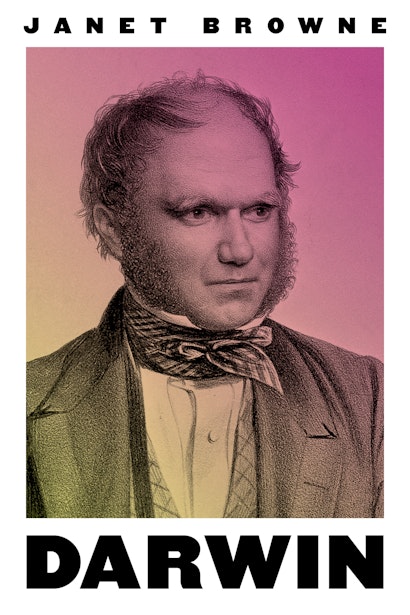
This idea for this book began with a simple question: Why do so many modern biologists have a picture of Charles Darwin hanging in their laboratories? More questions followed. How and why have the Gal谩pagos Islands become such a desirable destination for ecological tourism? Who thought of putting Darwin on the British ten-pound note? A city in Australia is named after him, he has a Twitter feed run by 鈥淒arwin鈥檚 Bulldog鈥�, his home in England is a museum, his books are valuable antiquarian objects. Several years ago, a racehorse named 鈥楴atural Selection鈥� ran twice (now retired). His birthday is called Darwin Day and is frequently used by local communities to support science and secularism. His name is vilified by creationist believers.
Clearly, Darwin is a present-day celebrity with wide reach. During his own lifetime, he became a international hero, celebrated and criticised in equal measure for the ideas published in On the Origin of Species by Means of Natural Selection (London, 1859). In that book he argued that animals and plants have an entirely natural origin, rather than being created by a divine power, and that every new species emerges from a previously existing species by means of what he called 鈥榥atural selection.鈥� Later, he explicitly included human beings in this scheme, even suggesting that humans emerged gradually from apes. He never once mentioned Adam and Eve. Although history tells us that he was not the only person to propose such radical ideas, these views were widely associated with his name and his book was discussed avidly by left and right, by literary folk, scientists, theologians, and general readers. The theory of evolution is one of the central narratives of modernity.
So, Darwin鈥檚 life story is one of the great scientific narratives of our time. Indeed, biographies of Darwin began to be written even before he died in 1882 and countless have been published during the following 140 years or so. My volume was composed at the start of the 21st century and reflects the newer histories of sciences that are emerging. One of my aims was to share the thrill of the archive, the unfolding of the papers, the reading of notebooks, coming to recognize Darwin鈥檚 handwriting and that of his family and friends, imagining him sitting across the room with a pleasant smile as he wrote yet another letter. Another was to treat his religious anxieties seriously. I hope that readers will catch something of Darwin鈥檚 actual presence in these pages.
In writing this biography, I also hoped to contribute to scholarly discussion in the larger literary and historical sphere about the significance of life writing. In particular, I anticipated that some of the science and the religious challenges that his new views generated might be hard for readers to grasp. Should a book be written with the science left out? That kind of biography鈥攁 life without the difficult scientific details鈥攈ardly does justice to the commitment and emotional investment of those men or women whose lives would only be partially represented. I tried to cover as much of Darwin鈥檚 science and religious trouble as was feasible and to explain what his contemporaries might be thinking and doing.
I did this by keeping his personal life to the forefront and providing a strong sense of the materiality of his domestic situation. Much of my interest lay in Darwin鈥檚 support system: I present him in these pages as a man who constructed and maintained overlapping circles of friends, neighbors, correspondents, and defenders鈥�a figure embedded in social networks that he deliberately put to use. The big idea was to explore how knowledge arises and circulates: how private ideas ultimately become public knowledge and the ways in which new and controversial proposals enter the community. More generally, I have emphasized the social conditions that helped Darwin circulate his theories, and the opposition that they generated. To large extent, this volume deals less with the details of the science and more with the cultural features that could create a scientist as remarkable as Charles Darwin.
Janet Browne, one of the world鈥檚 leading experts on Charles Darwin, is the Aramont Professor Emerita of the History of Science at Harvard University. Her books include the acclaimed two-volume biography, Charles Darwin: Voyaging and Charles Darwin: The Power of Place (both 快色直播), which won the National Book Critics Circle Award for Biography and the Pfizer Prize from the History of Science Society. She is also the editor of The Quotable Darwin (快色直播) and the author of Darwin鈥檚 Origin of Species: A Biography. She was on the editorial team of the Darwin Correspondence Project at the University of Cambridge, which published Darwin鈥檚 correspondence in thirty volumes.