
If you鈥檙e truly devoted to observing plant patterns in nature, you learn that hunger can wait.
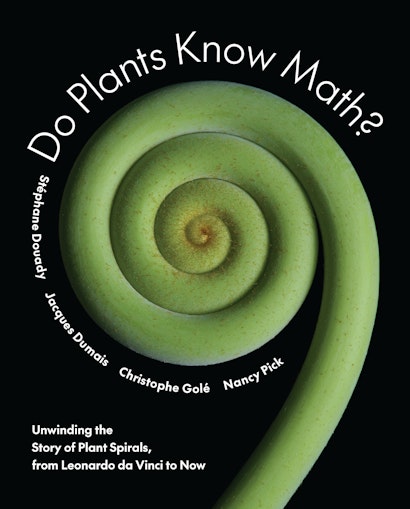
I鈥檝e received an invitation from one of my coauthors, physicist St茅phane Douady: he wants to spend a week working on our manuscript of Do Plants Know Math? at his family house in the south of France. Obviously I say yes. Together with our other French coauthor, Christophe Gol茅, we will draft chapters on the topic of phyllotaxis, the spirals found in a surprising number of plants, from sunflowers to strawberries. Many of these spirals fit the Fibonacci sequence, and for centuries scientists have tried to figure out how and why.
A few weeks later, I arrive at the medieval hamlet, one that St茅phane鈥檚 architect father helped to rebuild many years ago. The village has a long name suggesting stairways: P茅gairolles-de-l鈥橢scalette (PAY-gay-roll de less-ca-LET.) Stone houses built into the steep hillside lead up to a 12th-century castle鈥攁ll just as beautiful as it sounds.
It鈥檚 May, and the fields surrounding the village are dotted pink with orchids. But our first adventure begins with something more prosaic, when St茅phane runs out of the grapefruits he eats every morning for breakfast. On his bicycle, he makes a run to the nearest town, only to find that the grocery has not a single grapefruit left. 鈥淏ut Monsieur,鈥� the shopkeeper tells him, 鈥淚 have such lovely artichokes!鈥�
So St茅phane buys two artichokes鈥攅normous green globes with their long stems still attached, French style. For St茅phane, however, an artichoke is no mere appetizer: it鈥檚 an object of scientific observation.
As soon as he gets back to the stone house, St茅phane wants to make an artichoke video. But he鈥檚 forgotten to bring along the mechanism he uses to rotate plants, in order to study their phyllotaxis patterns on his laptop. 鈥淲ait,鈥� he says, 鈥渄o we have any clamps?鈥� He鈥檚 thinking he might be able to improvise.
Once clamps have been found, he needs a crank. His wife, Annemiek, who is also a research scientist, has an inspiration: the Parmesan cheese grater!
It鈥檚 perfect. St茅phane shaves down the stem of the artichoke until it fits snugly into the round hole of the grater. Clamping the grater to a small table, the artichoke is ready to roll. Chris turns the handle slowly, rotating the artichoke as smoothly as possible, while St茅phane films. It takes some stabilizing, and then some fiddling to center the axis, before he gets the one-minute video he wants.


Inside the house on his laptop, St茅phane isolates a segment of footage. Suddenly, the software aligns the leaves into neat rows of green teeth, converting the spherical vegetable into a flat map. Now it鈥檚 easy to count the number of basic spirals: 5 in one direction, 8 in the other. Both of them are numbers in the Fibonacci sequence.

But our work isn鈥檛 done yet. Not even close. While Chris and St茅phane analyze the subtle spiral transitions in the artichoke, I鈥檓 given a job: Count the leaves.
It dawns on me that I am not going to be eating this huge and delicious-looking artichoke for dinner. Instead, the vegetable has become a phyllotaxis research project in the flesh. I take the artichoke and sit down in a spare room with a red tile floor. Pulling the leaves off one by one, I arrange them into groups of five, resembling flowers. Not only are the leaves easy to count this way, but they form a kind of artichoke mandala.

The first leaves, pulled off the stem, are tiny and wrinkled. The next group, the outer leaves, are small and tough. As I work toward the center, gradually the leaves grow larger and more rounded, looking like little yellow-green bowls. Close to the choke, the leaves become thin and delicate鈥攚hite with a purple edge. Half an hour after I begin, I pull off the last leaf, nearly translucent, exposing the fine hairs of the choke. Arrayed on the floor in front of me are 44 鈥渇lowers鈥� of five leaves each, with three leaves left over. The grand total comes to 223. (Note that this is 10 short of the Fibonacci number 233. Did I miss a few? Or was this artichoke a bit below average?)
My artichoke count has been done in the name of science, but it has been more than that. Rarely have I spent a more pleasant and meditative half-hour. It is the Zen of artichokes!
But I realize that only now has St茅phane actually gotten to the good part. Once the choke of my artichoke is exposed, he takes out his knife and starts gently scraping. Beneath the choke, a pattern of tiny hexagons appears. Here are the spirals he鈥檚 most interested in. When Chris begins counting, he finds roughly 50 clockwise and 80 counter-clockwise. 鈥淚 don鈥檛 want to jump to conclusions,鈥� he says, 鈥渂ut I鈥檓 quite certain that when I count more carefully, there will be 55 and 89.鈥� Fibonacci numbers, of course.

Chris and St茅phane are particularly interested in the transitions in plants鈥攖he places where plant structures jump from a few to many, or from stem to leaf. In an artichoke, for instance, there鈥檚 a transition between where the leaves attach to the bottom and where the choke begins. Plants can be predictable in some places and surprising in others. 鈥淚 believe we could see transitions from (2, 3) phyllotaxis to (3, 5) in the pictures,鈥� Chris noted. 鈥淏ut it鈥檚 the transition after it, to (55, 89), that remains mysterious.鈥�
The truth is, all this artichoke observation has made me hungry. The next day, taking pity on us, St茅phane buys artichokes we鈥檙e actually allowed to eat. But even then, we keep the leaves of each artichoke in a separate bowl, so we can count them afterwards. A phyllotaxis scientist鈥檚 work is never done.
Nancy Pick is a science writer whose books include The Rarest of the Rare, telling the stories behind the natural history collections at Harvard University.