
Just last year, the Judiciary Committee of the U.S. House of Representatives convened a hearing on 鈥淓urope鈥檚 Threat to American Speech and Innovation.鈥� Central to the discussions was the suggestion that new European regulations on social media platforms pose an unacceptable affront to freedom of speech, including that of Americans.
The hearing was predictably marked with partisan jousting. Democrats wondered why the Committee was focused on foreign laws over which it has no jurisdiction, rather than concerns about free speech. On the Republican side, hyperbole flowed. One witness called by Republicans suggested that by adopting its new Online Safety Act, Britain had 鈥渂ecome North Korea鈥�.
I am an American who has lived in the United Kingdom for nearly two decades. My firm sense is that Americans and Europeans fundamentally misunderstand one another on free speech. Europeans I talk to are recurrently mystified by the notion that freedom of speech is 鈥渁bsolute鈥� in the United States. 鈥淚 can鈥檛 believe that people are allowed to say anything!鈥� a British graduate student once told me. Meanwhile, Americans I talk to assume Europeans essentially live under censorial tyranny. I once spoke to a senior American government lawyer who sincerely noted: 鈥淭here鈥檚 no free speech in England, is there?鈥�
Each side is in the grip of a caricature. The truth is much more nuanced. Europeans need to understand that in the United States, free speech is not absolute. Numerous categories of communications are constitutionally unprotected鈥攊ncitement to imminent violence, true threats, defamation, harassment, fraud, crime-facilitating speech, and plenty else. Moreover, there is internal debate on how to define these unprotected categories; U.S. courts have revisited and redrawn them over time.
As for my fellow Americans: freedom of speech is a legally enshrined right across Europe. Article 10 of the European Convention on Human Rights protects freedom of speech among all its signatories; that right is further codified into UK law under the Human Rights Act. Nor are these empty words; there is a vast body of adjudicating free speech disputes, often ruling on the side of speakers who have censored. It is true that European courts strike the balance differently from American courts. But it is a mistake to suggest that free speech isn鈥檛 one of the core values hanging in that balance.
Moreover, new European regulations on social media platforms are largely dedicated to protecting freedom of expression, not suppressing it (though you wouldn鈥檛 know that from House hearing). A key aim of the UK Online Safety Act (OSA) and the EU Digital Services Act (DSA) is to compel transparency, fairness, and greater accuracy in how platforms enforce their rules鈥攕o that allowed content really is left up, and forbidden content really is removed.
What鈥檚 more, the DSA empowers users whose speech has been taken down to appeal, and even to take platforms to dispute resolution. And OSA puts special requirements in place to guard against takedowns of journalistic and political content, as well as requiring platforms to give users greater control of what content they see. North Korea? Not so much.
There is, to be sure, another side to these regulations. The OSA compels platforms to reduce the presence of various forms of illegal content鈥攆rom child sex abuse material to weapons sales to speech recruiting terrorists or facilitating human trafficking. So far, so uncontroversial, even for Americans. It also forces sites with porn to keep kids out by checking users鈥� ages鈥攕omething that Texas also does, with the U.S. Supreme Court鈥檚.
It鈥檚 true the UK law prohibits more than American law. For example, the UK鈥檚 new 鈥�鈥� has been flexed to prosecute people for offensive online posts鈥攎ost infamously, the Irish comedian . The UK also has a new false communications offence targeting forms of disinformation. And it has longstanding 鈥渉ate speech鈥� offences targeting the 鈥渟tirring up鈥� of racial or religious hatred, as well as laws inciting terrorism (with no requirement of imminent danger like in the U.S.). It is doubtful that any of these laws would survive U.S. constitutional scrutiny.
There is a debate to be had as to whether Europe has bent too far in its effort to protect vulnerable citizens from verbal attack, or whether it is incentivizing platforms to take down too much speech for fear of legal sanction鈥攁 debate in which Europeans are actively engaged. Some European laws really do go. (German hate speech laws, which can restrict mere , come to mind.) Even so, this is not North Korean- or Russian-style totalitarianism, where political dissidents disappear and wind up dead. Some European laws misfire; it hardly follows that their entire approach to speech must be rejected.
Americans and Europeans would do better to stop talking past each other, and instead learn from each other. European law would benefit from embracing American doctrines like viewpoint neutrality, according to which there is a strong legal presumption against suppressing disfavoured viewpoints. But Americans should embrace the European view that free speech is not our only right; that there is more than one plausible way to decide what should and should not be protected; and that compelling social media platforms to take responsibility for moderating manifestly illegal content may not in fact represent a descent into autocracy.
The debate on free speech and its boundaries will always persist. But it is not, as commonly suggested, a debate between the defenders of liberal democracy and its enemies. It is a debate internal to liberal democracy itself.
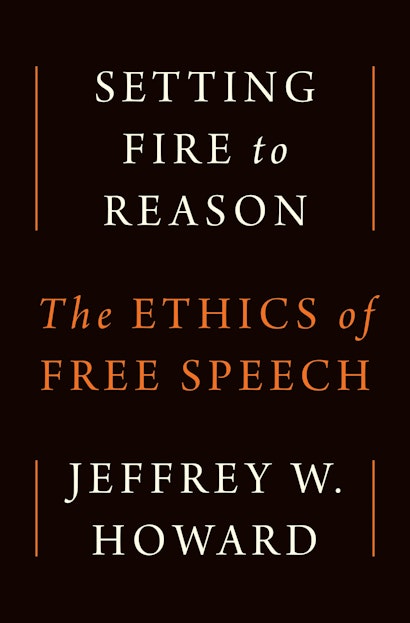
Jeffrey Howard is professor of political philosophy and public policy at University College London, director of the Digital Speech Lab, and coeditor of the journal Political Philosophy. His book Setting Fire to Reason: The Ethics of Free Speech is forthcoming with 快色直播.