
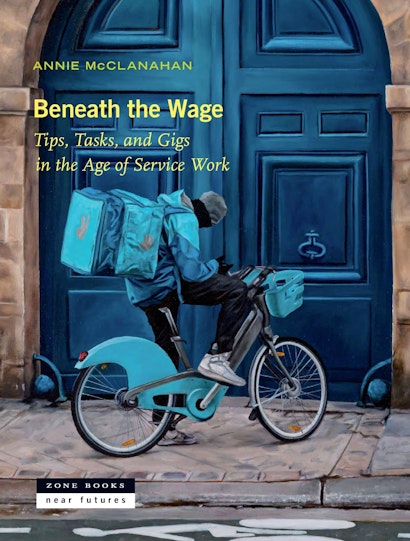
Service work has often been treated as a footnote to modern capitalism, Beneath the Wage reveals it as crucial to understanding how exploitation functions today. Uncovering a history that runs from eighteenth-century servants to present-day gig workers, Annie McClanahan retheorizes capitalism from the perspective of the service economy, challenging conventional assumptions about how work is waged, regulated, managed, and automated.
鈥淪ervice work鈥� seems like a big category鈥攈ow would you define it?
Annie McClanahan: Given that 80% of the US workforce is in the service sector, it is indeed a big and baggy term. Service work includes both the highest-paid professionalized work (financial advisors, lawyers) and some of the lowest-waged jobs (fast food workers, Uber drivers). My book focuses on the low-waged portion of the sector, which includes almost all of the 20 most common occupations in the US. Looking at that part of the workforce, we find jobs that are relatively hard to fully automate, that are difficult or impossible to outsource, and that involve unpredictable working hours or involuntary part-time work. I鈥檓 especially interested in low-waged service work that remains partially or entirely unregulated, either because it uses non-hourly methods of wage payment like tips and piece-rate or because workers are classified as 鈥渋ndependent contractors鈥� rather than as 鈥渆mployees.鈥�
From your title, as well as in the answer you just gave, it sounds like the idea of the wage is important鈥攃an you say more about that?
AM: The idea for this book really began the moment I realized that most histories and theories of wages presume the regulated, hourly wage as a norm. But as someone who has worked a lot of jobs where I mostly earned tips, I knew that wasn鈥檛 the full picture. The hourly wage is associated primarily with manufacturing work, where labor time is very rationalized and output can be determined by the machine itself. Service work, by contrast, tends to be much less predictable, much less technologically mediated, and with less quantifiable 鈥渙utput.鈥� Non-hourly methods of wage payment like tips鈥攁 form of compensation that dates back to eighteenth-century domestic service鈥攚ere thus perceived as necessary to ensure that service workers would 鈥渟elf-manage鈥� effectively. In the US, tipworkers were excluded from the minimum-wage provisions of the Fair Labor Standards Act and instead are still paid a 鈥渟ubminimum wage鈥� supplemented by customer tips. Those exclusions were possible in part because service work had been racialized and feminized: from the Black Pullman porters who were central to early-twentieth-century debates about tipping to the migrant workers who increasingly perform app-based gigwork today, female workers, non-white workers, and non-citizen workers have always been more likely perform un- or under-regulated in-person service work.
You mention that service work is less likely to be 鈥渢echnologically mediated鈥� than traditional manufacturing work, but technologies from automated check-out to gigwork platforms are more common than ever. Can you explain the place of technology in the service sector?
AM: On the one hand, service work has historically been hard or even impossible to fully automate. Despite the self-checkout machine, for example, most retail labor tasks still have to be performed by humans: we can鈥檛 even create a robot that can effectively fold and stack t-shirts! But technology is nonetheless increasingly central to the service sector, both as a form of intensification (extracting more output by forcing workers to worker harder, faster, or longer) and as a method of deskilling (breaking up jobs into smaller parts so that they can be performed by less-skilled or lower-waged workers). Technology is also being used for surveillance and automated management, especially in the gigwork sector: delivery and transportation workers are classified as 鈥渋ndependent contractors鈥� because they aren鈥檛 directly managed, but in practice the app itself can do most of what a human manager would do. Moreover, technological innovations over the last two decades or so鈥攆rom the expansion of the internet to the creation of LLMs and AI鈥攁re enabling what some economists are now referring to as 鈥渟o-so automation鈥� even in portions of the low-waged service sector where automation was once deemed impossible, like customer service or call center work.
A large portion of your book is about culture, from reality TV shows to conceptual poems to literary novels. What does culture have to do with service work?
AM: One of the things that I find fascinating鈥攁nd sometimes vexing鈥攁bout service work is that it鈥檚 remarkably intimate and implicated. Goods-producing work tends to take place out of view and at a distance from us, but most of us interact every single day with at least one, and often many, service workers. Low-waged service workers themselves rely on the labor of low-waged service workers, as when the bartender uses a transportation app to get to work or the barista gets a drink at the bar on her way home from a shift. Culture offers us a vital resource for understanding the way service work is embedded in everyday life. It also often becomes the site of urgent political critique. In the second chapter of the book, for example, I read poems created by 鈥渕icroworkers鈥� in the underdeveloped world hired to write verse for a few pennies per poem. I argue that they offer a profound (and often very angry) account of superexploitation in this sector. Near the end of the book, I look at 鈥渨orkers inquiries鈥� written by gigworkers about their laboring conditions, and I read them not just as empirical documents but also as literary texts in their own right.
You mention in the book that service workers have historically been excluded from labor history and from the mainstream labor movement. In recent years, though, it seems like we鈥檝e seen a lot of organizing in the service sector, from gigworkers and Starbucks workers to teachers and nurses. What conclusions can we draw from these movements?
AM: Contemporary service-颅worker organizing has powerful historical roots in groups like the mid-century Domestic Workers Union, but it also emerges out of some distinctively contemporary conditions: declining labor productivity and stagnant economic growth on the one hand, and skyrocketing subsistence costs on the other. As a result, the very service workers who make social reproduction possible are often unable to ensure their own most basic survival: domestic workers are unable to afford housing; child-颅care workers are unable to afford child care; delivery gigworkers are unable to afford groceries. In response, service workers today are engaging in some powerful political reframing. From the rise of 鈥渢enants unions鈥� to the fast-颅food workers 鈥淔ight for Fifteen鈥� campaign, more and more service-worker unions are linking wage demands not to the idea of compensation equivalent to productivity (what manufacturing workers used to call the 鈥渇ull fruits of one鈥檚 labor鈥�) but instead to the need for wages adequate to rising subsistence costs. They鈥檙e also emphasizing so-called 鈥渘on-economic鈥� demands, calling for access to good housing, child care, and education; for the rights of workers with disabilities or chronic illnesses; for the rights of queer and trans workers; for police abolition or justice for noncitizen workers or divestment from the technologies of genocide.
The coda of the book moves a little bit away from the low-waged portion of the service sector to your own workplace, namely higher education. Can you say something about why you end the book by talking about university teaching?
AM: Because a lot of the book centers on the tradition of the workers鈥� inquiry鈥攁 genre in which workers themselves describe their labor process, working conditions, and strategic opportunities鈥擨 wanted to attempt a worker鈥檚 inquiry of my own labor too. The coda of the book thus thinks about the threat of automation in the service sector by looking at the rise of ed-tech in the post-COVID era. From online higher education to AI, technology is increasingly being used to intensify and deskill teaching labor. Earlier I mentioned the idea of 鈥渟o-so automation鈥濃�� automation that increases productivity a little bit but often at a significantly lower level of quality鈥攁nd I think that really sums up what鈥檚 happening in higher education today. But I also think these threats come with strageic opportunities, too: if faculty can begin seeing our labor in the context of a long history of workers being automated out of work, then I think we can begin to organize ourselves in solidarity with other university service workers and with teachers in other parts of the education sector.
Annie McClanahan is an Associate Professor of English at University of California, Irvine. She is the author of Dead Pledges: Debt, Crisis, and Twenty-First-Century Culture.