
The subject line of the email was thrilling: 鈥淐ongratulations: you are now part of the history of the Milano Cortina 2026 Olympic Games!鈥� My application to carry the Olympic torch in my adopted home of Sicily had been accepted. Along with 10,000 others from every walk of life鈥攆rom famous celebrities to those who battle crippling disease鈥擨 would be part of the team that transports the flame from its origin in Ancient Olympia to the Games. I knew it would be a wonderful experience, but the strongest impression it left on me is not one that I expected.
That impression was left by the smile on a woman鈥檚 face鈥攁 unremarkable Italian woman wearing a fuzzy blue sweater whom I do not and never will know. At the end of my run, after I passed on the flame, she appeared out of nowhere and stood before me, mesmerized by the torch. It was one of those freeze-frame moments when everything else disappears in the midst of a clamoring crowd. We didn鈥檛 exchange a word or even make eye-contact but I felt some kind of bond with her, as if the torch was a magnet pulling us together. Instantly, others gathered around trying to take selfies鈥攕o many that the attendant had to reach for my hand to pull me and the torch out of the crowd and back into the torchbearers鈥� bus. The door folded closed and the noise was blocked out, but as we inched along behind the relay, I couldn鈥檛 stop thinking about that woman鈥檚 face and wondering what the Olympic flame meant to someone like her.
If anyone is able to explain what the Olympic flame represents, it should be me. Inspired by Olympic ideals as a young athlete, I have since have published books and articles on the philosophy of sport and the Olympic Games. I give lectures at the International Olympic Academy to students from around the world explaining how Olympism is a philosophy of life that emerges from the ideals of ancient Greece. In my application to participate, I described the torch relay as 鈥渁n ideal thread that unites different people through shared principles such as excellence, respect, friendship[i] Somehow, however, all those words seemed inadequate to describe the light I saw in that woman鈥檚 eyes. For her, and ultimately for all of us, the allure of the Olympic flame is something that goes beyond sport, or even beyond words.
The Olympic torch is ignited in Greece among the ruins of Ancient Olympia using a parabolic mirror to concentrate the sun鈥檚 rays. The ancient Olympic Games were a form of religious worship and feelings of reverence still abound in the lighting ceremony, which explicitly links the modern festival with its spiritual and historical origin. The Olympic torch relay is not historical, however. Cities like Athens had torch races for ephebes, but they were not part of the Panhellenic Games. Olympia had a sacred flame, and Philostratus tells us that the first athletic contests were run there to decide who would have the honor of lighting a sacrificial flame,[ii] but the heralds who travelled through Greece to announce the Games were not passing a torch. The modern ritual of carrying a flame from Olympia to the site of the Games is a symbolic action that transmits an idea鈥攐ne that may have been born in ancient Greece, but survives in the minds and souls of living people all over the world.
The Olympic idea cannot be captured by a formula or definition in any specific language. It is not the property of ancient philosophers or modern sports organizations. Still, the idea that lit up that woman鈥檚 face is the same idea that Pierre de Coubertin sought to revive in the 19th century, and the same idea that ancient authors like Pindar and Lucian tried to communicate. It is the basis not only for the Olympic Games, but for most forms of sport. At the same time, sports are not essential to it; they are a more-or-less effective expression of a spirit that is widely shared across historical and geographical boundaries. What is essential to the Olympic spirit is humanity, in particular our orientation toward improvement, the collective will to do better.
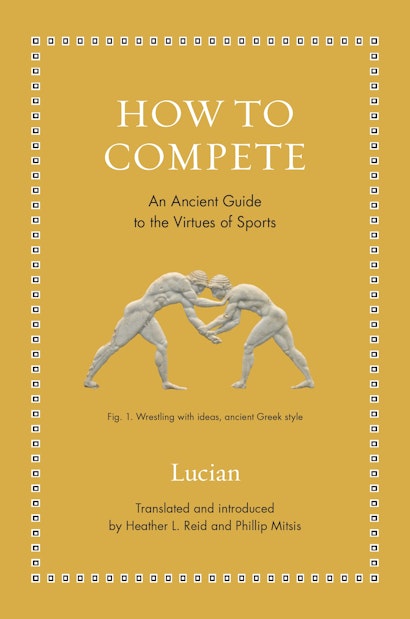
That the collective will to do better should be celebrated by athletic competition is a paradox appreciated since ancient times. Lucian鈥檚 Anacharsis begins with a famously barbarian and famously frank Scythian asking the legendary Athenian law-giver Solon why they allow their young men to fight like animals in the gymnasium. Anacharsis has come to Athens to learn about the best form of government and Solon argues that athletics are how 鈥渋ts citizens become best鈥� 搂14. Beyond the leafy crowns awarded to the winners, he claims, sport rewards the whole community with a 鈥渃rown of happiness (eudaimonia)鈥� that weaves together all of 鈥渢he most beautiful things one might pray to receive from the gods鈥� 搂15. Solon鈥檚 defense of the Greeks鈥� obsession with sports repeatedly fails to convince, but the Socratic-style dialogue unravels his confidence philosophically: not through denunciation, but through clarification. His justifications become increasingly plausible, and eventually he credits sports with inspiring a love for excellence, exertion, and glory among the people. Without that, Solon asks, 鈥渨hat good would we ever obtain, or who would desire to achieve anything brilliant (lampron)?鈥� 搂36.[iii] That brilliance reflects the Olympic flame and the idea it represents.
Mythologically speaking, the first Olympic torchbearer was Prometheus, who stole fire from the gods and carried it in a fennel stalk to humanity鈥攁 gift that elevated us above the other animals. The drive to become more like gods was represented by heroes like Atalanta and Heracles, whose excellence (补谤别迟脓) was emulated in athletic contests.[iv] Unavoidably the process of becoming more like a god is fraught with fatigue and failure, but when we experience a moment of athletic brilliance鈥攁s a competitor, a coach, an official, or a spectator鈥攚e all can feel the presence of something special. For the sake of that feeling, we embrace sport, along with its fatigue and failure, and despite its occasional scandals and injustices. Sport dramatizes the human will to do better together, and the Olympic spirit encapsulates this.
I will never know if the woman whose face I can鈥檛 forget is a lover of sport or philosophy like me. We come from different backgrounds and live different lives. What she taught me as she stared at that torch is that it doesn鈥檛 even matter. The Olympic spirit is really just the human spirit, and we can all share that without having anything else in common. There is a special kind of joy caused by the presence of that spirit, and by carrying the Olympic flame, I had the special privilege to ignite that joy among young and old alike. I remember the children from schools waving homemade flags, the grandfathers leaning on their canes, the military officers in decorated uniforms, the teenagers riding their bikes on the route. Everyone just seemed happy to be able to feel happy about something. The Olympic flame reminds us not only that the Games are about to begin, but that we are connected through our shared past and common humanity.
Heather L. Reid is Scholar in Residence at the Exedra Mediterranean Center in Siracusa, Sicily, and Professor of Philosophy Emerita at Morningside University in Sioux City, Iowa. She is a 2015 Fellow of the American Academy in Rome, 2018-2020 Fellow of Harvard鈥檚 Center for Hellenic Studies in Washington DC, and 2019 Fulbright Scholar at the Universit脿 degli Studi di Napoli Federico II. Her books include Ancient Olympic Philosophy (2024), Olympic Philosophy (2020), Introduction to the Philosophy of Sport (2012, 2nd. ed. 2023), Athletics and Philosophy in the Ancient World: Contests of Virtue (2011), and The Philosophical Athlete (2002, 2nd ed. 2019).
[i]
[ii] Philostratus, Gymnasticus, 5.
[iii] Lucian, Anacharsis trans Reid & Mitsis
[iv] Pindar, Olympian 10; Diodorus Siculus 4.14.2