
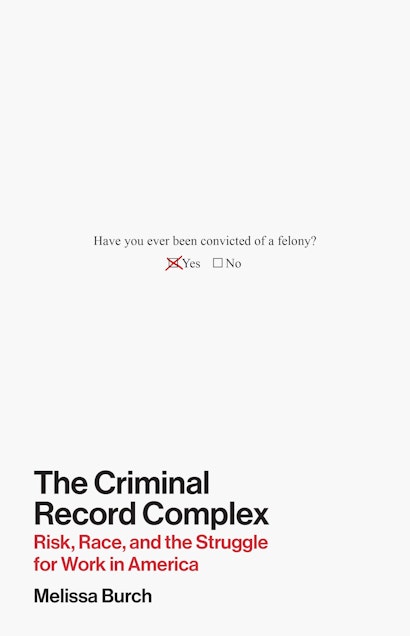
Most employers in the United States routinely conduct criminal background checks on job applicants, weeding out those with criminal convictions鈥攁nd thus denying opportunities to those who need them most. In The Criminal Record Complex, Melissa Burch sheds light on one of the most significant forces of social and economic marginalization of our time鈥攄iscrimination on the basis of criminal records. Chronicling the daily interactions of hiring managers, workforce development professionals, and job-seekers with felony convictions in Southern California, Burch shows that this discrimination is not simply a matter of employer bias.
When you began the research for this book, you were already working on issues of prison reentry from direct service and policy angles. What more did you want to know?
Melissa Burch: In the early 2000s, there was a consensus forming among elected officials that something needed to be done to address the prison reentry crisis, but at the same time, a reluctance to decriminalize, lower barriers, or do anything that could be read as 鈥渟oft鈥� on crime. In this mixed climate, organizers were winning reforms in some places, and in others鈥攊ncluding Los Angeles, where I lived and worked at the time鈥攕truggling to gain traction. I wanted to better understand the reasons behind the reluctance. Risk was often touted as the reason for excluding people with records, but it felt deeper, as if risk were a fa莽ade for something else.
快色直播 about law and punishment are more often written by historians, geographers, political scientists, criminologists and legal scholars than anthropologists. What did your ethnographic focus reveal that diverges from or complements these approaches?
MB: Observing and participating in people鈥檚 daily routines shows us how things work in practice鈥攈ow big ideas, laws and policies are understood, enacted, and felt on the ground. We also tend to think of people in categories and assume we know what motivates them as a group. Spending time with people inspires appreciation of their diversity and the complexities of real life scenarios. For example, we tend to talk about 鈥渆mployers鈥� and 鈥減eople with conviction records.鈥� But just as people from many different backgrounds may have convictions, people from a whole range of backgrounds become employers. When these uniquely situated individuals encounter one another in job market contexts, differences arise in how they interpret laws, implement policies, and respond to broader discourses and trends. These variations matter to the analysis and can only be seen at the level of the quotidian.
Your book identifies numerous factors that have contributed to the rise of employment background screening. But why call it a complex? What do you hope to convey by using this concept?
MB: The notion of an industrial complex is useful for understanding the way various interests in private and public sectors overlap and work together to produce a phenomenon. Insurance is a good example. There鈥檚 a relationship between decisions made in courts about who is liable for what and they types of people and events that are insurable and at what premiums. The concept of a complex is also helpful for identifying indirect and 鈥渄isinterested鈥� interests鈥攅ntities that benefit from criminalizing systems without necessarily considering or 鈥渃aring鈥� about those systems. For example, there鈥檚 a scene in the book鈥檚 introduction where I stop at a bakery to inquire about the 鈥渉elp wanted鈥� sign out front. The person behind the counter mentions that while the business has never before found it necessary to conduct background checks, they will soon begin doing so because their new payroll company includes background checks as 鈥減art of the payroll package.鈥� Payroll companies have no specific vested interest in background screening; they have an interest in providing the kinds of services that employers want, or are perceived to want. These kinds of indirect interests are undertheorized鈥攊n part because they are hard to get at empirically (i.e. how did criminal history become a factor in insurance underwriting; how did background screening become part of payroll packages?) 鈥� but as the book argues, enormously important to our understanding. An intricate combination of factors and forces led to the current situation in which many, if not most, employers will not hire someone with a felony conviction.
What most surprised you in doing the research?
MB: A few months in, I began to meet small and mid-sized business owners who didn鈥檛 conduct background checks and weren鈥檛 convinced that they were a useful way to sort out who would and wouldn鈥檛 be a good worker. This blew my mind. These were not people who had taken up the Fair Chance cause, they were just regular employers, operating many different kinds of businesses. As I learned more about their hiring practices, I saw that they had their own ways of assessing candidates that had nothing to do with risk-based assessment tools like credit checks and criminal background checks. Despite the pervasiveness of employment background screening, some employers believed more in their own methods.
Another thing that surprised me was the discovery that for generations, people have been calling for an end to the lifelong havoc wrought by the use of criminal records. In reading about the history of collateral consequences of conviction, I learned that a law reform movement had emerged in the mid-1950s to challenge government-authorized penalties disqualifying people convicted of crimes from privileges and benefits鈥� and that this movement had actually called for 鈥渢he abolition of laws depriving convicted individuals of civil and political rights.鈥� In fact, the 1962 Model Penal Code called for the 鈥渞emoval of disqualifications and disabilities,鈥� encouraging courts to adopt laws that would erase people鈥檚 criminal records at the end of their sentences and states to automatically restore voting and other civil rights on completion of a prison sentence.
Your book addresses multiple audiences鈥攂usiness owners, hiring managers, HR professionals, recruiters and job developers, as well as policy makers and people with criminal convictions who are looking for work. What one thing do you hope every reader takes away?
MB: We didn鈥檛 always use criminal records as a screening mechanism. The way they are currently being used is causing unnecessary harm, and there are other effective ways to vet people and build safe workplaces. That said, my research also led me to see that policy alone is not effective; people have to grapple with and internalize new ways of doing things, and the changes have to work for their organizations. I hope the book generates discussion and experimentation with what it could look like to stop conducting background checks for every position and to critically question their rationales for doing so.
Melissa Burch is Assistant Professor of Anthropology at the University of Michigan and Director of the Afterlives of Conviction Project.