
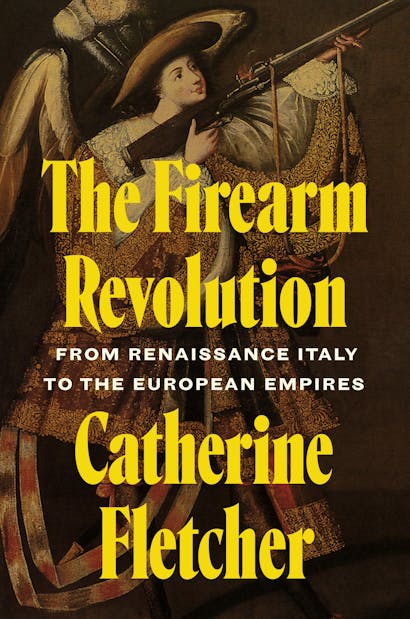
In Renaissance Italy, the gun was not only a tool of war but also a desirable object, a luxury item carried at court. As the gun proliferated in society, it became both a means of self-defence and a threat to civic order. In The Firearm Revolution, historian Catherine Fletcher explores the emergence of firearms in Renaissance Italy and beyond, describing the social transformations that accompanied the evolution of the handgun from innovative military technology to widely used personal accessory.
What prompted you to write a book about firearms?
Catherine Fletcher: I first wrote about guns in an essay for my Masters degree at the start of this millennium. That was not long after the United Kingdom had largely banned handguns, following the tragic massacre at Dunblane Primary School, where on the morning of 13 March 1996 sixteen children and their teacher were shot dead. I had attended high school in Stirling, about five miles away, so the gun question came rather close to home.
I came back to the topic over a decade later, when I was researching the life of Alessandro de鈥� Medici, ruler of Florence in the 1530s. I had learned from Alessandro鈥檚 household accounts that he was a gun owner, and I went looking for some research to put this into context. Yet there was still surprisingly little written about the social and cultural history of firearms, so I decided I had better write it myself.
Were you surprised by how familiar some of the early material seemed?
CF: I did not expect to find concealed carry being an issue in the 1520s, but governments in Europe were clearly worried about people carrying hidden guns. This anxiety emerged most clearly around a type of gun called a wheellock, which unlike the earlier matchlock could be fired without a lighted match. Smaller wheellocks could be concealed beneath a cloak and were banned across large parts of Europe in the first half of the sixteenth century. The debates around whether to allow wide access to guns are also very familiar. In documents from the sixteenth century, I have on the one hand a government official arguing that wide gun ownership helps cut homicide numbers, and on the other a writer making the case that in practice no-one under attack actually has time to pull a gun in self-defence.
What can we learn from the history of guns about dealing with risky technologies more generally?
CF: The law on guns was always lagging behind technological developments, and it was rarely effective. This was particularly true in post-conflict environments where people feared renewed war, banditry or both. There were also significant tensions within the state about how to deal with guns. Governments would be trying to improve shooting skills among the militia and at the same time trying to make sure guns weren鈥檛 too great a threat in everyday life. These tensions between the dual roles of the state in maintaining both external defence and internal social order are relevant to debates about all sorts of technologies. While government officials are trying to work out which policy aim to prioritise, the tech is getting out there and once it escapes it becomes very hard to persuade users to give it up. We鈥檙e seeing this lag right now in relation to regulation of AI.
How has the present-day context for this research changed since you started writing?
CF: When I began my research, I suspected that its most topical concern would be gun control, and that鈥檚 still very much on the agenda, especially in the United States. On the other hand, questions around the importance of a domestic arms industry have become much more prominent here in Europe over the past few years. We got used to a peace dividend after the fall of the Berlin Wall, but maybe that was the historical exception not the rule. If you look back in time at the industry, from the earliest years of European small arms production, states were trying to get the balance right between domestic arms production, civilian sales and exports. Sixteenth-century Venice had an export licence system for arms and armour, but there was also both explicit smuggling and a grey market via merchants who weren鈥檛 required to obtain licences in the same way as foreign powers. The issues aren鈥檛 so different today.
Do you have a favourite historical source on firearms?
CF: It鈥檚 very hard to choose, but some of the best descriptions of early European firearms in fact come from outside Europe. The narratives of guns in the Florentine Codex, which draw on the testimony of Indigenous veterans who fought the Spanish in 1520s Mexico, are particularly evocative. Among the material and visual culture, the most striking object is a Benin bronze, looted in 1897 and currently in the British Museum, produced in the late sixteenth or early seventeenth century and perhaps the earliest fully three-dimensional sculpture of a European gunman.
What鈥檚 the one thing you want readers to take away from this book?
CF: I hope it will make people think critically about an object that鈥檚 very common in the world today. When we look at early modern firearms they鈥檙e both familiar and strange. I hope that historical distance allows readers to stand back a little from what can be very polarized arguments today and to think afresh about how we got to where we are. That can be relevant both in the United States, with its ongoing litigation over gun control laws, and around the world in post-conflict environments where there are continuing arguments over whether or not communities ought to disarm.
Catherine Fletcher is professor of history at Manchester Metropolitan University. She is the author of several books on early modern Italy, including The Roads to Rome, The Beauty and the Terror: An Alternative History of the Italian Renaissance and The Black Prince of Florence: The Life of Alessandro de鈥� Medici.