
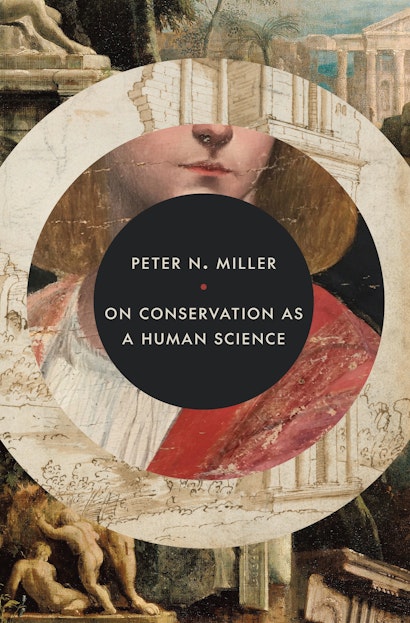
Conservation can be understood as a form of knowing; conservators extract meaning about the past from what remains, while noting what is missing and sometimes repairing it. In this erudite and virtuosic book, the historian Peter N. Miller imagines the outlines of a new, expansive notion of conservation that links the world around us鈥攏atural and man-made鈥攖o the world inside us鈥攐ur genome, our memories.
You鈥檙e a historian of scholarship, of ideas, what attracted you to conservation, which seems so practical and hands-on?
Peter N. Miller: I came to this project having worked for twenty-five years on the history of antiquarianism as a way of studying the past through all its remains, material as well as verbal. And because it unfolded before there was academic history鈥攚e鈥檙e talking the sixteenth and seventeenth centuries鈥攕tudying it meant unburdening myself of the subsequently established expectations for what history was, where it happened, and how it worked. I remembered that Peiresc, who was the engine driving that earlier project, once described how he conserved ancient Roman coins and an Egyptian mummy that had been thrown into the sea by sailors trying to avoid capture by corsairs.
But I confess that it 飞补蝉苍鈥檛 only the dimly perceived sense of a continuum between early modern study of the past and early modern objects conservation, between material culture studies and conservation, that grabbed me; that gave me the confidence that there was a story here that I could tell, but the very richness of the philosophical issues raised by conservation practice today. This was something that grew as I got pulled deeper into the project. And I should say that 鈥渢he project鈥� was an institutional, grant-driven project that I originally took on pro forma in my capacity as dean, not as a professor following my nose. That came after.
Conservation to most people is something very practical. You bring out its intellectual dimension. Does this have anything to do with your work as an academic administrator who has remained an active scholar?
PNM: Generally, of course, administration is considered antithetical, if not deadly, to scholarship. But I鈥檝e found it completely the opposite: administration is an opportunity to use institutional means to explore intellectual questions at the leading edge, instead of what normally happens, which is, that ideas percolate up over a very long time and eventually, in a very blunted and unsubtle way, change curricula and intuitional practice. But it doesn鈥檛 have to work this way. Institutions can be agents of experimentation, not just clumsy laggards to the thinking game. Running the decade-long institutional project 鈥淐ultures of Conservation鈥� was a fantastic education鈥攁 crash course, really鈥攊n conservation and enabled both the institution and me to identify and then mine a really rich lode of ideas. So, yes, maybe I was especially primed by my career to see the intellectual in the practical. The very title of the book is borrowed from the name of a fellowship that the project sponsored, first with the Rijksmuseum in Amsterdam, and then with the Metropolitan Museum of Art in New York. In fact, this same generative interchange between administration and scholarship also drove a parallel project of mine on the history and meaning of research that I undertook when I became Dean of the BGC and was thinking about how to re-make it as a graduate research institute. And that eventually became another book that you are publishing (Research: A Manifesto, Fall 2026).
How would you characterize the connection between this book and your previous ones?
PNM: My work on the history of antiquarian ways of studying the past鈥攍et鈥檚 use 鈥淧eiresc鈥� as shorthand for work that extended also to Islamic and Chinese antiquarianism鈥攐pened up a whole submerged history of what later, much later —like post-1968!鈥攂ecame known as 鈥渕aterial culture studies.鈥� I actually wrote Peiresc鈥檚 Mediterranean World and History and Its Objects at the same time, alternating summers until first one and then the other were done. Conservation as a Human Science completes this trilogy of books on how things reveal pasts. Each is written in a different way, with attention to the way of writing, with different sources and different foci. But, conceptually, they are connected chapters of a new history of historical research from the seventeenth century to the present. Research: A Manifesto even takes this story into the future.
What do you think your very different perspective on discipline let you see in conservation?
PNM: That is a great question! I鈥檓 a very big believer in the opportunities of seeing from outside鈥 guess, with all due respect to the necessity of getting the emic right, whether we鈥檙e talking anthropology or philology, that for me it鈥檚 really the friction of the etic that generates the most thrilling insights. Antiquarianism was exciting because it was historical scholarship that 飞补蝉苍鈥檛 history. And as I, a historian who thinks with philosophy, was able to go deeper and deeper into conservation by spending time listening to conservators and the scientists who worked on objects鈥攖hey are called, a bit misleadingly, conservation scientists, but they don鈥檛 do conservation, they study objects鈥擨 realized that so many of the very practical questions of the field were, first of all, conceptually, unbelievably rich鈥� in other words, not in principle 鈥減ractical鈥� at all, and, second, that they were questions that were fundamental to work in history, philosophy, art history, and literature. In short, that conservation was in a deep conversation with the humanities without either the conservators or the humanists really being aware of it or tuned in to the possible value of that conversation for their self-understanding. But then, as I worried away at this insight, I realized that conversation was at the heart of many other disciplines, many in the sciences, that didn鈥檛 think of themselves as doing conservation at all. Medicine, for instance, is about conserving living bodies; neuroscientists who work on memory deal with the conservation of individual experience; geneticists studying DNA are working on the conservation of a species鈥� experience; geologists work on the conservation of Earth鈥檚 experience. And then, of course, there鈥檚 the linguistic conjunction of conservation and conservative鈥攚hich takes us to social sciences like politics, which conserves discourses or ideologies, religion, which is about the conservation of belief, and anthropology, which studies the preservation of oral traditions and rituals. The very notion of 鈥渄iscipline鈥� can itself be understood as a conservation vehicle. I ended up convinced that conservation might be the most important way of conceiving of our life on this planet that we don鈥檛 think about. That we could really reorient our map of knowledge around conservation.
And, if I could add one more thought: it鈥檚 not just that conservation connects humanities and sciences, which it does, but doing this work in a dialogue with those 鈥渃onservation scientists,鈥� in particular, showed me that they were also historians, they also studied change over time. Only that their 鈥渓anguage鈥� was that of molecules and their 鈥渁rchive鈥� was the object itself. This was mind-blowing. And, as an administrator, it鈥檚 given me a lot more confidence that humanists and scientists can work together.
It seems that the future plays a very big role in your re-thinking of conservation. Could you say something about this?
PNM: If you think about conservation, you very quickly realize that we鈥檙e always conserving-for. For some future time, future people, future benefit. That means conservation comes with a vision of what the future will be and what the future will, therefore, need to have from us. This may be implicit, it may be unacknowledged, it may be unargued. But it logically must be true, otherwise we wouldn鈥檛 bother investing the time and energy required for conservation work.
Once we realize this, then we can see conservation for what it is deep down: a form of world-building. If it were a T-shirt, it would read 鈥淐onservation: World Building Since the Beginning of Human Time.鈥� I鈥檓 thinking of one of the objects I talk about in the book, a handax found in a cave in South Africa that was made about a million years ago and repaired a bit less than a million years ago. But it also means, since we are moving into a critical century for human life on the planet, that conservators of both natural and cultural heritage need to be part of how we strategize about climate- and human-driven loss. Just as much as my book makes an argument for how the training of conservators needs to change if we are to grasp fully the potential in conservation as a human science, we also need that new training to prepare conservators for their necessary role in public policy as we come to be faced with extremely difficult decisions about what to save and what to let go. In the twenty-first century, loss of cultural and natural heritage will become an above-the-fold story. We will want the people making these decisions to see conservation as a way of supporting the human. In that sense, conservation as a human science stands as an alternative to an algorithm-driven, actuarial approach to understanding and remediating loss.
You earlier brought up the 鈥渨ays of writing.鈥� Could you say something about how you wrote this book? It has a rather unusual structure.
PNM: I thought it very important in a book that jumped off from conservation to explore the wider reach of those ideas in distant galaxies of thought that it keep a grounding in objects and in the concrete context from which those ideas sparked. And so, I created a dialogue between each of my interpretative chapters and a preceding, introductory 鈥渃onservation history鈥� focused on a single object that keyed to the themes that would follow. I also silently structured the book in two parts, with the first focusing on ways of re-thinking conservation as a field of ideas and a second on re-thinking the formation of conservators in light of those ideas. The two parts are hinged by a chapter focusing on the most important conservation thinker of the twentieth century, Cesare Brandi. He was an art historian and philosopher, not a conservator, but he was the founding director of the Italian national conservation institute, and his publications established such conceptual theory as exists for conservation.
This experimentation with form continues my recent work. Peiresc鈥檚 Mediterranean, for example, is written in 36 sections of differing size, from one paragraph to a hundred pages, depending on the evidence that exists in his archive for those topics, History and Its Objects begins as genealogy, writing from the present backwards, before flipping into history and moving from the past back to the present, and The Weather on 9/9/01 is written in irregular fragments connected by an autobiographical voice. I do this because I am struck by the poverty of formats in academic inquiry. We still operate within the nearly 200-year-old Procrustean bed of seminar paper, lecture, conference, journal article, monograph. Why, even as our sense of what can be studied has exploded in the interim, do we keep to a set of formats born with the research seminar in mid nineteenth-century Germany? Are we so sure that they have exhausted the universe of possibilities? That they enable us to reach all the questions that we might ever want to ask? My guide here, as in so much else, is Carlo Ginzburg, who once told me that we need to think about 鈥渨riting as a cognitive tool.鈥� Change the way we write, and we can find new questions. I have kept these words in mind ever since I heard them, in September 2013.
In this book, they are the inspiration for its final chapter, on writing, and how new ways of writing conservation could ground new ways of thinking about conservation and defining the field of conservation. I don鈥檛 want to spoil one of the secrets of this book, but let鈥檚 just say that there is a prize for those who read it all the way to the end. Like in the boxes of Cracker Jack that my Dad used to buy me when I was a boy.
Peter N. Miller is the President of the American Academy in Rome and former dean of the Bard Graduate Center. He is the author of Peiresc鈥檚 Europe, Peiresc鈥檚 Mediterranean World, and History and Its Objects, among other books, and the coeditor of Conserving Active Matter.