
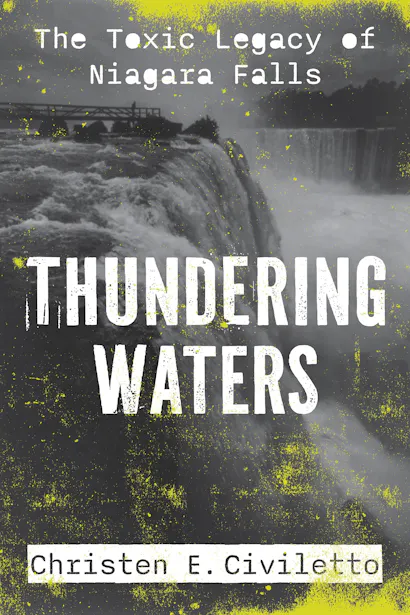
Every year, some 20 million people visit Niagara Falls, breathing in their mist and marveling at their power. But there鈥檚 a dark secret that those tourists鈥攁nd even most locals鈥攄on鈥檛 know. The city of Niagara Falls is the scene of one of the most horrific tales of environmental desecration of the past hundred plus years. In Thundering Waters: The Toxic Legacy of Niagara Falls, environmental attorney (and Niagara Falls native) Christen Civiletto exposes the astonishing story of exploitation and ongoing abuse lurking in the shadows of one of the world鈥檚 most treasured natural wonders.
Your family has lived and worked in Niagara Falls for four generations, and you grew up there. How did you first become aware that something was wrong?
Christen E. Civiletto: I had to move 900 miles away from Niagara Falls to have an epiphany.
By the 1990s, I鈥檇 already lost too many of my family members and acquaintances to illness. I was familiar with cancer and chronic illness because it seemed like everyone around me was sick. Young, old, it did not matter. It was normal. It wasn鈥檛 until I began practicing law in Atlanta, Georgia that a friend pointed out that such high levels of sickness are not normal. At my large Atlanta-DC firm, I couldn鈥檛 name a single person with cancer, let alone a young person. It was a wake-up call.
More alarm bells rang when I attended my ten-year high school reunion. I was surprised at how many people were dealing with chronic illness or cancer. We鈥檇 already lost several classmates. Ten years after high school? Much too young. I started paying closer attention. Soon after, I was diagnosed with a rather unusual cancer for my age. I had an overall sense of unease. For me, those were some of the first inklings of a problem.
How did your cancer鈥攁nd the cancer that took your father鈥檚 life鈥攕pur you to action?
CEC: I frequently ask myself that question. My father was diagnosed at just 62 with an exceedingly rare cancer called soft tissue spindle sarcoma. He was a beloved and newly retired high school special education teacher. He was the most incredible father to us and husband to our mom. His long list of interests and hobbies kept us all engaged or involved鈥攇olf, chess, skeet shooting, military and local history, and sailing. My dad鈥檚 diagnosis interrupted that full life. A regional sarcoma center told us it was 鈥渞are鈥�; 鈥渢he largest tumor鈥� they鈥檇 ever seen.鈥� We soon learned that this unusual cancer is tied only to exposure to plutonium or dioxin. I needed to know how or why he was exposed to those substances.
I began to research the area鈥檚 environmental history. It didn鈥檛 take long for me to realize that my hometown鈥檚 story is one marked by greed, exploitation, deception, illegal dumping, and misplaced patriotism. I started with a list of 89 toxic sites that I found on the internet. A few were familiar鈥擫ove Canal, after all, unfolded in front of our eyes as kids. But I soon learned that everywhere I lived, played, shopped, attended school, or worked was polluted.
My childhood house on Devlin Avenue was in the shadow of the pollution-spewing behemoths Hooker/Occidental, DuPont, and Carborundum. To our immediate west, Goodyear鈥攚here 78 workers developed bladder cancer鈥攑umped out vast amounts of chemicals through its stacks and remains open (and polluting) to this day. Numerous other Superfund sites and radioactive material associated with WWII鈥檚 Manhattan Project were three-quarters of a mile away. Our next move put us on Cayuga Creek, which was being poisoned by Love Canal.
Early in my research, we realized that my dad was likely exposed to plutonium while working at Carborundum Company, a silicon carbide plant that converted some of its operations to the Manhattan Project and Cold War weapons experiments. My grandfather worked there for 46 years; his father, an Italian immigrant, 44. We applied for compensation for my dad under the Atomic Workers鈥� Act, but, almost unbelievably, were told his exposure was below the threshold and denied a claim.
My dad died a year and a day after his diagnosis. But I kept researching. Those discoveries led to a lot of writing, and eventually to two toxic tort lawsuits in which I served as counsel for Niagara County residents who are suing Falls chemical companies.
My father鈥檚 diagnosis spurred a lot. I鈥檝e spent two decades researching these issues, trying to help residents get some sense of recourse, and conducting interviews with two thousand individuals, classmates, sewage plant workers, laborers, city employees, and family members. At least I finally have some answers.
Your book is a devastating account of corporate impunity and disregard for human and environmental health. Of all the misdeeds you uncovered, are there some that you find particularly shocking?
CEC: The misdeeds are legion, including the wanton dumping of hazardous waste, which took place 鈥渆verywhere and anywhere,鈥� as one factory employee put it. One such example is Occidental Chemical鈥檚 S-Area dumpsite. It is literally adjacent to the once-magnificent Niagara River, on an area reclaimed with fill from the river. Occidental admitted to disposing of at least 63,000 tons of chemical wastes into the landfill from 1947 to 1961. Some came directly from tanker trucks that rolled up to the riverside site.
I can guess as to why Occidental chose to dump some of the worst chemicals next to the Niagara River. What I cannot understand is why they chose to do it next to the Niagara Falls Drinking Water Plant. Then, when the same chemicals in the dumpsite were found in drinking water intake structures in 1968, a decade elapsed before drawn-out debates, testing, and Congressional hearings occurred. What was the source, they wondered? It took until 1997 for Niagara Falls to get a new drinking water plant. That saga of delay and harm is bad enough. But where did the City choose to build the new plant? One parcel over鈥攐n land that was used to bury incineration waste. It is shameful.
You spent 15 years in litigation against the corporations that poisoned your community. What did that experience teach you about the strengths and limitations of using the courts to hold polluters accountable?
CEC: The court system is ill-equipped to handle environmental cases. Cases take much too long. The chemical company defendants have an army of well-funded lawyers that will aggressively litigate cases. While motions are made, and delays ensue, people are living in their contaminated homes, just waiting. They become sicker as first one, then two, then ten years go by. Many of my clients died while awaiting a resolution.
Moreover, even if these cases actually make it to trial, the standards for testifying experts are needlessly strict. Federal judges act as gatekeepers under the decision. They require the 鈥渟ame level of intellectual rigor that characterizes the practice of an expert in the relevant field.鈥� But that does not work when testifying about nineteenth-century chemicals that were developed with little to no safety data. We know these poisons inflict harm on all body systems, but not enough published data exists linking specific chemicals with the myriad diseases they cause. More cases should be resolved using environmental conflict resolution processes, but that doesn鈥檛 happen nearly enough.
You left Niagara Falls for law school, which gave you valuable perspective on your hometown. Among those who stayed, how much is understood about the pollution in the community?
CEC: There鈥檚 a sense among many current residents that 鈥渋t鈥檚 everywhere,鈥� and 鈥渨hat can you do?鈥� The resignation is palpable. Despair is evident. With a handful of exceptions, there are not many people who want answers and accountability. Many of the older workers鈥攅ven the ones battling cancer鈥攆eel gratitude for the food they were able to put on the table. What they don鈥檛 realize is that their prolonged exposures have generational effects on their families. The harms and shortened lifespans are not worth it.
Many people think of industrial pollution as a thing of the past鈥攁fter all, the factories that produced it are long gone from rust belt cities like Niagara Falls. And they may assume that environmental agencies have taken care of cleanup and prevented similar harms. True or false?
CEC: People indeed make that assumption, and they shouldn鈥檛. Agencies in this area have spent decades working with polluters as they try to figure out how to barricade, corral, redirect, or pump and treat these poisons. Many of those poisons are still here, buried under aging landfill liners. The problem is that liners all eventually leak, because they are in contact with chemicals that degrade them. In fact, we already know that four supposedly remediated or barricaded sites continue to leach highly poisonous chemicals into the Niagara River. Moreover, New York鈥檚 county and state health agencies continue to deny that environmental toxins are a potential cause of any of the illnesses that top the charts in Niagara County, including cancer.
Your book documents failures in many realms鈥攂usiness, government, science, law, medicine. What are the most important steps we can take, as individuals and as a society, to reform those failed systems鈥攖o heal places like Niagara Falls and prevent the poisoning of other communities?
CEC: We must understand what happened here because it matters to people all over the world. Hazardous waste is a global problem. We do not know enough about the impacts of chemical exposure on teens or developing babies. We鈥檙e seeing lifelong neurological problems, and an increased likelihood of violent crime. Our very DNA changes when exposed to these chemicals鈥攎any of which were invented in Niagara Falls, the birthplace of the chlor-alkali industry. We don鈥檛 yet fully understand the generational impacts of these poisons. But we need to. Let Niagara Falls be the start of a concerted effort of research and study. Let it also be an example of accountability and even restitution. Addressing the injustices that occurred here will reverberate across the world.
Christen E. Civiletto is an environmental lawyer, law school adjunct, and former Niagara Falls resident. She earned her law degree from Vanderbilt Law School and has spearheaded high-profile litigation on behalf of hundreds of sick Niagara County residents against municipalities and major chemical polluters. Civiletto is also the cohost of the popular BOOKSTORM Podcast, on which she has interviewed hundreds of bestselling authors.