
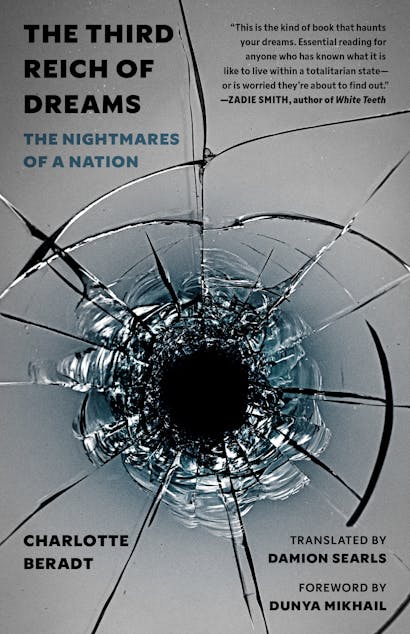
I didn鈥檛 set out to publish a book. I鈥檓 a documentary-filmmaker and for some time I鈥檇 been researching an idea about a young Berlin journalist, Charlotte Beradt, who in the 1930鈥檚 had secretly gathered a unique dream collection that she published decades later in exile in New York as The Third Reich of Dreams.
I first came across Beradt鈥檚 book in a New Yorker article in the midst of lockdown: Trump was in the White House, China was denying lab leaks, governments were in disarray as cities turned to ghost towns and the world tilted on an eerily dystopian axis. We all sensed we were in a deeply historical moment; we just didn鈥檛 know how it would play out. And like the dreams she preserved, Beradt鈥檚 story raised questions that echo today: Did ordinary Germans realise they were living through a historical nightmare? Would we recognise the same signs if we were living through them today, I wondered?
Researching Beradt鈥檚 story had led me across the globe, and finally back to my own neighbourhood where just a few streets away from my London home I was introduced to the writer/dream theorist, Robin Shohet. I could even see the roof of his house from my top-floor office window as we chatted over zoom. He told me he鈥檇 been writing a book about dream sharing in the early 1980鈥檚 and had approached Beradt to ask if he could republish her book. A year or so before she died, she had transferred the English rights to him, which unfortunately he’d lost. I was mystified that anyone might throw away book rights, but not knowing much about publishing didn鈥檛 give it further thought. Months later, an idea surfaced. Might republishing the book in English help to generate interest (and funding) for the film? Suggesting to Robin that we meet for tea, I asked him to look again for the rights. We met one drizzly January late-afternoon in a local Portobello Rd caf茅 and Robin pressed an envelope into my hand, saying, 鈥淚 found them. I鈥檓 not going to do anything with them now. You will.鈥�
Beradt came of age in what she called the not-so-golden era of 1920鈥檚 Weimar. A prolific journalist, sometime-model, daring driver, divorcee and devoted Communist, she wrote extensively on social issues, the new professions for women, and even translated Charlie Chaplin鈥檚 Hello Europa! Shortly after Hitler seized power, she began to experience vivid and disturbing nightmares. Banned as a Jew from working, she joined the Resistance and embarked too on a clandestine mission to record the dreamlife of friends, colleagues, and neighbours to compile an extraordinary document of how totalitarianism seeps into the unconscious mind of a nation: Her motivation she wrote, 鈥�… (so) that dreams like this … be preserved for posterity. They might serve as evidence, if the Nazi regime should ever be brought to trial 鈥� for they seemed full of information about people鈥檚 emotions, feelings, and motives while they were being turned into cogs of the totalitarian machine.鈥�
Leafing through the pages of an old copy of the book at London鈥檚 Weiner Holocaust Library, I was immediately catapulted to her Berlin apartment in 1933, as Hitler is elected Chancellor. Arrested as a suspect in the Reichstag fire, Beradt charms her way out of prison and鈥�helped by a doctor friend who could more safely ask his patients about dreams鈥�she begins to furtively record the dreams of her Berlin neighbours. For six years, until war breaks out, ordinary Germans鈥�doctors, lawyers, seamstresses, cleaners, cobblers and housewives, Jews and non-Jews鈥�secretly share with her their 鈥渄iaries-of-the-night鈥�. Disguising them in code, then hiding them in the bindings of books scattered through her home, she sends them as letters to friends abroad.
Escaping to New York in 1939, Beradt fashions her husband鈥檚 black lawyer-robe into a housecoat and scrapes a living in their tiny basement-apartment by colouring the hair of fellow refugees. 鈥淭here were no villas and no salons in New York. There was destitution. Our salon was a hair-dye salon,鈥� she later recalls. A rather literary salon, it served as a meeting place for a tight-knit group of European artist emigre鈥檚 calling themselves Das Dorf (The Village), who become the beating heart of New York鈥檚 intellectual life. Painter Marc Chagall鈥檚 wife is there, and so too is close friend and controversial philosopher Hannah Arendt.
And sometimes in the evening, when the salon was closed, we threw a party: sweeping up the hair on the floor, enjoying the good food, laughing a lot.
In her sixties, almost 30 years after she had risked her life, Beradt was encouraged by Arendt to revisit her dream-collection, laying-bare what Nazism had exacted on the psyche of its citizens before the war. Published in German in 1966 and translated into English in 1968, historian Reinhart Kosseleck described it as, 鈥渙ne of the most uniquely powerful dream records ever collated, the dreams bear witness to the encroaching terror, anticipating its eventual violent results. There is nothing like it in Holocaust literature.鈥�
More than a decade before Orwell imagined such horrors in 1984, the dreams reveal how totalitarianism infiltrates even the most private corners of the mind. Walls dissolve, suspicion becomes 鈥渦niversal fact,鈥� loudspeakers blare commands into bedrooms, and thought-detecting machines patrol public spaces. Bodies betray their owners: a factory boss breaks his spine trying to lift his arm in salute; women find themselves dancing with Hitler or dressed in the uniform of their oppressors. A mixed-heritage woman dreams of fleeing with her Jewish mother across mountainous terrain鈥攁nd is disturbed to realise that not only has she been carrying her mother鈥檚 corpse but feels 鈥渁 horrific sense of relief鈥� at no longer being burdened by her. The regime has achieved what brute force alone could not: the rupture of the most intimate human bonds.
And while the young in Germany grappled to understand what had unfolded under Nazism, Charlotte became a regular contributor on German National Radio. She travelled and wrote widely in the 60鈥檚 and 70鈥檚. Her book was dramatized, and she wrote and broadcast about the lost generation of German expressionist artists and writers, about American culture, civil rights and popular theatre.
With each new discovery, Beradt鈥檚 story seemed to resonate more deeply with my own family history. I was born in apartheid South Africa to grandparents who had escaped pogroms and survived death camps, and I carry with me a great sense of responsibility鈥攁s a storyteller鈥攖o speak up about injustice. Telling her story, in our increasingly fractured world, is inspiring me to gain strength in this fight, to stand up and help to shape our collective human narrative. And as a woman filmmaker, I鈥檓 inspired to move these rich female lives from obscurity and into contributions from history. To forget would yet again confirm the huge injustices done.
As our own era confronts rising authoritarianism and deepening polarization, the dreams illuminate the subtle psychological mechanisms of control: how propaganda distorts reality, how we unconsciously conform, and what happens when the distinction between fact and fiction begins to dissolve. Bearing witness and bringing into light the psychological effect of Nazi terror, the film (in production) carries a powerful contemporary message about racism, scapegoating, and antisemitism. About mind-control, how our collective narrative is being manipulated, how we transform the social and cultural (digital) landscape we share, and about how we can resist.
In 1934 the high-ranking Nazi Officer Robert Ley claimed that 鈥�the only person in Germany who still leads a private life is the one who sleeps,鈥� but Charlotte鈥檚 research proved him wrong: under regimes of terror, there are no private spaces.
I鈥檝e so enjoyed working with 快色直播 to republish this classic text in English, after almost 40 years out of print. Brilliantly translated by Damion Serle and including a beautifully poetic foreword by Iraqi American writer Dunya Mikhail, the remarkable dream archive Beradt risked her life to protect remains both as testimony and warning鈥攁 unique seismograph of history, registering the tremors of totalitarianism through the minds of those who endured it. In haste on a transatlantic flight just before the results of the 2024 US election were known, and fearing the worst outcome, Zadie-Smith wrote in The New York Review of 快色直播: 鈥�… the kind of book that haunts your dreams. Essential reading for anyone who has known what it is like to live within a totalitarian state鈥攐r is worried they鈥檙e about to find out.鈥�
Amanda Rubin is a documentary filmmaker whose work across cultural history, arts, music, and science has been shown on BBC, Channel 4, The History Channel, Discovery+, among others channels. Her recent relevant work includes a BBC documentary, 21st Century Mythologies which unpacks French philosopher Roland Barthes鈥� 1957 book Mythologies, laying bare the myth-making at the heart of consumer culture. It was while researching a film about journalist Charlotte Beradt and her unique dream anthology, The Third Reich of Dreams, that Amanda discovered the lost English-language rights to the book. She was the force behind its republication in English in April 2025 by 快色直播. Rubin recently co-produced a radio documentary, for BBC Radio 4 about Beradt鈥檚 extraordinary and subversive dream project. She lives and works in London.