
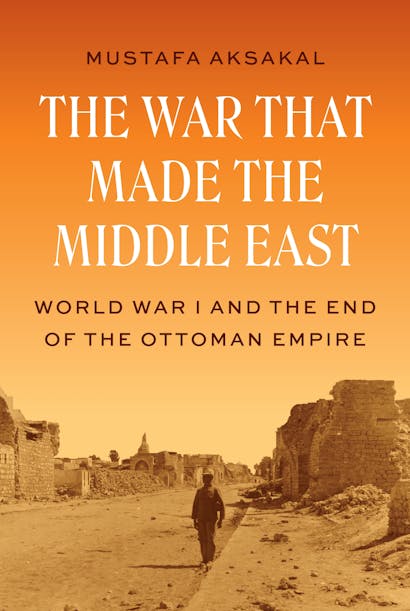
The Ottoman Empire鈥檚 collapse at the end of the First World War is often treated as a foregone conclusion. It was only a matter of time, the story goes, before the so-called Sick Man of Europe succumbed to its ailments鈥攊ncompetent management, nationalism, and ethnic and religious conflict. In The War That Made the Middle East, Mustafa Aksakal overturns this conventional narrative. He describes how European imperial ambitions and the Ottoman commitment to saving its empire at any cost鈥攊ncluding the destruction of the Armenian community and the deaths of more than a million Ottoman troops and other civilians鈥攍ed to the empire鈥檚 violent partition and created a politically unstable Middle East.
Why did you write this book?
Mustafa Aksakal: I wanted to write a history that could capture many of the complexities of the Ottoman First World War and the empire鈥檚 dissolution in 1922. It was important to me to link big picture developments 鈥� the international and the global developments 鈥� to local and individual experiences and perspectives. I also wanted to make very clear that this history was the history of an empire and not of a particular national or religious group. In fact, a central argument of the book is that the national identities that we associate with the Middle East today came into being only in the war鈥檚 aftermath. The more I read about Ottoman state and society in the nineteenth and twentieth centuries, the more I came to understand the Ottoman past as part of a much wider context, one that involved the histories of global empires and colonialism, and the technologies, laws, and practices that sustained them. A crucial aspect of this past was the increasing financial control under which the Ottoman state found itself. With the loss of financial control came the incremental erosion of the empire鈥檚 political independence. We don鈥檛 think of the Ottoman Empire as being colonized before 1914, but in fact many of its territories were under European jurisdiction or under outright European occupation. The First World War in the Middle East and the End of the Ottoman Empire can only be understood in the context of global history. The causes for the empire鈥檚 dissolution should be sought as much in international and global changes than in domestic ones.
I also wanted to show that it was not the empire鈥檚 ethnic and religious diversity that put an end to the Ottoman state, a state that had ruled over vast and diverse territories for centuries. It is often forgotten that before WWI in the Middle East meaningful interaction and proximity among the various religious and ethnic groups was the order of the day. I wanted to grapple with the idea of the region鈥檚 potential for coexistence without sliding into some kind of romanticization or nostalgia. There is no point in being nostalgic about the empire, but nor do I see a point in being triumphant or celebratory about the nation-states that replaced it.
Can you speak a little bit more about the title of your book?
MA: I see the First World War in the Middle East as a truly pivotal moment, and I am not just thinking of the redrawing of political boundaries and the creation of new states. Those were critical to the history of the modern Middle East as well, of course, and especially the fact that the Arab lands of the Ottoman Empire became British and French ruled colonies, under the designation of 鈥渕andates鈥�. It also marked the birth of the statelessness of the Palestinian and Kurdish peoples, a product of the war we are still contending with today. By the book鈥檚 title I am not just talking about the fact that the Ottoman Empire disappeared and new countries took its place. What I wanted to emphasize in the title is that the phrase 鈥渢he Middle East鈥� really came into common usage only after the First World War and that in the process it erased the memory of a multiethnic, multireligious, multilingual state whose political, economic, and social institutions had accommodated and vast and diverse population with relative stability.
Why was the First World War in the Ottoman Empire so violent?
MA: The war transformed the Ottoman domestic political environment. In the context of a global war, Ottoman political competition at home became part and parcel of waging a world war. Pre-1914 Ottoman political contests and internal dynamics turned into military confrontation. But it was of course the state that wielded military force. What had been already an uneven political competition prior to 1914, now became an uneven military competition. And it was not only guns and manpower the state controlled but it also decided over the allocation foods and harvests, and the means of transportation. The state turned out to be incredibly violent and deadly, going after groups and populations whose loyalties it questioned 鈥� Armenian, Assyrian, and Greek-Orthodox Christians, but also Muslim Arabs and Kurds. In a sense, the Ottoman Empire was at war against the world and against itself.
What were some of the main outcomes of the war?
MA: The war cast a long shadow over the Middle East for over a century now. For the people of the Middle East, war and violence hardly disappeared with the end of the First World War in 1918 or with the empire鈥檚 subsequent dissolution. The new states continued to face many of the challenges that plagued the Ottoman Empire. Questions of building a prosperous economy, establishing political institutions of representative government, or achieving international sovereignty remained elusive goals in many parts of the Middle East. But the crucible of war also forged new national identities imbued with traumas that continue to inform if not shape politics across the region today.
Mustafa Aksakal is associate professor of history and the Nesuhi Erteg眉n Chair of Modern Turkish Studies at Georgetown University. He is the author of The Ottoman Road to War in 1914: The Ottoman Empire and the First World War.