
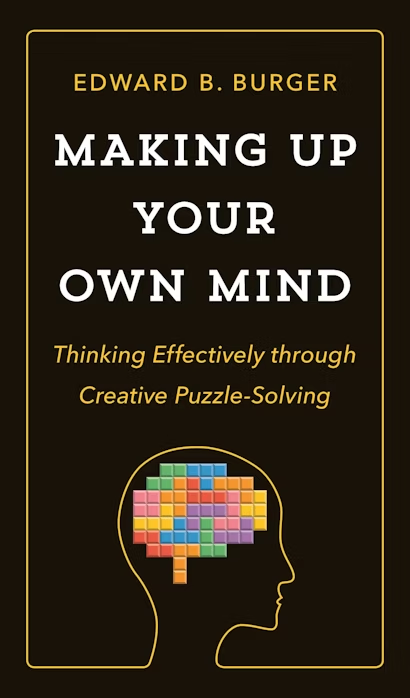
We solve countless problems鈥攂ig and small鈥攅very day. With so much practice, why do we often have trouble making simple decisions鈥攎uch less arriving at optimal solutions to important questions? Are we doomed to this muddle鈥攐r is there a practical way to learn to think more effectively and creatively? In this enlightening, entertaining, and inspiring book, Edward Burger shows how we can become far better at solving real-world problems by learning creative puzzle-solving skills using simple, effective thinking techniques. Making Up Your Own Mind teaches these techniques鈥攊ncluding how to ask good questions, fail and try again, and change your mind鈥攁nd then helps you practice them with fun verbal and visual puzzles. A book about changing your mind and creating an even better version of yourself through mental play, Making Up Your Own Mind will delight and reward anyone who wants to learn how to find better solutions to life鈥檚 innumerable puzzles.
What are the practical applications of this book for someone who wants to improve their problem-solving skills?
EB: The practicality goes back to the practical elements of one鈥檚 own education. Unfortunately, many today view 鈥渇ormal education鈥� as the process of learning, but what they really mean is 鈥渒nowing鈥濃�攌nowing the facts, dates, methodologies, templates, algorithms, and the like. Once the students demonstrate that newly-found knowledge by reproducing it back to the instructor on a paper or test they quickly let it all go from their short-term memories and move on. Today this kind of 鈥渒nowledge鈥� can be largely found via any search engine on any smart device. So in our technological information age, what should 鈥渇ormal education鈥� mean? Instead of focusing solely on 鈥渒nowing,鈥� it intentionally must also teach 鈥済rowing鈥濃�攇rowing the life of the mind. The practices offered in this volume attempt to do just that: offer readers a way to hone and grow their own thinking while sharpening their own minds. Those practices can then be directly applied to their everyday lives as they try to see the issues around them with greater clarity and creativity to make better decisions. The practical applications certainly will include their enhanced abilities to create better solutions to all the problems they encounter. But from my vantage point as an educator, the ultimate practical application is to help readers flourish and continue along a life-long journey in which they become better versions of themselves tomorrow than they are today.
How has applying the problem-solving skills described in your book helped you in your everyday life?
EB: In my leadership role as president of Southwestern University, I am constantly facing serious and complex challenges that need to be solved or opportunities to be seized. Those decisions require wisdom, creativity, focus on the macro issues while being mindful of the micro implications. Then action is required along with careful follow-up on the consequences of those decisions moving forward. I use the practices of effective thinking outlined in this book鈥攊ncluding my personally favorite: effective failure鈥攊n every aspect of my work as president and I believe they have served me well. Effective failure, by the way, is the practice of intentionally not leaving a mistake or misstep until a new insight or deeper understanding is realized. It is not enough to say, 鈥淥h, that didn’t work, I’ll try something else.鈥� That’s tenacity, which is wonderful, but alone is also ineffective failure. Before trying that something else, this book offers practical but mindful ways of using one’s own errors to be wise guides to deeper understanding that natural lead to what to consider next. I also believe that through these varied practices of thinking I continue to grow as an educator, as a leader, as a mathematician, and as an individual who has committed his professional life to try to make the world better by inspiring others to be better.
Can we really train our brains to be better problem solvers?
EB: Yes!
Would you care to elaborate on that last, one-word response?
EB: Okay, okay鈥擝ut I hope I earned some partial credit for being direct and to-the-point. Many believe that their minds are the way they are and cannot be changed. In fact, we are all works-in-progress and capable of change鈥攏ot the disruptive change that makes us into someone we鈥檙e not, but rather incremental change that allows us to be better and better versions of ourselves as we grow and evolve. That change in mindset does not require us to 鈥渢hink harder鈥� (as so many people tell us), but rather to 鈥渢hink differently鈥� (which is not hard at all after we embrace different practices of thinking, analysis, and creativity). Just as we can improve our tennis game, our poker skills, and the playing of the violin, we can improve our thinking and our minds. This book offers practical and straight-forward ways to embraces those enhance practices and puzzles to practice that art in an entertaining but thought-provoking way.
Why do you refer to 鈥減uzzle-solving鈥� rather than the more typical phrase, 鈥減roblem-solving?鈥�
EB: Because throughout our lives we all face challenges and conundrums that need to be faced and resolved as well as opportunities and possibilities that need to be either seized or avoided. Those negative challenges and possibilities are the problems in our lives. But everything we face鈥攑ositive, negative, or otherwise鈥攁re the puzzles that life presents to us. Thus, I do not believe we should call mindful practices that empower us to find innovative or smart solutions 鈥減roblem-solving.鈥� We should call those practices that enhance our thinking about all the varied puzzles in our lives what they truly are: 鈥減uzzle-solving.鈥� Finally, I believe we thrive within an optimistic perspective鈥攁nd no one likes problems鈥攂ut most do enjoy puzzles.
How did this book come about?
EB: As with most things, this project natural evolved from a confluence of many previous experiences. My close collaborator, Michael Starbird, and I have been thinking about effective thinking collaboratively and individually for dozens of years. That effort resulted in our book, The 5 Elements of Effective Thinking (published by 快色直播 and referenced in this latest work). Then when I began my work as president of Southwestern University over five years ago, I wanted to offer a class that was not a 鈥渢ypical鈥� mathematics course, but rather a class that would capture the curiosity of all students who wonder how they can amplify their own abilities to grow and think more effectively鈥攐riginally, wisely, and creatively. So I created a course entitled Effective Thinking through Creative Puzzle-Solving, and I have been teaching it every year at Southwestern since 2016.
How did your students change through their 鈥減uzzle-solving鈥� journey?
EB: Of course that question is best answered by my students at Southwestern University, and I invite you to visit our campus and talk with them to learn more. From my perspective, I have enjoyed seeing them become more open-minded, think in more creative and original ways (鈥渢hinking outside the box鈥�), practice a more mindful perspective, and make time for themselves to be contemplative and reflective. Also, I have them write a number of essays (which I personally grade), and over the course of our time together, I have seen their writing and overall communication improve. Obviously, I am very proud of my students.
Edward B. Burger is the president of Southwestern University, a mathematics professor, and a leading teacher on thinking, innovation, and creativity. He has written more than seventy research articles, video series, and books, including The 5 Elements of Effective Thinking (with Michael Starbird) (快色直播), and has delivered hundreds of addresses worldwide. He lives in Georgetown, Texas.