
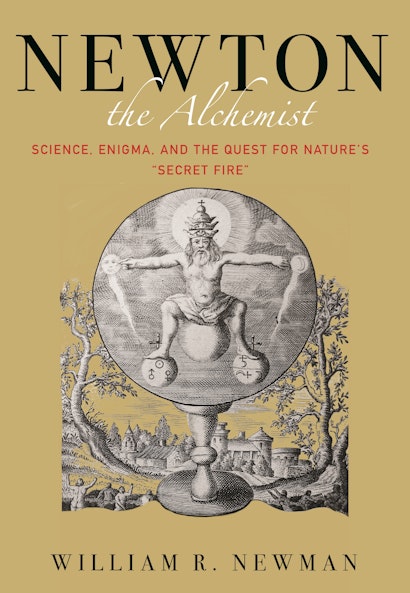
When Isaac Newton’s alchemical papers surfaced at a Sotheby’s auction in 1936, the quantity and seeming incoherence of the manuscripts were shocking. No longer the exemplar of Enlightenment rationality, the legendary physicist suddenly became “the last of the magicians.” Newton the Alchemist unlocks the secrets of Newton’s alchemical quest, providing a radically new understanding of the uncommon genius who probed nature at its deepest levels in pursuit of empirical knowledge.
People often say that Isaac Newton was not only a great physicist, but also an alchemist. This seems astonishing, given his huge role in the development of science. Is it true, and if so, what is the evidence for it?
WN: The astonishment that Newton was an alchemist stems mostly from the derisive opinion that many moderns hold of alchemy. How could the man who discovered the law of universal gravitation, who co-invented calculus, and who was the first to realize the compound nature of white light also engage in the seeming pseudo-science of alchemy? There are many ways to answer this question, but the first thing is to consider the evidence of Newton’s alchemical undertaking. We now know that at least a million words in Newton’s hand survive in which he addresses alchemical themes. Much of this material has been edited in the last decade, and is available on the Chymistry of Isaac Newton site at . Newton wrote synopses of alchemical texts, analyzed their content in the form of reading notes and commentaries, composed florilegia or anthologies made up of snippets from his sources, kept experimental laboratory notebooks that recorded his alchemical research over a period of decades, and even put together a succession of concordances called the Index chemicus in which he compared the sayings of different authors to one another. The extent of his dedication to alchemy was almost unprecedented. Newton was not just an alchemist, he was an alchemist’s alchemist.
What did Newton hope to gain by studying alchemy? Did he actually believe in the philosophers’ stone, and if so, why? And what was the philosophers’ stone exactly?
WN: Newton’s involvement in alchemy was polyvalent, as befits a pursuit that engaged him intensively for more than three decades and which traditionally included multiple goals. The term “alchemy” in the early modern period was largely coextensive with “chymistry,” a field that included distilling, pigment-making, salt-refining, and the manufacture of drugs alongside the perennial attempt to transmute metals. Beyond an interest in all these technical pursuits, Newton employed alchemical themes in his physics, particularly in the area of optics. Newton’s theory that white light is a mixture of unaltered spectral colors was bolstered by techniques of material analysis and synthesis that had a long prehistory in the domain of alchemy. But at the same time, he hoped to attain the grand secret that would make it possible to perform radical changes in matter. The philosophers’ stone as described by alchemical authors was a material that could transmute base metals into gold and silver and “perfect” certain other materials as well. At the same time, many authors believed that the philosophers’ stone could cure human ailments and extend life to the maximum limit that God would allow. Some of Newton’s sources even claim that the philosophers’ stone would allow its possessors to contact angels and to communicate telepathically with one another. Did Newton believe all of this? Suffice it to say that nowhere in his voluminous notes does he dispute these assertions, even while recounting them. Although he may have been exercising a suspension of disbelief in the case of the more extravagant claims for the philosophers’ stone, his long involvement in the aurific art implies that he must at least have thought the alchemists were on to something when they discussed transmutation.
Did Newton also believe, as many contemporary alchemists did, that the totality of Greek and Roman mythology was just encoded alchemy?
WN: It’s certainly true that Newton’s favorite sources thought Greek and Roman mythology to contain valuable alchemical secrets. Ovid’s Metamorphoses was a particularly popular target of interpretation, since the whole book deals with radical transformations of one thing into another. Newton himself decoded the story of Cadmus and the founding of Thebes, one of Ovid’s myths, into practical laboratory instructions in one of his notebooks. In Newton’s early reading, Cadmus becomes the iron required to reduce the metalloid antimony from its ore stibnite, and the dragon who attacks Cadmus is the stibnite itself. But does this mean that Newton believed the originators of the myth to have meant it as a veiled alchemical recipe? If so, this would run contrary to Newton’s extensive interpretations of ancient mythology and religion that occur alongside his studies of biblical chronology. In these texts, which occupy about four million words and are thus even more extensive than his alchemical writings, Newton argues that the famous figures of ancient mythology were actual people whose lives were later embellished by mythologizing writers. It is likely, then, that Newton’s alchemical decoding of mythology is actually an attempt to interpret early modern writers who used ancient myth as a way of wrapping their processes in enigma rather than signifying that he himself believed Ovid, for example, to have been an alchemist.
What did Newton make of the bizarre language that alchemists traditionally used for their secrets, including terms like “the Babylonian Dragon,” “the Caduceus of Mercury,” and “the Green Lion”?
WN: Newton spent decades trying to decipher the enigmatic terminology of the alchemists. In reality, exotic Decknamen (cover-names) were only part of an extensive and well-developed set of tools that alchemists had long employed for the purpose of revealing and concealing their knowledge. Other techniques included syncope (leaving out steps and materials), parathesis (adding in unnecessary terms and processes), and dispersion of knowledge, which consisted of dividing up processes and distributing them over different parts of a text or even putting the parts in entirely different texts. The bulk of Newton’s reading notes consist of his attempts to arrive at the correct meaning of terms, and he was aware of the fact that the same term often meant different things to different authors. His Index chemicus, for example, lists multiple different meanings for the term “Green Lion,” which Newton links to specific writers. In a word, Newton’s alchemy is as much about the literary decipherment of riddles as it is about putting his interpretation to the test in the laboratory.
Did Newton consider himself to be an “adept,” that is, one of the masters of alchemy who had acquired the great secret of the art?
WN: Although Newton occasionally records eureka moments in his laboratory notebooks such as “I saw the sophic sal ammoniac” or “I have understood the luciferous Venus,” he never records that he found the philosophers’ stone or performed an actual transmutation. He seems to have viewed himself as being on the way to finding the philosophers’ stone, but not to have ever thought that he had attained it. Nonetheless, his rapport with the adepts is clear. Several of his manuscripts record instances where he copied the early modern alchemical practice of encoding one’s name in a phrase that could be interpreted as an anagram. Michael Sendivogius, for example, a celebrated Polish adept, became “Divi Leschi Genus Amo” (“I love the race of the divine Lech”). The most famous of these anagrams in Newton’s case is “Jeova sanctus unus,” which can be rearranged to yield “Isaacus Neuutonus,” Latin for Isaac Newton. This is not the only such anagram in his alchemical papers. One manuscript in fact contains over thirty different phrases in which Newton concealed his name. Along with other clues in his papers, this suggests strongly that Newton believed himself to belong rightly to the band of the adepts, even if he was only an aspirant to their ranks.
How does your book Newton the Alchemist change what we already knew about Newton’s alchemical quest?
WN: Thanks to scholarly work done in the last third of the twentieth century, there is currently a widespread “master narrative” of Newton’s alchemy, though one with which I disagree. The major scholars of the subject at that time argued that alchemy for Newton was above all a religious quest, and that its impact on his more mainstream science lay in his emphasis on invisible forces that could act at a distance, such as gravitational attraction. Contemporary sources ranging from popular outlets such as Wikipedia to serious scholarly monographs echo these themes. In reality, however, there is little to no evidence to support either view. Although there was a constant bleed-through from his alchemical research to his public science, Newton pursued the philosophers’ stone neither for the sake of God nor for the sake of physics. Instead, he practiced alchemy as an alchemist. In a word, the celebrated scientist aimed his bolt at the marvelous menstrua and volatile spirits of the sages, the instruments required for making the philosophers’ stone. Difficult as it may be for moderns to accept that the most influential physicist before Einstein dreamed of becoming an alchemical adept, the gargantuan labor that Newton devoted to experimental chrysopoeia speaks for itself.
A common view of Newton’s alchemy is that he kept it a secret from the world. Is this true, and if so, why was he so secretive? Did he think that alchemy was somehow dangerous? Or was it disreputable?
WN: Newton generally kept quiet about his alchemical research, though he did engage in collaborations with select individuals such as his friend Nicolas Fatio de Duillier, and later, the Dutch distiller William Yworth. The main reason for his caution lay in his concern that alchemy might lay claim to secrets that could be dangerous if revealed to the world at large. The social order would be turned topsy-turvy if gold and silver lost their value as a result of the philosophers’ stone falling into the hands of the hoi polloi, and other disastrous consequences might result as well. Newton’s anxiety emerges quite clearly from a letter that he sent to the Secretary of the Royal Society, Henry Oldenburg, in 1676. The occasion was a publication by another alchemical researcher, Robert Boyle, who had recently published a paper on a special “sophic” mercury that would grow hot if mixed with gold. Newton was alarmed at Boyle’s candor, and suggested to Oldenburg that the author of The Sceptical Chymist should in the future revert to a “high silence” in order to avoid revealing secrets that the “true Hermetick Philosopher” must keep hidden lest they cause “immense dammage to ye world.”
You argue in your book that it’s not enough to read about Newton’s alchemical experiments, but that historians actually need to do them in a laboratory. Tell us what you have found by repeating Newton’s experiments and why this is important.
WN: Anyone who tries to wade through Newton’s laboratory notebooks will be struck at once by the multitude of obscure expressions that he employs for materials. Although terms such as “the Green Lion,” “sophic sal ammoniac,” and “liquor of antimony” already existed in the literature of alchemy, they meant different things to different authors. In order to determine what their precise meaning was to Newton, one must look carefully at the properties that he ascribes to each material and to the protocols that he applies when he uses it in the laboratory. A good example may be found in the case of liquor of antimony, which Newton also refers to as vinegar, spirit, and salt of antimony. Extensive examination of these terms in his notebooks shows that they were interchangeable for Newton, and that they referred to a solution of crude antimony (mostly antimony sulfide) in a special aqua regia. Having made this material in the laboratory, I was then able to use it to make other Newtonian products, such a “vitriol of Venus,” a crystalline copper compound produced from the dried solution of copper or a copper ore in liquor of vitriol. This product is volatile at relatively low temperatures and can be used to volatilize other metals, which helps explain why Newton thought he was on the path to alchemical success. He hoped to liberate the internal principle of metallic activity by subtilizing the heavy metals and freeing them from what he saw as their gross accretions.
Was alchemy considered a deviant or “occult” practice in Newton’s day? Did doing alchemy make Newton a sorcerer or witch?
WN: It is a popular modern misconception that alchemy, astrology, and magic were all part and parcel of the same “occult” enterprise. To most medieval and early modern thinkers, these were distinct areas of practice, despite the currently reigning stereotypes. Newton had little or no interest in astrology, which did not distinguish him from most European alchemists. If by “magic” one means sorcery or witchcraft, this too was an area quite distinct from alchemy, and entirely alien to Newton’s interests. There was an overlap with alchemy in the domain of “natural magic,” however, and Newton evinced a marked interest in this field in his adolescence. One of the things that I have been able to show is that his earliest interest in alchemy, as revealed by his copying and reworking of an anonymous Treatise of Chymistry in the 1660s, may have grown out of his youthful fascination with works on natural magic and “books of secrets.” But natural magic was considered a legitimate field of endeavor by most experimental scientists in the seventeenth century, not a transgressive or deviant activity.
William R. Newman is Distinguished Professor and Ruth N. Halls Professor in the Department of History and Philosophy of Science and Medicine at Indiana University. His many books include Atoms and Alchemy: Chymistry and the Experimental Origins of the Scientific Revolution and Promethean Ambitions: Alchemy and the Quest to Perfect Nature. He lives in Bloomington, Indiana.