
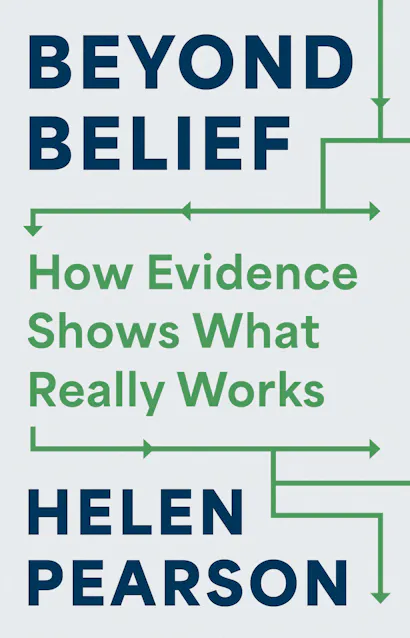
Today, more and more people around the globe are using scientific evidence to figure out what works鈥攊n health, government and business as well as conservation, schools and parenting. This wasn鈥檛 always the case. In Beyond Belief: How Evidence Shows What Really Works, Helen Pearson tells the story of the evidence revolution鈥攁 worldwide movement that promotes evidence-based thinking鈥攁nd shows how it can help us all, especially in an age of alternative facts.
What is your book about, in a nutshell?
Helen Pearson: In a world flooded with questionable claims and misinformation, Beyond Belief argues that scientific evidence can help us distinguish what鈥檚 reliable from what鈥檚 not.
The book tells the story of the 鈥渆vidence revolution鈥�: a global movement built on the idea that decisions should be guided by rigorous evidence rather than opinion, intuition, or tradition. Almost everyone has benefited from evidence鈥慴ased medicine鈥攊n which doctors use clinical trials to test whether treatments work鈥攜et few people know how recent this shift is, or how hard鈥憌on. Evidence鈥慴ased medicine is only a few decades old.
Can you say a bit more about 鈥榚vidence鈥� as a concept?
HP: The word evidence means information indicating whether a belief is true or valid. I use the term evidence in the book as shorthand for 鈥榚vidence from empirical research,鈥� meaning information collected by careful observation and experimentation. But there are other types of evidence, including evidence in a court of law and evidence from lived experience. Nowadays, the term is often attached to all kinds of things and used as a synonym for 鈥榖ased on a bit of data or research鈥�. But this can give a gloss of legitimacy to something undeserved. Attaching 鈥榚vidence-based鈥� to something doesn鈥檛 automatically make it right.
What inspired you to write this book and where did the evidence revolution start?
HP: A few years ago, I met and interviewed Iain Chalmers, a remarkable British doctor and researcher, and was inspired by his story.
In the 1960s, Chalmers and some other pioneering doctors realised that much of what they鈥檇 been taught in medical school was wrong. Most decisions about treatment were based on someone鈥檚 opinion (鈥榙o this because I think it鈥檚 right鈥�) or conventional wisdom (鈥榙o it this way because that鈥檚 how it鈥檚 always been done鈥�). What generally happened was that everyone followed the advice of the most senior doctor in the room鈥攚hat some people now call 鈥榚minence-based medicine鈥�.
These pioneers argued that medical practices should instead be based on evidence from research, such as randomised trials showing whether a drug works. This approach was radical when it first emerged. But it quickly caught on, sparking a revolution known as evidence-based medicine, which raced around the world in the 1990s and has become the main way in which Western medicine is practised.
As a science journalist for the journal Nature, I was already steeped in research and medicine, but learning about this history was eye-opening. The idea that medicine should be based on scientific evidence now sounds blindingly obvious, but few people realise that the term evidence-based medicine is barely 35 years old. That鈥檚 a big reason I wanted to write the book.
Did the evidence revolution then spread to other fields?
HP: Yes. As I went on reporting, I learned that evidence-based medicine is part of a bigger movement, sometimes called an 鈥榚vidence revolution鈥�. I started interviewing people who are passionate about evidence in disciplines I鈥檇 never explored before. I visited a researcher who was pioneering evidence-based policing at London鈥檚 Scotland Yard. I spent time with scientists in Cambridge, UK, who are busy gathering evidence on what works to protect almost every species on Earth. I met a manager who is fighting a lonely battle to turn management and business into an evidence-based field, now working from an old school bus in South America.
I ended up interviewing over 200 researchers and other experts involved in evidence. So the book looks at how evidence is being embraced across lots of fields鈥攎edicine, government policy, policing, conservation, management, education, international development and even parenting鈥攁s well as the huge barriers it faces.
How did you try to bring the story to life for readers?
HP: The evidence revolution is a wonderful human story and the book centres on the characters involved. Usually, one person in a field came to realize that their discipline was based on hunches, anecdotes and conventional wisdom, just like medicine once was. They realized that it would be better to do things that evidence shows work 鈥� and they set about changing things. So, I tell the story of all these eccentrics and rebels who came to share this simple belief that decisions based on evidence can make the world a better place, and the problems they faced along the way.
Are there lessons in the story that people can use in their own lives?
HP: Yes, absolutely. I wanted the book to be empowering. It shows how using evidence could help all of us make better decisions鈥攁nd includes a few tips on where we can start. One of the simplest is to be skeptical and ask for the evidence behind a claim from an influencer, company or politician. I write about other 鈥榚vidence hacks鈥� in the book too.
It鈥檚 important to acknowledge the limitations and criticisms of evidence. Researchers agree that the evidence movement is imperfect, that research is sometimes flawed and fails to provide answers and that evidence is complex and is only one factor in making decisions. In medicine, doctors draw on the best available evidence alongside the preferences and circumstances of the person being treated.
Why are some people rejecting evidence now?
HP: Surveys generally show that public trust in science and scientists remain reasonably high, but clearly some people are questioning or undermining science and evidence. For instance, health secretary Robert F. Kennedy Jr. and others in the MAHA movement have at times rejected scientific consensus and promoted misleading health claims.
Some researchers say this pushback is because the public views scientists and research institutions as elite and out of touch with their concerns. Some people feel like scientific evidence鈥痙oesn鈥檛鈥痗apture their lived experience or help address their problems. That鈥檚 compounded by social media and the wider online world: it鈥檚 harder for credible information to stand out amongst a tide of inaccurate information. The鈥痗urrent opposition to evidence needs to be understood and taken seriously.
Another issue is that we tend to think in terms of stories and anecdotes, which is why one person鈥檚 experience (鈥渋t worked for me鈥�) often feels so much more convincing than data about thousands of people (鈥渋t doesn鈥檛 work on average in a trial鈥�). One of the biggest challenges for the evidence movement now is working out how to address these biases and concerns and encourage the use of evidence.
What鈥檚 your favourite part of the book?
HP: It鈥檚 probably the instances in which evidence pops up in unusual places. If you bought a pint of beer in some pubs in England around 1998, you might have unknowingly been part of an unlikely-sounding randomised trial on beer glasses. Pubs were randomly assigned to serve drinks in regular or toughened glasses. This study helped show that stronger glasses cut glass accidents and crime and helped convince the pub trade to switch to toughened glass. There were an estimated 40,000 or more fewer glass assaults in England and Wales in the year after the pub trade switched. The book has lots of stories about extraordinary, randomised trials around the world.
What are some examples of conventional wisdom that evidence has overturned?
HP: One of the most tragic ones that I write about centres on sudden infant death syndrome, or SIDS. In 1958, the paediatrician Benjamin Spock made a small change in his best-selling parenting book Baby and Child Care. He said that parents should put babies to sleep on their fronts rather than their backs. But careful observational studies later showed that front sleeping was linked to a higher risk of SIDS. The promotion of front-sleeping by Spock and others is now thought to be one of the most lethal pieces of unsubstantiated advice in the history of child health. Scientists later calculated that at least 50,000 deaths in USA, Europe and Australasia could have been prevented if evidence had been synthesized and acted on earlier.
As someone who鈥檚 managed a large team at work, I also found it illuminating to discover that many standard management practices are not supported by evidence. For instance, there isn鈥檛 particularly strongly evidence the performance appraisals are effective at improving employees鈥� performance. One expert called the annual performance appraisal 鈥渁 soul-destroying ritualistic charade鈥�.
Your book talks a lot about evidence synthesis. What is this and why is it important?
HP: Scientists carry out evidence syntheses to get an overview of a wide body of research. They are 鈥渆verything the world knows about how to solve an important problem in one place鈥�, as one interviewee described it to me.
They鈥檙e important because looking at one study at a time can be problematic. Studies can reach different or misleading conclusions because of the different way they were conducted or because of chance. We see the confusing consequences of this all the time when newspapers report on a study finding that red wine is good for you, and then the next week feature a study saying it鈥檚 bad. It鈥檚 better to look at all relevant studies together and try to extract a signal from the noise.
In medicine, many thousands of systematic reviews鈥攁 common type of evidence synthesis鈥攁re used to create recommended guidelines for doctors about how to treat patients. It鈥檚 an invisible bedrock of knowledge on which modern medicine is based.
Helen Pearson is an award-winning journalist and editor for Nature and a TED speaker. Named European Science Journalist of the Year (2025), she is an honorary professor at University College London, where she teaches science writing, and the author of The Life Project: The Extraordinary Story of 70,000 Ordinary Lives.