
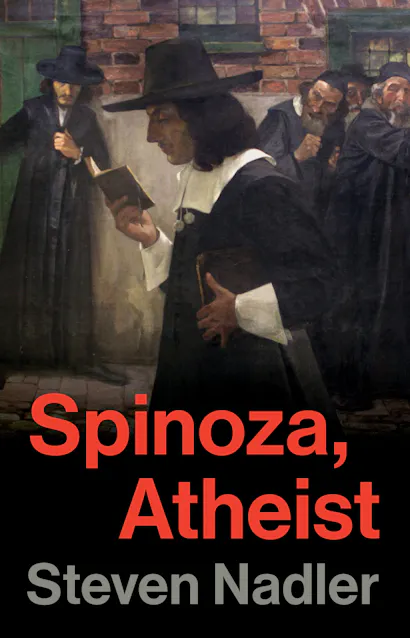
In 1656, a young Amsterdam merchant was excommunicated by his Portuguese-Jewish community in the harshest terms it had ever used. Baruch Spinoza was accused of unspecified 鈥渉orrifying heresies,鈥� but the precise reasons for his expulsion remain a mystery. When he published his Theological-Political Treatise in 1670, which was condemned as 鈥渢he most atheistic book ever written,鈥� he began to reveal to the world what his heresies may have been. Yet ever since the eighteenth century, most readers and scholars have assumed that Spinoza was a pantheist鈥攅ven a 鈥淕od-intoxicated man,鈥� as the poet Novalis put it. After all, how could a person whose books are suffused with talk of God be an atheist? In Spinoza, Atheist, Steven Nadler, one of the world鈥檚 leading authorities on the philosopher, aims to settle the question and show that that鈥檚 exactly what he was.
Another book on Spinoza? Do you ever feel you’ve written enough on him?
Steven Nadler: Yes, it is. And no, I haven鈥檛. The thing about Spinoza is that it is easy to become obsessed with him. Once you start studying him, you are hooked, your life is changed. You will devote hours and hours to trying to understand him. We do not have a lot of works by Spinoza, but the ones we do have are so rich and complicated, covering many different philosophical, religious, political, moral and psychological topics. You sense that all the big questions that motivate people to turn to philosophy and/or religion in the first place鈥攓uestions about goodness, happiness and the meaning of life鈥攁re addressed in his two major treatises, the Ethics and the Theological-Political Treatise, with remarkable insight and wisdom. And yet, each time you read Spinoza it gets more difficult. New questions arise, and you realize that things you once thought you understood are not that simple. It is back to square one, and you start reading all over again. And again. And again.
What led you to write this new book?
SN: For years I have been arguing鈥攊n articles and a book chapter here and there鈥攖hat Spinoza is an atheist. Not in the very ambiguous seventeenth-century sense, of someone who does not share some mainstream view of God, but an honest-to-God-or-Nature atheist. I have been swimming against a strong current, since, from the late eighteenth century on, most studies of Spinoza鈥攁s well as popular media鈥攃all him a 鈥減antheist鈥� (or, more recently, a 鈥減anentheist鈥�). So I figured it was time to lay all my cards on the table, look at the way Spinoza鈥檚 God has been read over the centuries, and present my case in full.
What do you mean by 鈥榓theist鈥�? How does an atheist differ from a pantheist?
SN: An atheist is someone for whom there simply is no God at all, no true divinity, nothing deserving of worshipful awe, reverence, hope or fear, etc. And I believe this is Spinoza鈥檚 view, since he wants to minimize the role that such irrational passions play in our lives. A panthest, on the other hand, who insists that God is Nature and Nature is God, while they will agree with the atheist that all there is is nature鈥攏o transcendent or supernatural being鈥攕till believes that there is something divine about nature, that it is a proper object of worship, awe, reverence. I understand why people want to read Spinoza in this way, but I think it seriously misconstrues so much about the nature of Spinoza鈥檚 moral, religious and political project.
Why do people read Spinoza in such disparate ways?
SN: The thing about Spinoza is that he is a kind of Rorschach Test. People see in him just what they want or need to see. For readers over the centuries he has been an atheist, a pantheist, a mystic, a rationalist, a Christian, a political radical and a political liberal, even a rabbinic thinker. Perhaps it鈥檚 because his philosophy is so complex and difficult, but also because it is so tempting, and so easy, to see him as a hero鈥攁 brilliant, rebellious young man to opposed orthodoxies鈥攖hat everyone wants to claim him as their own. I鈥檝e recently been studying how in New York, in the first half of the twentieth century, the Yiddish radicals (mostly anarchists and socialists) lionized him.
Does it really matter?
SN: Well, yes, it does matter! When interpreting a philosopher, it is important simply to get it right. (Maybe this is the difference between reading philosophy and reading a novel.) I believe there is a correct way to read Spinoza, and it is the way he wanted to be read. I am not opposed to people using Spinoza or any philosopher for their own purposes. If the New York Yiddish radicals want to appropriate Spinoza to their political and secular agenda, fine by me. The more people who read Spinoza, especially today, the better. But it is important that in so appropriating him, to whatever your cause, you do not betray him鈥攖hat is, you do not distort what he is arguing for.
We need heros, and Spinoza is an outstanding candidate: someone who can show us鈥攖o use an overused phrase鈥攈ow to speak truth to power. In our present predicament, both in this country and abroad, where truth and rationality are under assault, we could do worse than take our lead from Spinoza, once he is properly understood.
Steven Nadler is Vilas Research Professor and the William H. Hay II Professor of Philosophy at the University of Wisconsin鈥揗adison. His many books include Rembrandt鈥檚 Jews, which was a finalist for the Pulitzer Prize, Spinoza: A Life, Think Least of Death: Spinoza on How to Live and How to Die (快色直播), and A Book Forged in Hell: Spinoza鈥檚 Scandalous Treatise and the Birth of the Secular Age.