
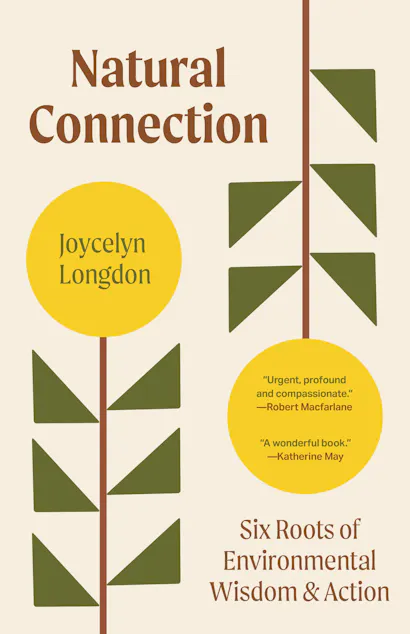
Reimagining environmentalism as an act of doing and a way of being in the world and climate action as a shared goal, not an individual burden, Natural Connection draws on the legacies and ongoing resistance of marginalised communities around the globe to guide us toward a more sustainable relationship with the living world.
In Natural Connection, you present six conceptual roots to guide our journeys toward creating a safe and thriving shared future. Why did it feel important to you to weave themes concerning justice鈥� from race, to climate, to whose knowledge gets prioritized鈥� together rather than treating them as separate conversations throughout each root?
Joycelyn Longdon: There is often a tendency to fall into siloes in environmental research and activism, but our global challenges, social, political and ecological, are intimately connected. Without acknowledging these interconnections, we risk missing important data points, levers of change and opportunities for collaboration and solidarity. It was important for me to bring these intersecting themes together to show clearly how they manifest, through real-life case studies, bridging the theory of intersectionality to its practice. Facilitating intersectional thought and action in environmentalism is essential to ensuring that those most vulnerable to the impacts of climate and biodiversity breakdown are not inadvertently harmed by the action and solutions we develop, which are not inherently neutral. Further to this, communities on the frontlines, whether in the US or in Ghana, India or the UK, have unique worldviews, experiences and approaches to survival which must be centred in decision making around climate and nature. Here, intersectionality is not just about minimising harm, but also about maximising the relevance, efficacy and impact of environmental action.
The book starts with a discussion on the power and perils of fueling environmentalism through anger, and you end the discussion with a chapter titled, 鈥楯oy is the sister of rage鈥�. Why is it necessary for joy and anger to be held together?
JL: Despite its negative connotations, evoking images of violence and aggression, rage is a complex emotion that provides huge potential in fueling collective action. It鈥檚 a rational response to a world that seems ever more unstable, unpredictable and destructive. But, paraphrasing Audre Lorde, it is only potentially useful, if used with precision, for anger, directed misguidedly, or left to fester and rot inside us, fails to achieve the visions of action and liberation we may strive for, instead, making us hard, disengaged and apathetic. In order for rage to both ignite and sustain us, it must be fused with joy.
In moments of despair, I always come back to the words of Robin Wall Kimmerer, who reflects that 鈥榚ven a wounded world holds us, giving us moments of wonder and joy. I choose joy over despair. Not because I have my head in the sand, but because joy is what the Earth gives me daily and I must return the gift鈥�. An absence of joy is an act of violence on the Earth itself; it is to ignore the beauty that the world offers us every day, without fail, and despite destruction. Accessing and enacting joyful rage is a rebellion against not only the material impacts of environmental breakdown, but also the mindsets and worldviews that give rise to it. Seeing joyful rage as a way to connect to the living world requires us to be able to not only identify and fight for the systems we want to end, but also imagine those that we want to create.
Imagination also emerges as an essential dimension to your concept of rooted environmentalism, and you advocate for a decolonisation of imagination. What does that look like, and why is imagination such a powerful tool in environmental work?
JL: Coming back to the rise in apathy and disengagement that feel particularly relevant amidst today鈥檚 overwhelming polycrisis, it becomes ever more necessary to resist the logics of colonialism and capitalism, which through a language of limitation, aim to convince us that there exist no alternatives to the present world order. That we are powerless to the domination of extraction, oppression and destruction we witness, and that a future built on mutual love, care and respect for the world鈥� while a nice thought鈥�is impossible. Racism, extraction, pollution, destruction, poverty and overconsumption are tools of imagination wielded by colo- nialism and capitalism to maintain the status quo. They keep us from seeing the world as it was and as it could be, and yet, through the historic and ongoing stories of previously colonised peoples who have faced the impossible, we find that these ideas are not hard truths, they can and must be dismantled. By building a strong collective imagination, by dreaming and scheming together, the impossible can be endured, scaled, shaped and shattered time and time again.
In the innovation section of the book you push back against the idea that technology and nature sit on opposite sides. When did you first start questioning that way of thinking?
HP: For me, questioning the binary between technological advancement and ecological flourishing began when I started my PhD programme, which focused on developing technologies, primarily AI, to monitor and protect natural ecosystems. Through a four-year participatory collaboration with a forest community in Ghana, focusing on ecoacoustic technologies for biodiversity monitoring鈥� essentially shazam for nature鈥� my PhD questioned whether it is truly possible to resist extractive and harmful practices and build and design technologies which can be rooted in justice, social and ecological. My collaborations with the forest and community showed me that by deploying technologies through a genuinely deliberative approach, more organic forms of knowledge production emerge outside of Western, extractive or colonial paradigms. From deconstructing ecoacoustics sensors, to reimagining data work as a communal practice that fosters interpersonal, intergenerational and interspecies connection, to centring storytelling as an approach to technology design, community members have appropriated and reimagined ecoacoustic research for their context, rooting it within their traditional practices and ecological knowledge. What is clear is that technology is radically transforming our response to ecological breakdown, and its impact is not neutral; its future is a story still being written. For me, the ongoing question is who is doing the telling.
One of the book鈥檚 big challenges, addressed in the theory section, is how we think about expertise. Whose knowledge is most often overlooked in environmental decision鈥憁aking, and what are the consequences of ignoring it?
JL: There is a prevailing orientation which manifests explicitly and implicitly in formal environmental spaces, such as in academia, policy making and global environmental conferences, that centres Western knowledge and excludes other ways of knowing, sensing and developing solutions to address environmental breakdown. This orientation perpetuates classist, racist, and exclusionary practices that limit collaboration across cultures and geographies. Even in spaces that do recognise the power, benefit and necessity of including diverse knowledge systems, there is often either a sharp demarcation between Western knowledge and Indigenous knowledge, for example, where the former is framed as scientific and legitimate and the latter only seen through the lens of culture. Or, there is an intense romanticisation, tokenism and even extraction of Indigenous or local knowledge systems. With the reality that many projects, even when framed as participatory, seldom shift power and leadership to Indigenous or local communities, these practices can lead to the othering of marginalized communities, rather than genuine collaboration, exchange and reciprocity. By ignoring the wide range of theorists that exist, professional and organic, who bring immense value and insight to environmental decision making we risk entrenching harmful power dynamics that contradict and undermine the objectives of the environmental solutions we seek.
You wear many hats: researcher, technologist, writer. How did you approach writing Natural Connection in a way that stayed rigorous but still felt accessible and engaging?
JL: I love the creativity that arises from being rooted in many worlds. It makes the writing process surprising and deeply fulfilling. My writing process begins in a very structured and analytical way with very little writing and masses of reading. In this sense, the beginning of my process is indistinguishable from my more as an academic. It is on this basis, once I have completed the more structured phase that creativity, emotion and play enter into the process. I cease to be a researcher and let elements of poetry and conversation enter. This phase is heavily influenced by my work as a speaker and facilitator, connection to wide ranges of people, from different backgrounds, industries and fields around the world. My approach in these contexts is very relational and this is how I bring in the more accessible and emotive elements of my writing.
For readers who care about the planet but feel overwhelmed or discouraged by the scale of today鈥檚 environmental crises, what do you hope Natural Connection can offer them?
JL: In the epilogue of the book, I speak to our collective task in holding and cultivating hope through a time of collapse. In conversation with Rebecca Solnit, we discuss how hope is often confused with optimism which, in fact, holds the same space as defeat.
Optimism tells us that everything will work out okay, whilst defeat tells us that if we can鈥檛 protect everything or everyone, then we can鈥檛 protect anything. As Rebecca tells me, both outlooks, 鈥榓re a form of confidence in that you know what is going to happen and therefore nothing is required of you鈥�. Through the stories and ideas I share in Natural Connection, I hope readers may find a new and grounded view of their relation to the world, and the power they have to reshape it, encouraging a practice of curiosity, prioritising and nurturing connection, over a false sense of certainty. Where we may not know what the outcome of our actions will be, but know that the work is worth doing in the seeding of new worlds. We must, as late activist and author Joanna Macy urges us, learn to 鈥榙ance with despair鈥�, becoming intimate with the severity of the moment we are living through and the present possibilities for change and transformation.
Joycelyn Longdon is an award-winning environmental justice technologist, writer and communicator. As a PhD candidate at the University of Cambridge, she investigates the design of justice-led conservation technologies. Featured in British Vogue鈥檚 December 2023 鈥淔orces for Change鈥� issue and a TEDx speaker, she has spoken and consulted for a broad range of organisations, including the United Nations, the Design Council and Greenpeace.