
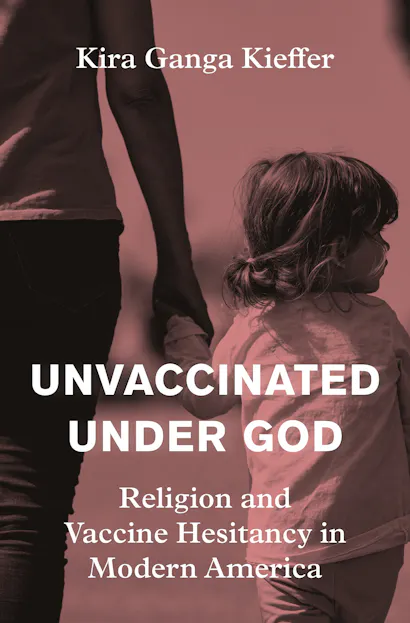
Vaccine hesitancy in America didn鈥檛 begin with the uproar over the mRNA vaccines for Covid-19. The late twentieth and early twenty-first centuries saw resistance to a wide variety of vaccines. In Unvaccinated Under God, Kira Ganga Kieffer shows that debates over vaccine safety and mandatory vaccination were about more than diseases or injections. They have been proxies for existential concerns about justice and morality. Kieffer argues that vaccine hesitancy in the U.S. should be understood as religious expression鈥攏ot as the product of scientific misinformation.
You are a scholar of religion and American religions. How did studying religion lead you to research vaccine hesitancy?
Kira Ganga Kieffer: During graduate school, I started researching alternative health and medicine, spirituality, and consumer wellness culture. I wrote about multilevel marketing, essential oils, and gender. I decided to write my dissertation about how different forms of alternative health, such as taking herbal supplements and using essential oils, were forms of religious practice. In fact, I wanted to put three case studies in historical conversation, and I decided on vaccine hesitancy as the third one because it was different from the others. Vaccine hesitancy was 鈥渁lternative medicine鈥� because it was about abstaining or holding back from a mainstream medical technology and therefore questioning or refusing traditional medical authority and expertise.
I was intrigued when I heard about some measles and mumps outbreaks around the country in the late 2010s and went forward with researching that case study first. When I presented on this topic in November 2019 at the American Academy of Religion Annual Meeting, so many people came up to talk to me afterward and shared personal experiences of feeling vaccine hesitant when they were raising young children. I saw that this was a topic that resonated with people, which is a hugely important part of my desire to be a scholar.
And then Covid-19 hit a few months later. I saw anti-masking protests on Cape Cod when my husband and I were on our way to do socially distanced nature walks. The protests really scared me, but my scholar-brain wanted to understand the motivations behind them. I saw so many parallels with vaccine hesitancy and realized that these folks would likely be hesitant about any new vaccine that could come to market for Covid. I wrote an article about that, which attracted the interest of my editor Fred Appel at PUP. We discussed how I could write a history of vaccine hesitancy in the United States through the lens of religion, which is a completely new take on this topic. The rest is in my book!
In Unvaccinated Under God, you take a new perspective on vaccine hesitancy that shifts the explanation toward religion and away from scientific illiteracy, anti-science beliefs, and misinformation. How does religion help us reconsider this topic?
KGK: My book analyzes vaccine hesitancy at different key moments as religious expression. I think about religion and religiosity very broadly and functionally. The big picture questions that interest me are: Where do popular discussions or movements concerning bodily purity, parental authority, the importance of mothering, come from? Why are they more resonant with many Americans at some times than at others?
From my perspective, vaccine hesitant people express concerns that are quintessentially religious. By 鈥渞eligious,鈥� I mean that their worries are about how to act when they are faced with existential questions about how to keep their body or child鈥檚 body healthy or how to give meaning to physical experiences that are otherwise inexplicable.
In my research, I find that vaccine hesitant people develop fears that vaccines鈥撯�揺ither individual vaccines or the combination of many vaccines鈥撯�揾ave much larger impacts on our bodies than are medically intended. Vaccine hesitancy develops among communities who harbor concerns that vaccines are unsafe, which they base on personal experiences and unorthodox interpretations of scientific and medical data. As a result, they fear that vaccination can cause more harm than good for some people, even when the medical establishment and the government attest to vaccine safety, efficacy, and the moral benefit of mass vaccination programs. The religious actions they take are narrative and embodied. Some discuss how they became vaccine hesitant using a conversion framework in which they experienced a trauma that caused them to adopt a completely new perspective on how medicine works. Others focus on preserving purity and fighting pollution through the decisions they make about foods, drinks, medications, and their immediate environments. And more recently, many fight politically for religious exemptions to mandatory vaccines by equating medical freedom with religious liberty.
How does your understanding of religion incorporate the views or practices of particular religious groups, such as Roman Catholics or Christian Scientists?
KGK: No major religious institution or tradition opposes vaccines or has opposed vaccination writ large, either now or historically. You might then say, well, vaccine hesitancy is not religious because priests, imams, rabbis, etc. don鈥檛 have scripture to say don鈥檛 vaccinate. But that is just one sliver of the picture.
This is because religious authorities are not the only authorities around, and religious ideas affect far more people than simply the most devout followers. They are embedded in our culture and people pick them up when they apply to their lives or lived experiences. In my book, I differentiate between traditional religions, such as Christianity or Buddhism, and more secular religiosity which mainstream Americans use to express existential concerns, moral quandaries, and ideas about how to know what is sacred. I cover both traditional and the non-traditional uses of religion.
What surprised you most in writing about the history of vaccine hesitancy?
KGK: I will give you two surprises. The first came at the beginning of my research, and it was the realization that vaccine history and hesitancy are largely about the role of children in American culture. We receive most of our vaccinations as young children, and it is our mothers who make the decisions about those vaccinations. Therefore, my research and analysis took me into a whole world of changing parenting cultures over fifty years and forced me to think critically about the importance of gender roles and expectations, contestations over authority, and how many American mothers have expressed spirituality through performing mundane maternal labors.
The second surprise came when I really started to engage with the last chapter of the book, which covers the first two years of the Covid-19 pandemic. I was living through the pandemic during most of my research time, but I purposefully held off on analyzing any data I collected from social media and news coverage because I researched and wrote in chronological order. So, I was surprised to find out that Covid vaccine hesitancy was different than all the other forms of vaccine hesitancy I had already written about. It was far more adult-centric, partisan, and dominated by White Christian conservative identity politics than earlier debates about other vaccines. The last third of the book charts how and why vaccine hesitancy changed in the years prior to the pandemic leading so many Americans to reject Covid-19 vaccines and later to adopt many of the ideas of today鈥檚 Make America Healthy Again movement.
Kira Ganga Kieffer is visiting assistant professor of religious studies at Fairfield University.