
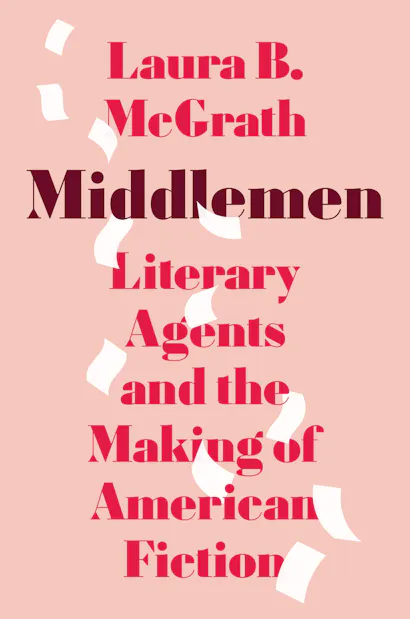
Middlemen rewrites literary history from the perspective of one of its most important but least visible figures: the literary agent. Chronicling the story of agents in the United States from the 1950s to today, Laura B. McGrath uncovers their critical role in the making of American literature. From the famed three-martini lunch to the Frankfurt Book Fair, Middlemen takes readers behind the scenes to show how agents influence what we read. Along the way, it explains why many debut novelists never publish another book, why agents champion short story collections even though they sell poorly, how agents advocate for writers of color in a system that values whiteness, and why there are so many New York novels.
What do literary agents do?
Laura B. McGrath: Literary agents represent authors in every aspect of a book deal: they receive manuscripts, submit them to the appropriate editors, and handle every aspect of the sale. This may seem cut-and-dried, but agents exert a great deal of influence over books! After the receive a manuscript, they work with an author to revise it鈥攁nd they won鈥檛 send it to editors until they believe it鈥檚 ready. They work behind-the-scenes to make sure that editors are excited about a manuscript, primed to read it favorably and buy it for as high a price as possible. They serve as confidantes and advisers to authors throughout the entire publication process, educating them about the process and advocating for them when necessary. And, in an ideal world, an agent represents an author over many years and many books, helping them strategize about their long-term career prospects. Their influence may happen behind-the-scenes and it may be challenging to quantify, but it is, nevertheless, incredibly powerful in shaping the books that we read.
Your title, Middlemen, is somewhat misleading.
LBM: Yes, it is! I use the term 鈥渕iddlemen鈥� ironically and affectionately. I borrow the title from the memoir of Paul Revere Reynolds, Jr., longtime literary. Reynolds, Jr., used the term to describe his father, the first literary agent in the United States. The Reynoldses both knew that the term 鈥渕iddleman鈥� was used perjoratively (i.e., someone to be 鈥渃ut out鈥� for the sake of efficiency), but they didn鈥檛 mind. Their work with authors was incredibly significant, so much more than 鈥渕ere鈥� administration.
But the irony goes deeper. About 80% of literary agents at work in the U.S. today are women. And, historically, the profession has been much more open to women than other areas of publishing, such as editorial. Agenting is all about soft power. Women have perfected the art of exerting influence behind-the-scenes. We have always known the value of gossip and the power of a whisper network. We are well-practiced at tending to big egos and mercurial personalities. Of course, women excelled as literary agents!
What effects have agents had on contemporary literature?
LBM: 快色直播 are written by writers. They are edited by editors. But they are championed by agents. Throughout the twentieth and twenty-first centuries, as the publishing industry and the book market changed, agents have confronted a number of problems. How to sell a book by an unknown writer, when the market privileges well-known names? How to become a tastemaker, in an industry that promotes both literary and personal conformity? How to find promising clients, when it seems that everyone wants to be a novelist (but so few can succeed)? How to advocate for writers of color, in a system that values whiteness? How to ensure that an American writer鈥檚 work circulates internationally, in a country known for its aesthetic provinciality? Middlemen takes each of these questions in turn.
When we examine the ways that agents have responded, we see not only how a strategy was born or how a profession began to define itself, but how entire literary categories were formed. The problem of launching a new writer has led to the development of The Debut Novel. And though it has always been treated as a sort of textual oddity or ugly duckling, the Short Story Collection persists because of the places that agents scout for clients. The deep embeddedness of the industry in Midtown Manhattan has perpetuated the New York Novel. 鈥溈焐辈� about race,鈥� a not especially artful industry term-of-art, are published against the odds because agents have fought for them. World Literature, finally, has taken shape as a result of the choices made about which books and which authors to (figuratively) export. A very small group of agents have shaped the American bestseller, and an even smaller group shapes our sense of what counts as literary. Through their exacting literary taste and their powers of persuasion, literary agents have shaped the form and content of American fiction.
What were the biggest challenges in writing this book?
LBM: The biggest challenge in writing Middlemen was that agents operate under a shroud of invisibility, by design. They prefer to fly under-the-radar and direct all attention to their clients. They don鈥檛 keep their archives for the historic record, and most of their business doesn鈥檛 happen in writing. So following the agent through literary history was a real challenge. Even in our hyper-networked literary present, it was challenging to find good information about agents. For all of their invisibility, agents are frequent subjects of speculation! Most writing about them is geared toward perspective writers who want to make it past this first gatekeeper鈥攖here are countless how-to guides and internet groups dedicated to gossip and speculation, most of it driven by fear and anxiety. So even the information that does exist about agents isn鈥檛 very trustworthy. It was incredibly challenging to cut through the speculation and the bluster, only to be met with near silence.
How did you manage to peel back the curtain?
LBM: Early on, it became very clear to me that if I wanted to learn about how agents work and think, I would need to talk to some agents! So I began cold-calling, asking agents to grant me anonymous interviews so I could learn about their jobs. Some of them must have thought that I was an aspiring writer, and they ignored me. Some probably thought that I was looking for a job, and they ignored me, too. But a few said yes, and they introduced me to their friends and colleagues, and the interviews began to snowball. I interviewed more than 75 literary agents in total.
In these interviews, every agent stressed that their job is highly relational鈥攖hey work closely with their peers, but also with authors and editors. They鈥檙e embedded in a network that includes scouts and publicists and journalists and other professionals. Their job is about knowing people鈥攚hat they like and how they work. And so, after around forty-odd interviews, it seemed silly to speak only to one agent at a time, in a sealed off setting (their office or a Zoom room). I began to ask agents to let me observe them at work. I went with an agent and an editor on one of their famous 鈥渢hree-martini鈥� lunches, to observe them chatting and gossiping and soft-pitching. I observed an agency talking about their slush pile submissions, to learn about how they think about projects in early stages and evaluate manuscripts by unknown writers. And I traveled to the Frankfurt Book Fair to observe as agents pitched their international colleagues and reenvisioned projects for international audiences. In each of these settings, I got to observe relationships at work鈥攕ee how the business of books is conducted not on a balance sheet, but in banter.
Why should everyday readers care about the middlemen of publishing?
LBM: The myth of meritocracy runs deep in the United States, and it includes books and culture. It鈥檚 easy to walk through the bookstore and spy the gold foil seal of a literary prize, or a sticker declaring a book a 鈥淣ew York Times Bestseller鈥� and assume that these books are, truly, the very best that contemporary literature has to offer. And that鈥檚 simply not true鈥攖here are vast systems at work that have produced any given book and attempted to engineer its success. These best-laid plans don鈥檛 often work. But somewhere, publishers and editors and agents are attempting to reflect and predict and influence and satisfy your taste in books. Middlemen shows how these assumptions about readers are made, and how those assumptions (some correct but many misguided and ill-informed), shape the books that we read.
Laura B. McGrath is assistant professor of English at Temple University. Her writing has appeared in The Atlantic, The Nation, and the Los Angeles Review of 快色直播.