
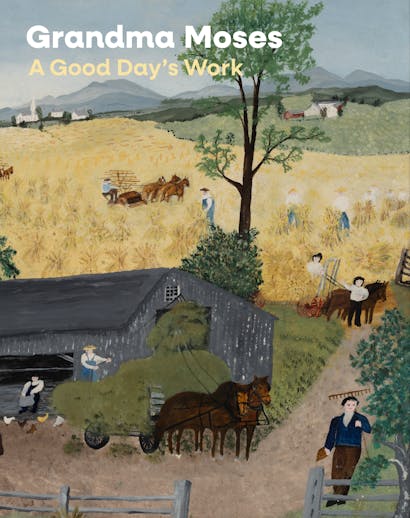
Grandma Moses: A Good Day鈥檚 Work repositions Anna Mary Robertson 鈥淕randma鈥� Moses (1860鈥�1961) as a multidimensional force in American art, whose beloved recollections of rural life earned her a distinctive place in the cultural imagination of the postwar era. Moses was eighty years old when Otto Kallir, a New York art dealer and recent 茅migr茅 from Nazi-held Austria, introduced her to the world. 鈥淕randma Moses,鈥� as the press dubbed her, quickly became a polarizing figure, beloved by the public yet dismissed by the art world for her story-time scenes and lack of formal training.
Grandma Moses: A Good Day鈥檚 Work is a major retrospective exhibition and catalogue at the Smithsonian American Art Museum, but the project is grounded by a major collection initiative as well. How did SAAM decide to commit to Moses in such depth?
Leslie Umberger: When I became SAAM鈥檚 inaugural curator of folk and self-taught art in 2012, one of my first tasks was to assess its self-taught art collection. The absence of Grandma Moses got my attention, as she was arguably the most famous female artist of her day鈥攕elf-taught or otherwise. Adding her work to the collection became a priority. Moses was painting old-timey narrative scenes at a moment when the American art world was enraptured by the abstract expressionists and taking the world鈥檚 center stage. If you imagine Grandma Moses versus Jackson Pollock, the divide between audiences is easy to understand. But I felt that the enormity of her popular appeal versus the vitriol with which the art world met her and her paintings was worth investigating.
Self-taught artists follow their own stars; they aren鈥檛 interested in art world trends or games. Moses didn鈥檛 go looking for a way into the art world. She found a creative path that suited her own needs and abilities and allowed her to stay busy and re-live her ten decades of life when her body could no longer keep up with her mind. She made some fantastic paintings and contributed a great deal to the larger story of American art. SAAM determined that Moses鈥檚 was a story worth telling. Over a span of ten years, the museum shaped a premier collection of her work, which anchors the exhibition and catalogue but will also feature prominently in the museum鈥檚 galleries from here forward.

What will readers of the catalogue discover about Grandma Moses that they might not in the exhibition alone?
LU: The exhibition immerses visitors in the richness of Moses鈥檚 ability to convey the natural world and evoke the power of community. The catalogue delves more deeply into the life story that grounded every painting Moses made through a series of essays and perspectives. It situates her within& varied contexts, allowing us to see beyond the 鈥淕randma鈥� stereotype and consider Moses as a smart, observant, creative and curious woman who lived a long and eventful life. This more expansive view explores the contribution Moses made to American landscape painting, and chronicles the important relationship she would come to have with her gallerist, Otto Kallir. It positions Moses within the context of the 鈥渨orker culture鈥� that peaked in the 1930s, which simultaneously aligns and differentiates her from other midcentury American artists who drew on a similar ethos.
It also illuminates, for the first time, the eighteen years Moses and her family spent living in post-Reconstruction Virginia. Even though Moses only began painting the memories of her life after the consuming focus of farming and raising a family had subsided, those years in Virginia as a young wife and mother profoundly shaped the farm matriarch persona that made Grandma Moses the artist she later became. Her memories from that era offer some insight as to why her imagery remained persistently upbeat鈥攅ven when life wasn鈥檛 so sunny.
Are there any surprises in store for audiences who think they know Grandma Moses already?
LU: People think of Moses paintings as cheerful scenes of farm life and family celebrations, and they aren鈥檛 wrong鈥攖hese are the scenes that made her famous. But I was quite intrigued by some of here lesser-known images. Like any farmer, Moses was keenly aware that the natural world was a place of balance; where the calm and the storm go hand-in-hand. She acknowledged that life meant one had to 鈥渢ake the bitter with the sweet.鈥� I found her paintings of thunderstorms, blizzards, and forest fires to be rich and enthralling, vivid ruminations on the turbulence of the natural world. It鈥檚 also interesting to see how, whether she is depicting a blazing stand of pines, the thin crispness of Halloween night, the soft, slightly-blurry look of spring鈥檚 first bloom, or the warm brittle look of hay at harvest time, her innate sense of color, light, and texture will transport you into the moment in a way that is powerful and immersive.

North-Eastern scenes such as 鈥淥ut for Christmas Trees,鈥� and the maple sugar harvest made Moses famous, yet this project gives significant attention to the years the Moses family lived in Virginia. Can you expand on why that era was particularly important to illuminate, and what audiences may find surprising?
LU: Moses was born in upstate New York, died there, and lived there most of her life in between, so naturally this was a dominant part of her character and identity. But she and her husband moved to Virginia鈥檚 Shenandoah Valley as newlyweds. Their five children were all born in the South, and five others鈥攁lso born there鈥攄ied in infancy and stayed behind in the Virginia soil when they eventually moved back North. This was also the place that Moses鈥檚 skills as a businesswoman came to the fore; her know-how with butter making was key to her family鈥檚 success. Moses was hesitant about being a 鈥渟tranger in a strange land鈥� when they first left home. But she came to love the mountainous beauty and the endless bounty of the place that, with time, became home. In her mind, an activity like making apple butter was as tied to location and local flora as the North鈥檚 maple sap harvest. Our research into the five Virginia farms that Moses and her family lived on in the last decades of the nineteenth century made her come alive as an adopted southerner鈥攊n addition to being a native northerner. She loved the Shenandoah Valley deeply and, when the time came, returned to New York only reluctantly.

Moses鈥檚 101-year-long life spanned the Civil War, two world wars, the Spanish Flu, Reconstruction and post-Reconstruction, and the Civil Rights era, as well as great personal losses along the way鈥攜et she didn鈥檛 paint any of these things. How and why did she paint what she did?
LU: Moses once said, 鈥淵ou don鈥檛 get to be ninety-five without having some sad memories and knowing ugly things. But I don鈥檛 believe in painting ugliness.鈥� When she turned her focus to painting, I think it served multiple purposes. She was grieving the loss of her husband and one of her daughters, and, to some extent, the loss of an active farm and family life that had long defined her. Painting became the means through which she cradled those memories and accounted for a life that she described as 鈥渁 good day鈥檚 work.鈥� Moses foregrounded the rosy because she had been raised to get through the hard times by dogged hard work and determination, and by banding together with others in the hard times in order to rightfully share life鈥檚 bounty in better times. She didn鈥檛 want to re-live struggles she had worked to get past or confront the horrors of war and inhumanity. For Moses, picture-making was a means of processing and coping, but also of reminding people of the powers of honest work, mutual aid, and a life well lived.

Leslie Umberger is senior curator of folk and self-taught art at the Smithsonian American Art Museum, where Randall R. Griffey is head curator and Eleanor Jones Harvey is senior curator. Erika Doss holds the Edith O鈥橠onnell Distinguished Chair in Art History at the University of Texas at Dallas. Stacy C. Hollander is a scholar of American self-taught art and former deputy director of curatorial affairs, chief curator, and director of exhibitions at the American Folk Art Museum in New York. Katherine Jentleson is the Merrie and Dan Boone Curator of Folk and Self-Taught Art at the High Museum of Art in Atlanta. Jane Kallir> is president of the Kallir Research Institute in New York.