
In 1974, philosopher Thomas Nagel published a now-famous paper titled “What is it Like to be a Bat?” He was exploring the mind-body problem, that classic philosophical conundrum about how the physical and the mental are related to each other. By imagining how another species experiences the world, Nagel hoped to explore the difference between subjective and objective perspectives as well as the notion of consciousness itself. But why a bat? He explains (emphasis mine):
I assume we all believe that bats have experience. After all, they are mammals, and there is no more doubt that they have experience than that mice or pigeons or whales have experience. I have chosen bats instead of wasps or flounders because if one travels too far down the phylogenetic tree, people gradually shed their faith that there is experience there at all. Bats, although more closely related to us than those other species, nevertheless present a range of activity and a sensory apparatus so different from ours that the problem I want to pose is exceptionally vivid (though it certainly could be raised with other species). Even without the benefit of philosophical reflection, anyone who has spent some time in an enclosed space with an excited bat knows what it is to encounter a fundamentally alien form of life.
I’ll wager there’s a story behind that last sentence, though I could also argue that spending time in an enclosed space with virtually any wild animal could make one feel similarly. I’m also intrigued by the assumption that mammals are automatically more likely to have experiences similar to those of humans. Nagel’s reflections spawned numerous commentaries and critiques from psychologists and neuroscientists as well as philosophers, including one titled, presumably ironically, “What is it Like to be Boring and Myopic?” None of them, however, thought his choice of an animal that exists outside the realm of our experience was faulty, or questioned the notion that non-human animals are akin to life forms from another planet.
Those attitudes are falling out of favor, as more discoveries point to the extraordinary capabilities of creatures with much smaller brains and less similarity to humans than bats. People, it turns out, are quite willing to “shed their faith,” as Nagel puts it, that invertebrates have experiences. Octopus, for example, are having a moment, with philosopher Peter Godfray Smith writing about their potential intelligence and personality in his book Other Minds, where he beautifully contemplates how their complex behavior suggests a connection to us that is absent in most other invertebrates.
More recently, in Daughter of Mother of Pearl, Mandy-Suzanne Wong finds similar connections to even more unlikely creatures, such as abalone or starfish. She believes those animals see her as a kindred spirit of sorts, suggesting that a starfish she encountered experienced “silent amazement” at encountering a human.
I understand that awe—it’s part of why I became a biologist. Yet many scientists, including me, find the notion that the creatures that amaze us are amazed right back, a bit of a stretch. Ecologist Jeremy Fox said in his blog, “Whatever you think it’s like to be an abalone is entirely your own imagination at work. It’s projection–it’s you imagining what you would feel like if you were an abalone.” I have to agree. It’s not that I am unsympathetic to finding continuity in nature, where we are all related to each other, but we don’t need to see animals as having the exact same feelings or abilities as humans to do that. What’s more, seeking those parallels can encourage us to simplistically categorize animals as friends or foes, based on that perceived similarity.
People think that considering other species as our brethren makes us humble. It doesn’t. It just means we assume they are just like humans, rather than try to understand what it means to be them, to have tentacles, or fly through the night swooping down on moths and mosquitoes we “saw” with our ears. And it also makes us prey to the long-outdated notion of traveling up or down that tree, as if animals can be ranked as more and less like people, with those closer to us, like fellow mammals, more likely to think and feel as we do. Certainly, the tree of life represents relative evolutionary distance between the common ancestors of any two species. But we can find similarities in behavior or anatomy because of many causes, including convergent evolution, where similar selective pressures cause apparent similarities in form, like the wings of bats and birds. Species with which we share more recent common ancestry aren’t guaranteed to be smarter or have similar emotions, so we shouldn’t be surprised at similarities with species that are further away.
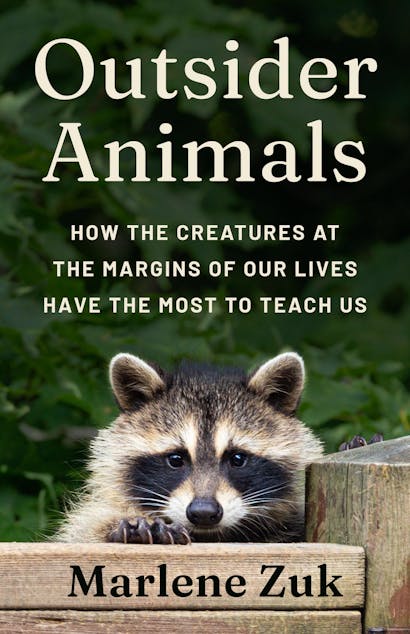
In Outsider Animals, I hope to get past the stereotypes and the urge to categorize animals as “good” or “bad,” “natural” or “invaders.” I explore the ways that animals we often encounter, like raccoons or rats or even cabbage white butterflies, are neither replicas of people nor robots, and how their complexity is sometimes ignored when we interact with them. This doesn’t mean I don’t love lots of kinds of animals. I do. I even love animals no one has heard of, like tardigrades, or animals that make most people nervous, like spiders. But I recognize that this love doesn’t require me to be in synch with their psyches.
Focusing on outsider animals—those we don’t necessarily seek out or find useful—h±đ±ô±č˛ő us see them as themselves, rather than extensions of people to be glamorized or held up as models. When it comes to animals that are close to us, like dogs, our tendency is to anthropomorphize them. If animals are totally alien or unfamiliar, like aardvarks, our emotional investment is low. But maybe we can find a middle ground, and admit to a certain curiosity about coyotes, or gulls, or snakes. It’s not that I want people to stop romanticizing animals. I want them to romanticize them better. That means avoiding not only anthropomorphism, the projection of human qualities onto animals, but what noted primatologist Frans de Waal calls anthropodenial, describing animals as though they automatically lack those qualities. Can we instead keep our preconceptions at bay and embrace that curiosity?
Marlene Zuk is Regents Professor of Ecology, Evolution, and Behavior at the University of Minnesota and a member of the National Academy of Sciences. She has written for The New York Times, the Los Angeles Times, and New Scientist. Her books include Dancing Cockatoos and the Dead Man Test: How Behavior Evolves and Why It Matters and Paleofantasy: What Evolution Really Tells Us About Sex, Diet, and How We Live.