
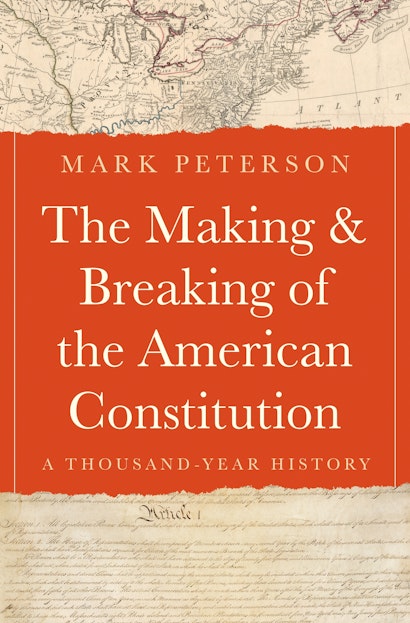
Mark Peterson traces the American constitutional tradition to the control of land in medieval England, showing how the founders incorporated the aspirations of Magna Carta with the administrative principles of the Domesday Book, a meticulous survey and valuation of landed property commissioned by William the Conqueror. This framework encouraged the growth of democratic self-government in a young nation. It also institutionalized the colonization of territory and the expulsion of Indigenous peoples, establishing a legal blueprint for transforming tribal lands into revenue-yielding real estate for settlers. Peterson鈥檚 riveting narrative paints an arresting picture of a dynamic republic whose frame of government has changed enormously to meet the challenges of the modern age but whose written constitution has changed very little.
There have been many histories of the American Constitution鈥攚hat makes this book different?
Mark Peterson: Most histories of the Constitution tend to do one of two things: either they focus narrowly on the events of the 1780s, and in particular the Constitutional Convention of 1787, with special emphasis on the personalities, politics, and interests of 鈥渢he Founders鈥�; or else they follow the subsequent fortunes of the 1787 written text through controversies, conflicts, and amendments, often featuring court cases, judges, and legal analysis.
This book is very different. It revises our understanding of what constitutions are and always have been: not just written texts or rulebooks for government, but rather relationships between the people of a nation, the framework of government they shape for themselves, and the written instruments they use to define and limit their government. This understanding was universally held by the people who made new American constitutions in the Revolutionary era鈥�they were obsessed with creating frameworks of government and written instruments suitable to their own distinctive societies. This book offers a new version of American constitutional history by focusing just as much on major changes in the American land and people, as it does on how frameworks of government and written instruments have been adapted (or not) to those changes. In that sense, it鈥檚 a social history of the American constitution.
The United States only 250 years old, but you call this 鈥淎 Thousand-Year History鈥�? Why?
MP: The book begins in the Middle Ages, specifically with the Norman Conquest of England and the 鈥淒omesday Book鈥� created by William the Conqueror in 1086. The practices of landholding and government first laid down in writing then had an enormous influence on the colonization of America and the shaping of its governmental traditions. Colonization was itself a form of conquest and a massive transformation of landholding, very different in nature from the Norman Conquest but critical to shaping both the aspirations and practices of American government. Unless you understand where the ideas and assumptions about government that shaped colonial America come from, as well as how the conditions and challenges of life in America differed from those in Britain, it鈥檚 impossible to understand why and how Americans created new constitutions in the Revolutionary era and what purposes they served.& But it鈥檚 equally important to extend that story from the Revolution to the present, to see how the evolution of America鈥檚 highly dynamic society has moved the nation鈥檚 needs and challenges ever farther away from the purpose for which its Constitution was designed.
When you talk about the 鈥減urpose鈥� of the Constitution, what specifically do you mean?
MP: Many Americans today think of the Constitution as an ideal template for American government, a set of abstract principles on which the nation was originally founded. That鈥檚 not really what it was, or what happened in 1787. The United States had already generated a complete constitution as of 1781. In that year, the individual states (which had each formed their own constitutions as sovereign entities) finally ratified the Articles of Confederation by which they had jointly framed a 鈥減erpetual union鈥� among themselves. This constitutional framework was strong and effective enough to win the war with Britain and establish American independence.
After the peace treaty of 1783 granted the US the enormous territory west of the Appalachians (then owned and occupied by dozens of Indigenous nations), some Americans began to think the Articles were not adequate for the challenges the nation now faced. The national government under the Articles lacked the formal powers and the financial and military strength necessary to gain control of the West鈥�the very problem that had undermined British authority after 1763. I argue that the main purpose of the new constitutional realignment of 1787 was to address this specific challenge. Many of the features of the new Constitution, from its principles of representation to the various branches鈥� checks on each other鈥檚 powers, to the Bill of Rights appended later, had already been developed by the states and adapted from British constitutionalism. They were important features that Americans had already come to expect in their governments, but they were not the purpose for which this new constitution was created.
How did the Constitution鈥檚 original purpose shape the nation鈥檚 history? Has its purpose changed over time?
MP: We can see the impact of the empowerment of the federal government by the new Constitution in the extraordinary expansion of the nation鈥檚 territory and population across the nineteenth century. This was the principal activity of the federal government in its first century. It resulted in the rapid transformation of the continent and its consolidation under US control, at the expense of Indigenous Americans. Although Americans today take this history for granted, the speed and scale of this transformation has few if any parallels in human history. Arguably, the most dramatic change in the American Constitution over its first century was the addition of 32 new states to the original 13, extending the national domain far beyond its original limits, and adding 60 million people to the original 4 million. None of this was foreordained in 1776, but the 1787 Constitution was crafted and adapted to make this possible.
By the end of the 19th century, many Americans were aware that the 1787 constitution had not been designed for the increasingly urban and industrial country the US had become. A series of amendments to the written constitution was passed early in the 20th century, attempting to reshape the frame of government to suit the conditions of the modern nation. But this process was truncated by the emergencies of the Great Depression, WWII, and the Cold War. The nation and its government continued to grow and change (much of this change promoted by the expanding federal government itself), but the written instrument was barely altered to accommodate these changes.
Is this what you mean by the 鈥淢aking and Breaking鈥� of the Constitution?
MP: In a general sense, yes. What I 诲辞苍鈥檛 mean is that the Constitution was made by 鈥淭he Founders鈥� in 1787 and then broken by politicians nowadays but was just fine in between. Rather, by conceiving of constitutions as relationships, we can see that they are continually being made, broken, and remade. In the 1770s and 1780s thirteen former British colonies realigned their constitutional relationship in the wake of the collapse in North America of the much-revered British Constitution, which had not been adapted to suit the colonies鈥� changing conditions and accommodate their growing importance within the empire. The new constitutional order constructed in the 1780s was already being pulled apart by the 1810s, when Congress took over the sovereign people鈥檚 power to add new states to the Union from foreign territory. This accelerated an expansionist process that culminated in the Civil War鈥�a severe test that remade the constitutional order once again.
Over the past century, the country has changed dramatically鈥�I use material from the US census to demonstrate this. Its government has also completely remade itself. But the written instrument that is supposed to both empower and limit that government has not been sufficiently adapted to suit these new conditions. The United States has reached a point analogous to the British Empire in the 1770s 鈥� its much-revered constitution can no longer adequately address the challenges of the nation America has become.
Since your thousand-year time frame projects the story forward into the future, what do you think of the prospects for America鈥檚 constitutional order? What might a new realignment look like?
MP: I 诲辞苍鈥檛 claim any greater ability than the next person to predict the future. But the history this book recounts suggests two persistent patterns in Anglo-American constitutionalism worth noting. One is that major constitutional realignments in our tradition are always driven by problems or crises that can鈥檛 be resolved under the current constitution. They are not abstract statements of government ideals鈥�they are meant to address glaring problems. And the second tends to follow from the first: the new realignments themselves are usually not 鈥渃onstitutional鈥�鈥�they happen in ways that do not follow the rules of the current order. This was true of the 1787 US Constitution, where the Philadelphia convention delegates set aside the instructions they had received from the Confederation Congress, created a different kind of government altogether, and invented new standards for ratification, different from what the Articles of Confederation had called for.
Today the American constitutional order seems to be foundering in many ways, with a government inadequate to deal with a wide range of 鈥渆xternal鈥� crises鈥�climate change, wealth inequality, and global migrations, to name just a few鈥�as well as 鈥渋nternal鈥� problems within the government itself鈥�radical power imbalances among the government鈥檚 branches, a huge administrative state with minimal constitutional support, ever increasing inequality in representation, and many more. What combination of these or other issues might trigger the crises that would lead to a major realignment, and what the new result will look like, I can鈥檛 say. But it is encouraging to note that in the major constitutional realignments of the past, cherished principles, rights, and freedoms have persisted and been strengthened through constitutional change. And remember: Americans today, just as in the 1780s, have the right and the duty to repair or replace a broken constitutional order if it no longer meets the needs of the world they live in and the future they hope for.
Mark Peterson is the Edmund S. Morgan Professor of History at Yale University. He is the author of The City-State of Boston: The Rise and Fall of an Atlantic Power, 1630鈥�1865 (快色直播) and The Price of Redemption: The Spiritual Economy of Puritan New England.