
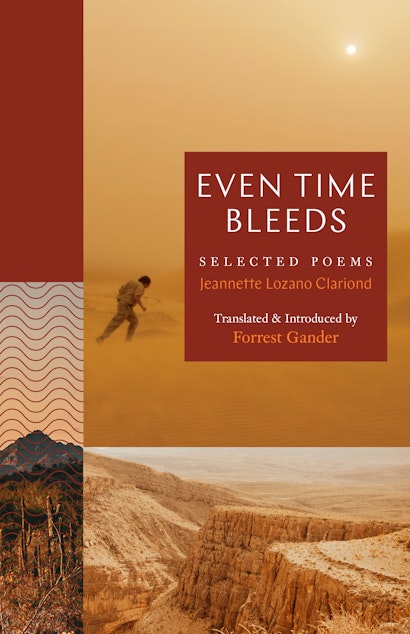
One of the first images I saw when writing my first poem was a bleeding mirror. I remember the first glance and the first lines:
Like a mirror that bleeds
like a wound that keeps seeping
I slip
down the volcano’s mouth
I slip
between your legs
trying to hold myself together.
The title of the poem is «Genesis.» Later, I came to understand that one is born into poetry through the body of language (Il corpo del linguaggio). An image allows us to voice our Ars poetica.
That first poem provided me the path I was to follow. The perfection of language accompanies the perfection of love and the perfection of pain. Even Time Bleeds is an anthology organized and transcribed thanks to the subtleties of Forrest Gander’s eye. I consider blood as the vicarious means of connecting with traditions where borders are erased and the world is seen as pure crystal. Saint Augustine confessed that he knew what time was though he could not explain it. I see time as a wound that inevitably drains down the crystal.
Am I condemned to see everything around me as pain? Not necessarily. The Western world has been taught that suffering should be avoided at any cost. Suffering is what broadens our spirituality. This is the sadness we find in Montaigne and Hamlet.
Neither wars nor weapons can help us reach a higher level of being. One image is much more compelling than radium or nuclear weapons. Poetry is silence at its highest. It is how we listen to one another and ourselves.
We enter a monastery to become one with silence. We enter the depths of poetry to hear the silence and settle it within ourselves, so it becomes “something.� That somethingness is transformative in ways no other art allows. Poetry is a destiny back to one’s origins. It is the root, and it is the foliage, the crest, and the abyss. Poetry is a lifelong question for which there is no answer. But poets must write what they see. This is their truth, and their life’s commitment: writing what has been seen as form of salvation, whatever salvation means for each individual voice. To me, writing is both my sin and my salvation. Like Job, if I speak, I place my finger inside the wound; if I stayed silent, the wound would not speak. This is what I mean by “somethingness�. There is no possible way of describing or defining what sort of strength we gain when we write or read poetry.
Good readers are cowriters. Critic and professor Harold Bloom once said to me when I asked what he meant by “strong� poets: “I was thinking about Nietzsche.� His answer had to do with “sartker,� which he took after the German philosopher. Being strong asks of poets being able to glue-up the fragmented self. I cannot think of a better example than James Merrill’s “The Broken Bowl,� one of the most perfect poems of the 20th Century in the English language. This is the first stanza:
To say it once held daisies and bluebells
Ignores, if nothing else,
Its diehard brilliance where, crashed on the floor,
The wide bowl lies that seemed to cup the sun,
Its green leaves curled, is constant blaze undone,
Spilled all its glass integrity everywhere
Spectrums, released, will speak
Of colder flowerings where cold crystal broke […].
Materialist atomists like Leucippus and Democritus maintained that everything in the universe, including consciousness and emotions, is composed of tiny blocks of matter, or atoms. Atoms travel in a downward direction, but there comes a moment when they perform the clinamen. The clinamen, according to Coleridge, is a detour; it leaves its orbit and, like the poet, breaks free from tradition. That is what makes a strong poet: owning a voice. This is achieved through genuine emotions that arise from the subconscious and self-knowledge. I’m not talking about automatic writing; I’m referring to the poet’s ability to see inside his or her own thoughts in images. By refining these images, they delve deeper into their voice and strengthen what they wish to say. In a broken bowl we see the fragmented piece on the floor, the sun, the splints, the crystal… but we can also see the strength and the intensity that enables the bowl (us) to reconstruct itself in the solitudes of love, in the solitudes of loss. We do not see the blood, instead, we look at the reflections of light assisting us to ascend in a way no other art can.
This is perhaps the greatest accomplishment of poetry: to descend, to fall, to break, to know that in writing and reading we become one again. In Christian tradition, “blood� has to do with the Savior. In poetry, in Even Time Bleeds, “blood� is nearer to sacrifice in the sense that it shares the same root as sacred (sacer in Latin). I am not dealing with a sword on the body. I am inciting beauty through void, somethingness, silence, contemplation.
Jeannette L. Clariond is an award-winning Mexican writer and translator. She has published many collections of her own poetry as well as Spanish translations of Elizabeth Bishop, Anne Carson, Primo Levi, and other writers.