
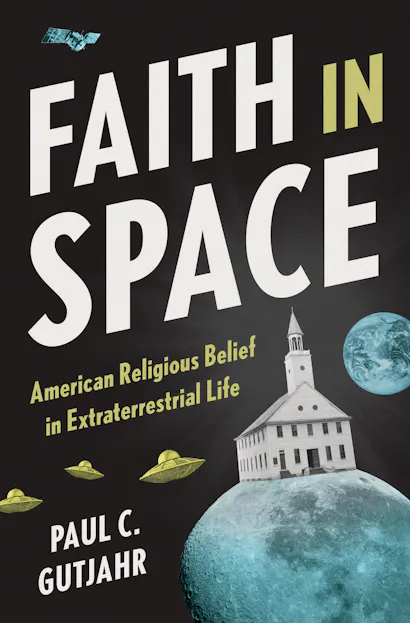
Over the past three centuries, belief in extraterrestrial life has had a profound influence on American religion. Faith in Space examines the key thinkers and religious leaders throughout American history who built faith communities around the notion that we are not alone in the universe, and that the path to spiritual truth leads heavenward to the stars.
What initially sparked your interest in exploring this topic?
My interest in this topic began in the late 1990s. I was working on a piece on early Mormonism, and I came across the fact that the Mormon prophet Joseph Smith鈥檚 father had commissioned missionaries to the moon in the 1830s. When I began to think about early Mormons viewing other planets as missionary fields, I thought that there just might be a book in this. In fact, I had planned on making this my second book, but I kept running into difficulties. The issues surrounding American religious belief in life other planets ended up being far more complicated than I had anticipated. Far more American religious traditions had a concern with extraterrestrial life than I had originally thought, and often the beliefs and practices of these traditions were quite complex. After collecting materials and thinking about the topic for over two decades, I finally sat down to write the book. It has ended up being my tenth book project.
You set the stage for your discussion of American religious belief in alien life by talking about something you call 鈥渆xtraterrestrial cosmologies.鈥� What exactly do you mean by this term, and why is it important?
鈥淐osmology鈥� is but a fancy term for the stories human tell themselves about their place in the universe. Cosmologies are conceptual frameworks we construct to explain in an ordered fashion what is out there and why we are here. All religious traditions have cosmologies, ways of explaining human existence in the context of larger scheme of often divine beings and divine meaning. 鈥淓xtraterrestrial cosmology鈥� is a term I coined to point to those cosmologies that include distinct, and often pivotally important, beliefs in extraterrestrial life. Such extraterrestrial cosmologies help humans see that they are not alone as intelligent life forms in the universe, and that often the role of humanity has far-reaching influence on the workings of the entire universe. These cosmologies teach us that our actions and the actions of those on other worlds are inextricably tied together, binding the fate of humanity to intelligent life elsewhere and everywhere in the universe.
Your book focuses on both religion and science when it comes to humanity鈥檚 quest for salvation. What are some of the key intersections between scientific innovation and religious belief that you discuss when it comes to the development of American religious belief in extraterrestrial life?
I cover about a dozen different religious traditions in my book and one of their defining characteristics is that they are either new traditions or new offshoots of old traditions. The key here is their newness. These nascent traditions were often open to new ideas and new ways of looking at things that older traditions were not. They also advertised their newness as a key component to the truth claims they made.
For many of these traditions, new advances in technologies spurred their interest in extraterrestrial life. My book covers over three centuries of extraterrestrial religious belief in the United States. I will offer just three examples of this, each taken from a different century.
- During the eighteenth century great advances were made in optics and the telescope. This allowed people to see new planets and already known planets in new ways. These advances showed us much more detailed topographies of the Moon and Mars in the nineteenth century. This interest in the moon led to new speculation about it perhaps being inhabited. The Mormons became interested in life on other planets during this time and many of its early leaders thought different planets in our solar system were inhabited.
- The invention of the telegraph in the nineteenth century was a mind-bending technology for many. For the first time, messages could be sent great distances without any real physical trace. Paper and the mail were no longer needed to send a note. You could do it through electronic pulses. This new reality of disembodied messages from faraway places was quickly adopted into Spiritualism and its belief that you could contact those who had died. What many people do not appreciate about Spiritualism is the fact that Spiritualists communicated not only with the dead but with beings on other planets. The spirit rapping or tapping so associated with early Spiritualists was but the manifestation of a cosmic telegraph that connected the living to the dead and to those on other planets.
- In the twentieth century, the great technological advance was the atom and then the hydrogen bomb. For the first time, humanity had created a weapon that could destroy the Earth. Questions arose about whether humanity鈥檚 technological reach had outpaced its moral ability to control such power. Scientology and many of the UFO religions picked up on this anxiety and offered teachings where beings from other planets could come and interact with humanity to show them a way out of the apocalyptic tendencies of their new weapons technology.
You write that many Americans 鈥渨ould be startled to learn the extent and power a belief in extraterrestrial life has had on American religious thinking.鈥� Please give a few examples of how a religion鈥檚 cosmology has affected the beliefs, practices, and behaviors of its adherents.
One of the great through-lines in my book comes in the fact that Christianity, and its most favored form in the United States, Protestantism, has been touched by a belief in extraterrestrial life. Many of the religious traditions found in this book are rooted to various extents in American Protestant belief. Both the Mormons and the Seventh-Day Adventists had deep ties to American Christianity and took many standard Christian beliefs of the nineteenth century and then began to transform those beliefs into something new. For the Mormons, their belief in life on other planets provided a framework for the new teachings on polygamy and eternal progression. Leading a righteous life on Earth could result in progressing to a place in the next life of taking charge of one鈥檚 own planet and populating it with spirit children. In the twentieth century, the leaders of Heaven鈥檚 Gate saw themselves as the fulfillment of two prophetic figures found in the Bible鈥檚 Book of Revelation. These two latter-day prophets taught that, because the End Times were near, it was vitally important that their followers adopt certain ascetic practices (such as abstaining from sex and partaking of daily rituals of purifying meditation) that would allow them to separate from this world in order to get ready for space travel to another, better world.
Who is your ideal reader for this book?
I have tried hard to write a book that would appeal to the educated non-specialist. I wanted people who enjoy being curious and learning new things to read it. I wanted to tell a story about American religious traditions that would introduce new ways of look at American religion and its relationship to religion, print and media culture, and technology. Mark Twain has a witticism I have always liked: It is not that hard to be funny, one just needed to tell the truth. I thought a lot about this tidbit from Twain when I was writing this book. I thought if I can just tell the stories of these religious traditions in a lucid enough manner, people could not but be swept up in the innately fascinating aspects of the traditions I discuss.
In the end, I hope that people will come away from this book and say that they enjoyed it and that they learned from it. I want them to say: 鈥淲ow, I never knew that. That is amazing.鈥�
Paul C. Gutjahr is Ruth N. Halls Professor of English at Indiana University. His books include The Oxford Handbook of the Bible in America; The Book of Mormon: A Biography (快色直播); Charles Hodge: Guardian of American Orthodoxy; and An American Bible: A History of the Good Book in the United States, 1777鈥�1880.