
Since 2012, the annual UN-sponsored World Happiness Report has charted the wellbeing experienced by the inhabitants of close to 150 countries. For the last eight years, Finland has held the coveted title of happiest country in the world, typically trailed by other northern European nations. By contrast, the United States last year came in at the unimpressive rank of 24, despite the country’s famous embrace of the pursuit of happiness as an unalienable right in the Declaration of Independence.
Though criticized on various grounds, the existence of the Report shows a growing realization that beyond such metrics as size of territory or population, natural resources, GNP, or military power, there are other qualities that define a country. What if a state is wealthy and politically stable, but its people are still feeling unhappy? The Report elevates happiness to a global value and is evidence of a widespread belief that—notwithstanding obvious cultural differences and expectations—at the end of the day, we all want to be happy.
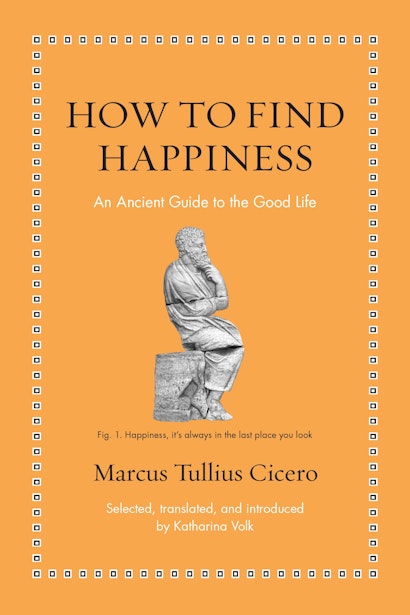
The idea that the pursuit of happiness is a shared human trait has been around for a long time (perhaps because it is true?). “Of course we all want to be happy,� wrote the Roman statesman and orator Marcus Tullius Cicero in 46 BCE. In doing so, he was echoing not only centuries of popular sentiment but also the teaching of Greek philosophers. Even though such thinkers were a famously contentious lot, ready to disagree with each other on points large and small, they all concurred that human beings strive for happiness or, in Greek, eudaimonia. What they meant by this was not a momentary feeling of elation, but a steady state of wellbeing, predicated on living well, that is, consistently and consciously acting in a manner understood as appropriate for human beings.
Those pursuing happiness in the modern world have a large array of resources at their fingertips—quite literally, since the internet will provide everything from folksy wisdom to psychotherapy In Greco-Roman antiquity, by contrast, if you were serious about finding true eudaimonia, you would have sought out a philosopher. In addition to attempting to provide convincing theories about everything from plant life to metaphysics, philosophy billed itself as an “art of life,� offering therapy or what was sometimes called medicine for the soul. Philosophers thus often acted as what we would call life coaches, helping their students to change their beliefs and habits, and thus ultimately achieve happiness.
Unsurprisingly, however, different philosophers had different ideas of how to attain eudaimonia. Over time, a number of philosophical schools emerged, each with its own formula for becoming happy. They all optimistically maintained that it is possible, in principle, for human beings to achieve happiness and typically claimed that there was just one thing (or a few) needed to reach that goal. This philosophical key to happiness was called by the Romans the summum bonum or “the greatest good.� It is the thing we all need to strive for since its possession is the guarantee of eudaimonia.
The Roman Cicero was not a philosopher but had studied philosophy with numerous Greek teachers and retained a lifelong interest in the subject. In the early 40s BCE, he was badly in need of a little happiness himself. Not only had his beloved daughter died in childbirth, but Rome had been convulsed by a civil war, in which Cicero had been on the losing side. Julius Caesar, the winner, had established a dictatorship, and the Roman Republic, the political system to which Cicero had dedicated is life, lay in tatters. While Cicero had survived the war and had even been pardoned by Caesar, he was politically powerless and deeply depressed about the situation. It was at this point that he turned back to philosophy.
In addition to attempting to apply philosophical precepts to his own life (a process we can trace in his letters), Cicero also started to write philosophy. Since, he reasoned, he was no longer able to serve his fellow Romans as a politician, he would do them a different service and create a philosophical corpus, the first in Latin, in which he introduced his readers to the various schools and debates of Greek philosophers. Within months, he composed a series of philosophical works, which survive to this day and have significantly shaped the history of western philosophy.
In one of the earliest texts in the series, De finibus bonorum et malorum (“On the Greatest Good and Evil�), Cicero tackled the question of the summum bonum, that alleged key to happiness. Rather than promoting his own ideas, he decided to give equal exposure to the three philosophical schools most prominent in his day: Epicureanism, Stoicism, and the so-called Old Academy of Antiochus. While the last was to enjoy only a short-lived popularity, Epicureanism and Stoicism continued to be significant in the history of philosophy and are both in fact undergoing a revival today. Their ideas about the greatest good could not be more different: the Epicureans believed that the key to happiness lay in pleasure, while the Stoics maintained that the only thing that counted was virtue or moral excellence.
What connected the two schools, however, was a stress on human agency and self-sufficiency. The Epicureans defined pleasure as the absence of all physical and mental disturbance, a state to be reached by our realization that most things we think we need or value are not actually necessary to our wellbeing, and that many things of which we are afraid are not in fact to be feared. Once we realize how very little we need in life, and how easy it is to get those things, we have found the peace of mind that is true happiness.
The Stoics too believed that happiness is a question of attitude. We need to determine in every situation what the morally right course of action is and attempt to follow it to the best of our abilities. Life being as it is, we will not always be successful in these attempts and may, on occasions, even fail spectacularly. No matter, according to the Stoics: virtue is its own reward, and the very knowledge of being a moral person is what creates happiness.
What did Cicero himself believe? Well, he makes it pretty clear that he does not hold with the Epicureans and believes that morality is a significant component in happiness. But is it enough? Being a good person is nice, but how about being a good person with a good salary? To what extent is our happiness really up to us, rather than being determined by circumstances beyond our control? Cicero refuses to make his readers’ minds up for them. We must all find our own ways of pursuing happiness.
Katharina Volk is professor of classics at Columbia University and the author of The Roman Republic of Letters (¿ìÉ«Ö±²¥), among other books.