
It would be difficult to find a 21st century horror film that was more critically acclaimed and more genuinely terrifying than Hereditary; when I give talks to horror afficionados and mention this film, everyone in the room reflexively starts nodding and chatting excitedly. The superficial reasons for the enthusiasm no doubt lies in the film’s ultra effective fear-factor. But the underlying reason, I think, is that the film does something extraordinary in its thinking about women in relation to patriarchy.
Early in the film, we meet Annie (Collette), whose mother has recently died, and who is speaking in very dark terms about her at her funeral. Over the course of the film, we learn that Annie’s birth family was supremely traumatic and traumatized: her father committed suicide by self-starvation. Her brother hanged himself, saying that his mother (and Annie’s, of course) had tried to put people into his body. Her mother had suffered from dissociative identity disorder. “So that was her life,” says Annie in a support group. But of course, it was also Annie’s life; that, at bottom, is what Hereditary is about: what Annie inherits from her mother, whether genetically/spiritually or environmentally/circumstantially.
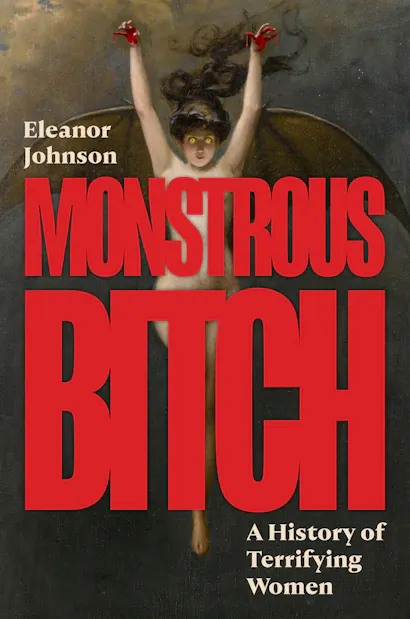
But the film’s title means something else, too. It’s referring to how both Ellen (Annie’s mother) and Annie herself inherit a larger system of violence, mental illness, trauma, and the occult, by dint of their femaleness. What, the film asks, do we inherit by being women? The film’s answer, as we’ll see, is that we inherit Monstrous Bitchery, and in probably its gnarliest modern form. In this film, the Monstrous Bitch paradigm turns back to its most Lamashtean roots: she is the ultimate evil, false mother, sacrificing her children rather than loving them and caring for them. She is a reproductive abuser, an aspiring feticide, an infanticide, a seducer of youths, and a horrifically terrifying slinger of invectives, curses, and spells. But, unlike in the films of the 2000s and 2010s, this film makes the Monstrous Bitch ultimately self-destructive and brutal in a way that isn’t liberatory, but just shocking. She may seem, in some ways, to bite back against the Patriarchy in the film, but ultimately, she’s every bit as fettered to it and dehumanized by it as her own victims. In fact, she is her own victim. So Ari Aster’s excruciatingly brilliant film seems eager to remind us of the limitations even on the notionally liberatory category of the Monstrous Bitch—such as it had been between 2000 and 2018 in film—when that Monstrous Bitch is still operating under a Patriarchal order of power.
What do I mean? Let’s get into it.
Annie’s mother, Ellen, was apparently hyper-involved in Annie’s reproductive life. Annie talks about how her mother had tried to be controlling and intrusive during her pregnancy with Peter, her first child. She did this even though Annie herself didn’t want the child, because she was too afraid. She confesses—in one of the film’s most agonizing scenes—to Peter himself that she repeatedly tried to kill him in the womb, but she failed. Annie also tells us that, with her second child—the girl Charlie—her mother took control of the child, acting in effect as an evil surrogate mother, sneakily harming the relationship between Charlie and Annie, to her own benefit. So Annie comes across as having some decidedly Lamashtean aspirations (trying to kill a baby in utero), while her mother also comes across as Lilith-like (in that she was inappropriately overinvolved in the pregnancies, in a way that terrified Annie, and functioned as a surrogate mother, sidelining Annie herself). So we’ve got at least two Monstrous Bitches, in terms of reproductive tampering, going back before the action of the film has actually started. That is, all this information, which comes out relatively late in the film, is the prehistory of the action of the film itself, not something we see playing out real-time.
And it’s not just fetuses and babies that these women mess with, but also children. Annie has a history of trying—at least once—to murder her own son after he was born: she reveals that she attempted to light him and herself on fire with turpentine during some kind of sleepwalking episode. She also puts her children in dangerous situations regularly, eventually with fatal consequences: she forces Peter to take Charlie to a party, knowing that Charlie has a lethal nut allergy, and doesn’t send her with her EpiPen. Charlie eats nuts in some cake; her throat starts to close; this unleashes a sequence of events that result in her being decapitated by a phone pole as Peter desperately tries to drive her to a hospital. Peter (and Annie) blame Peter for Charlie’s death, but ultimately, the film is very clear that Charlie would have lived if Annie hadn’t made Peter take her to the party.
But that’s not all. Annie fulfills the traditional invective-hurling, oath-swearing, curse-casting role of the Monstrous Bitch, going back to Mesopotamia, cycling through Greek, roiling through Rome, and carrying through the Euro-American period. We see it first in the incontestable emotional abuse she inflicts on her children: she calls Charlie “an idiot” for walking around outside without shoes on. Over the dinner table, after Charlie has died, she unleashes the single most stinging verbal assault I have ever seen on film against Peter, blaming him outright for Charlie’s death and calling him a “little shit.” There are many, many terrifying scenes in this film, but this one might be the one that’s hardest to watch—a mother so unhinged that she’s trying to destroy her own child with her screaming, blistering words. I don’t think there’s a deliberate reference, but definitely a resonance with the Ancient Mesopotamian: this scene always puts me in mind of Tiamat, screaming at her sons and grandson in Enuma Elish. The psychological abuse she inflicts on her family—now, only her husband and Peter—takes perhaps is most obviously witchy form when she forces them to help her with a séance intended to bring Charlie’s soul back into their home. Peter is so terrified of her in this scene that he begs his feckless, weak father to intercede and save him from Annie. But she can’t be stopped; she’s like a woman possessed—which, as we’ll see, she genuinely is. Annie has been taught the incantation and ritual by a woman named Joan, who she doesn’t realize really is a witch and friend of her dead mother. Peter sobs as she, for the second time in this film, terrorizes him with her voice.
Simultaneous with Annie’s verbal brutality toward Peter, we have the ongoing reality of Ellen’s curse on Annie and her children. Although it only becomes clear slowly, over the course of the film, Ellen had set a massive spell in motion prior to her death—which her friend Joan is helping bring to fruition—in which Ellen partially possesses Annie and Charlie comes at least partially (and maybe completely) to possess Peter. Like mother, like daughter: the women of this family are brutal, unstable, manipulative, cruel, dehumanizing spellcasters. It is in their blood, in their psyches, and in their familial culture.
The third criterion for full participation in the heritable cultural lineage of the Monstrous Bitch is seductiveness. That element in this film is somewhat harder to discern, since one of Annie’s defining interpersonal characteristics is her coldness and aloofness, especially toward her husband Steve—she flinches at his touch, often refuses to sleep in bed with him, rarely even smiles at him. But, on the other hand, she’s very quick to jump into bed—literally—with her son; when she’s not railing at him, she’s often way, way too close to him. Building on the visuals of her climbing on top of him in bed, of course, we also have the aforementioned backstory in which she lit covered both Peter and herself in turpentine, hoping to set them both on fire together; to be sure, on the one hand, she’s simply trying to kill him and herself. But the mechanism for their shared destruction is clearly also a metaphor for erotic engagement—doused in liquid and set aflame? Annie is not not erotically obsessed with her son. Amplifying that dynamic yet further, Annie enacts a strange kind of reversed Oedipal dynamic in the film; according to classical Freudian psychology, sons want to kill their fathers and marry their mothers. In this film, Annie eventually kills Steven—allowing him to burn to death in their living room—in order to have unrestricted access to Peter herself.
Seduction, reproductive tampering, spellcasting. Same monstrosity we’ve seen for thousands of years, clawing its rapacious way into the present.
But unlike in Suspiria, Raw, Teeth, Jennifer’s Body, or Ginger Snaps, the women in the family line who participate in the witchiness—including Charlie, only a fledgling little witch by the time she dies, guilty only of being weird and decapitating pigeons—all die. Charlie is decapitated. Ellen died before the action of the film began. Annie winds up brutally decapitating herself by stabbing herself repeatedly in the neck while possessed by the undead power of her mother. All die. So this film, in a way, breaks the trend of the 21st century, wherein the Monstrous Bitches bite back. Here, it seems more that the Monstrous Bitches are self-destructing, rather than biting back against a Patriarchy that has, for thousands of years, dehumanizing and monsterized them. That, for me, was a disappointing place for a horror film about the heritability of female monstrosity to turn.
Like I said, though, Ari Aster has made a perfect film, and here’s why. Even though all the Monstrous Bitches in this film die; even though they all die bloodily and wind up literally decapitated; even though there is very little in this film to redeem this lineage of Monstrous Bitchery as anything other than well and truly monstrous, this film makes a loud, brilliant, and powerful contribution to the evolutionary history of Monstrous Bitchery, in how it theorizes the reason behind all this self-destructive, abusive, female cruelty, seduction, and violence. The film still blames the Patriarchy for it.
This dynamic in the film is very easy to miss—just as it has been easy to miss the Patriarchy’s motivating force behind Monstrous Bitchery in the millennia before—but once you see it, you can’t unsee it. All the horror in this film owes itself not to some radical, heritable, matriarchal energy. But rather to a coven that is dedicated to an ancient, demonic Patriarch, named Paimon. First, Ellen, we find out late in the film, was in fact consecrated and married to Paimon in a ceremony shortly before her death; she wasn’t an autonomous matriarchal monster, but a willing and ecstatic participant in her own subordination to Paimon. Second, when Annie finds a book about the coven’s devotion to Paimon, she reads that the demon will only willingly possess the body of a man: “King Paimon is male and thus covetous of a male body.” Yes, we’re looking at a coven of witches, and, yes, we’re looking at a family line of monstrosity that appears to be passed down through its women, but in the end, it’s revealed that all of this witchcraft and heritable female violence is in response to a Patriarchal demon in want of a male form—which will be Peter. So, third, in the final scene, as Peter is becoming possessed by Charlie’s resurrected spirit, Joan addresses him/her, saying, “Charlie, it’s alright now. You are Paimon, one of the eight kings of hell…We’ve corrected your first female body, and give you now this healthy, male host.” Look at that language: “we’ve corrected your first female body.” Charlie was the destined vehicle for Paimon, but Charlie was, inconveniently, born into a female body. That’s why the coven had to arrange for her to be killed, so that her soul could be reincarnated—with Annie’s unwitting help—into Peter, who could in turn be possessed by Paimon himself. A film that seems to be about heritable Monstrous Bitchery in the female line winds up loudly confirming that Monstrous Bitchery—however autonomous it may seem—is a backformation of patriarchy.
Ari Aster, you are something else.
This is essay is adapted from a piece that originally published on .
Notes
This is actually the second party that Annie forces Charlie to attend without an EpiPen; the first is Ellen’s funeral. During the first, Annie specifically calls attention to the fact that they didn’t bring Charlie’s EpiPen, when she sees Charlie eating a chocolate bar of unknown origin.
Eleanor Johnson is professor of English and comparative literature at Columbia University. Her books include Scream with Me: Horror Films and the Rise of American Feminism (1968–1980); Waste and the Wasters: Poetry and Ecosystemic Thought in Medieval England; Staging Contemplation: Participatory Theology in Middle English Prose, Verse, and Drama; and Practicing Literary Theory in the Middle Ages: Ethics and the Mixed Form in Chaucer, Gower, Usk, and Hoccleve.