
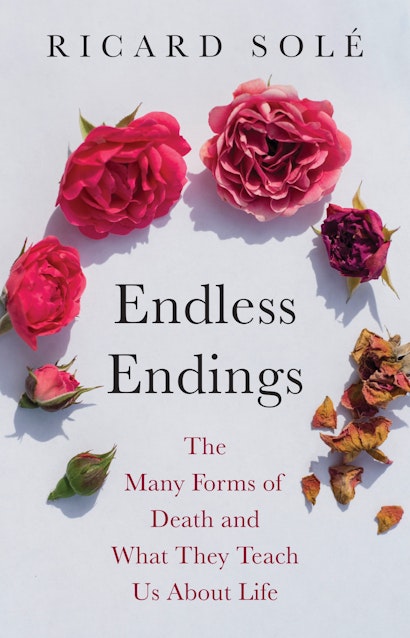
Using death as a connecting theme, in Endless Endings, Ricard Sol茅 explores the differing meanings of death in varied forms, reflecting on questions that are pushing forward the frontiers of scientific understanding. As Sol茅 reveals, life鈥檚 endings can be just as fascinating and varied as life itself.
Where did the idea for your book originate?
RS: The book had an almost magical beginning. I first imagined it after giving a talk called Frankenstein 2.0 at the first Science Biennial in Barcelona, shortly after the two-hundredth anniversary of Mary Shelley鈥�s novel. And the place could not have been better: the old anatomy hall of the Academy of Medicine, with this beautiful wooden amphitheater and, right in the middle, the marble table where autopsies had been performed and where Ram贸n y Cajal himself had taught. It was ten o鈥�clock on a cold February night and, when the talk ended, there was this strange electricity in the room. Soon afterwards my editor, Carmen Esteban, invited me to turn those ideas into a book. Writing it was much more difficult. The pandemic interrupted the project and suddenly death was no longer something one could think about from a comfortable intellectual distance. It was everywhere, in the empty streets, in the uncertainty, in the people we were losing. When I returned to the manuscript, I wanted science to remain the main thread, but I also let literature, philosophy, cinema and personal experience enter the conversation. In the end, the book became less about death itself than about endings, and about what endings can teach us about life, complexity, memory and identity.
Why is death so important? What is the connection with your research?
RS: Death is absolutely central to human nature. Cormac McCarthy once said, 鈥�Death is the major issue in the world. For you, for me, for all of us. It just is.鈥� And I think he was right. Without death, religion would probably not exist in anything like its present form, and much of mythology, philosophy and art would be unrecognizable. The fact that we know we are going to die has shaped our fears, our rituals, our desire to leave something behind, and perhaps even consciousness itself. There is also a very direct connection with my research on the origins and evolution of complexity, because death appears at every scale. Cells die, organisms die, species become extinct, ecosystems collapse, languages disappear, technologies become obsolete, cities decline, civilizations vanish. In ecology, extinction is not simply an accident that happens to life; it is part of the dynamics of life. Complex systems emerge, persist for a while and eventually lose the organization that made them what they were. So death is not really the opposite of complexity. It is part of its history.
Death is not only a random event. In living organisms like us, there is 鈥�programmed cell death.鈥� Why?
RS: This is one of the most beautiful paradoxes in biology: death is part of the creative machinery of life. You could not build a human body without cells knowing when to disappear. Think about your hand. In the embryo, the fingers emerge not only because cells grow, but also because the cells between the future fingers are deliberately eliminated. Without that massive programmed cell death, your hand would look very different. So birth and death are already working together before we are born. And the process never stops: every day tens of billions of cells in our bodies die and are replaced. Our tissues survive because cellular birth and cellular death remain in balance. Cancer is, in part, what happens when that balance breaks down and cells escape some of the mechanisms that normally tell them when to stop dividing or when to die. And this story goes incredibly far back in evolutionary time. Many of these mechanisms emerged in the ancient oceans, in a world shaped by conflicts and alliances among primitive cells, bacteria and viruses. We are, in some sense, the result of billions of years of those evolutionary arms races.
Can we define death?
RS: That is one of the problems I explore throughout the book, because there may not be a single definition that works at every scale. I deliberately discuss things that initially seem very far from biological death, such as machines, cities or languages, because they force us to ask what exactly disappears when something dies. At the cellular level, though, there is a definition I find especially beautiful. A living cell is constantly maintaining a difference between an inside and an outside. Its internal chemistry is very different from the surrounding world, and keeping that difference alive requires a continuous flow of energy and matter. Once the cell can no longer sustain that disequilibrium, the distinction collapses. Inside and outside begin to become the same. In that sense, death is the loss of a difference. And surprisingly, something similar happens with much larger systems. A city or a civilization exists because it maintains flows, boundaries, memories and internal organization. When those disappear, the buildings may still be there, but the system that once inhabited them has gone.
How can machines die?
RS: It sounds like a strange thing to say, doesn鈥�t it? But machines actually have surprisingly interesting forms of mortality. At one level, their survival statistics can look rather similar to those of living organisms: machines age, accumulate failures and eventually reach a point where repairing them is impossible or simply no longer worth it. But then there is another dimension, which comes from us. Humans are extraordinarily good at anthropomorphizing things. We form emotional bonds with objects, and even more so with machines that respond to us. In Japan, people have held funerary rituals for robotic dogs that could no longer be repaired, and now we are seeing people develop very strong emotional relationships with artificial intelligences. We are probably not that far from the world imagined in Her.
Long before AI, machines were already making us question what it means to be alive. You tell a remarkable story about this in the book.
RS: Yes, and that is something I find fascinating: none of these questions really began with AI. More than two hundred years ago, mechanical automata were already forcing people to ask where mechanism ended and life began. In the book I tell this wonderful story about an automaton maker whose machine was considered so uncanny that both creator and creation ended up in jail after accusations of heresy. I love the story because it feels incredibly modern. Whenever a machine begins to resemble us too closely, we suddenly discover how uncertain our definitions of life, agency, and death really are.
Why do you say that there are different deaths of the mind?
RS: Because the mind does not really have a single beginning, so perhaps it does not have a single ending either. Our sense of self is continuously assembled from memory, language, perception and the changing architecture of the brain. During the first years of life, the brain undergoes an enormous reorganization, and most of us remember almost nothing from that period. There was a version of ourselves that experienced the world, had fears and pleasures and relationships, and yet that person has almost completely disappeared from memory. At the other end of life, neurodegenerative diseases reveal another kind of death. In Alzheimer鈥�s disease, the body may continue functioning while memories, recognition, language and identity are progressively dismantled. What is especially striking is that this can look like development running backwards: abilities that took years to assemble disappear layer by layer. I also explore how we are beginning to use technologies such as virtual reality to confront absence and the fear of death. Whether these technologies help us accept mortality or simply allow us to postpone thinking about it is another question.
Can death be defeated?
RS: Aging can certainly be understood better, and that can help us live healthier lives for longer. Research on aging is already teaching us a great deal about diseases such as progeria, where children age extraordinarily fast, and perhaps we will eventually be able to overcome some of the limitations imposed by our evolutionary history. But immortality is something else. Nature already gives us organisms with extraordinary regenerative abilities and even forms of negligible senescence. Some jellyfish can do remarkable things when it comes to escaping ordinary aging. But I doubt many of us would exchange our lives for the cognitive life of a jellyfish. There may be a price for being a highly complex conscious organism. Our brains are astonishing, but they are also extraordinarily difficult to regenerate without disrupting the very patterns that make us who we are. So I am much more interested in extending healthy life than in fantasies of immortality. We have been given this completely improbable interval of consciousness. Maybe the best answer is not to demand that it lasts forever, but to enjoy it and use it as well as we possibly can.
Languages and information also die.
RS: Yes, and this is one of the places where the idea of death becomes especially revealing. Darwin himself noticed the similarity between languages and species. Languages originate, diversify, migrate, compete, hybridize and disappear. A language dies in a very precise and rather moving way when its last speaker dies and nobody remains who can inhabit that particular world of sounds, meanings, memories and distinctions. Globalization is accelerating this process, and when a language disappears we lose much more than a dictionary: we lose a way of organizing experience. Information in general faces a different and perhaps even stranger danger. For most of history, if you wanted to destroy information you burned books, demolished libraries, censored writers or put them in prison. The digital age has introduced another possibility: you do not need to destroy information if you can simply drown it. False information can compete with true information, and it often has important advantages because it can be simpler, more emotional, more surprising and perfectly adapted to what people already want to believe. So perhaps the best way to kill information today is not silence but noise. And if a society loses the ability to distinguish reliable knowledge from manufactured falsehood, then what is at risk is much more than a collection of facts. Our shared capacity to construct reality together begins to disappear, and without that, democracy itself can die.
Ricard Sol茅 is the ICREA Research Professor at the Universitat Pompeu Fabra in Barcelona, where he is head of the Complex Systems Lab, and external professor at the Santa Fe Institute. He is the author of Phase Transitions and coauthor of Viruses as Complex Adaptive Systems, Self-Organization in Complex Ecosystems (all 快色直播), and Signs of Life.