
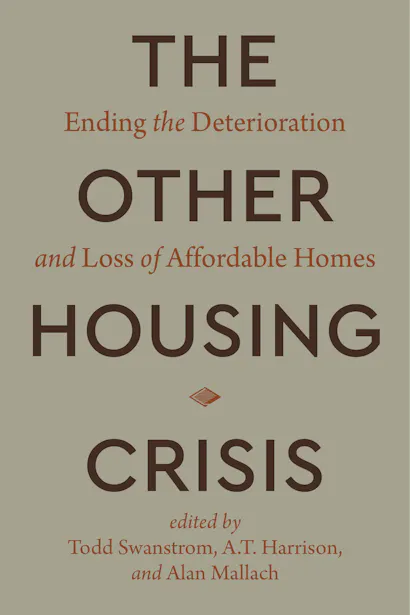
The United States is in the throes of a housing crisis, framed by the media as a crisis of affordability. People pay too much for housing鈥攁nd the solution, it seems, is to increase the supply to drive down the cost. But the national conversation on housing affordability ignores the issue of housing quality. Most people find affordable housing not through public subsidies but by purchasing or renting older housing in the private market. For older housing to be affordable, it is almost always in disrepair and/or is in a disinvested neighborhood with low market values. Little noticed by the media, millions of American homeowners and renters live in unsafe and unhealthy housing.
We all know that there is a crisis in housing availability and affordability in the US right now. What is the鈥�other鈥痟ousing crisis you highlight in your book?
Todd Swanstrom: The country is in the middle of a huge conversation about housing affordability. This is good because many people pay way too much for housing. The conversation about housing affordability, however, completely ignores the issue of housing quality. Most people acquire affordable housing not through government subsidies but by renting or owning a home that is sufficiently deteriorated, or in a sufficiently disinvested neighborhood, that it becomes 鈥渁ffordable.鈥� Housing affordability and housing quality are two sides of the same coin. The housing affordability problem is worse than the statistics suggest because many people are forced to sacrifice quality in order to achieve affordability. They end up living in homes that damage their physical, mental, and financial health.
In addition, housing deterioration reduces the supply of affordable housing. We estimate the US loses about 400,000 units of housing each year — mostly due to deterioration and abandonment. If we could save just half of these homes, we鈥檇 increase the supply of affordable housing and help keep prices down. It is almost always cheaper to preserve an existing home than to build a new one. This is especially true if the new home requires new infrastructure like roads, sewers, water, etc.
How did you become involved in this issue?
TS: About five years ago, the St. Louis Vacancy Collaborative approached researchers at my university with a few simple questions: What is the extent of housing deterioration in St. Louis? Does deterioration cause vacancy and abandonment? Being good researchers, we started by surveying the literature. We were shocked to learn that there was no publicly available data on housing deterioration in St. Louis. So, we created our own questionnaire and mailed it to 2,500 older homeowners.
This project drove home to me the depth of the problem, and I have been focused (some would say obsessed!) with housing deterioration and home repair ever since. One of my first experiences was that my name and phone number were on the first page of the survey in case people had any questions. I asked our survey researcher if I would get a lot of calls and she said, 鈥渄on’t worry, Todd, you’ll probably get about 5.鈥� I got over 200 calls! One woman said that she had filled out the questionnaire but couldn’t get to the mailbox because her front steps had collapsed. Instead, she passed the survey through a window to a neighborhood boy who took it to the mailbox. Then she asked if we had funds to repair her stairs.
These phone calls tore my heart out. Many were African American widows living in big old homes and desperate for help. They were always polite but there was nothing I could do except refer them to programs with multi-year waiting lists.
Is this mostly a problem in older American cities?
TS: Clearly, housing deterioration is a problem in older cities. In St. Louis, we found that the average older homeowner lived in a home that was 97 years old and required over $13,000 in repairs. But we just completed a study of the need for repairs in suburban St. Louis County, where the average home was 62 years old and needed over $9,000 in repairs. And the problem is worse in many rural areas; the average repair needs for low-income households in the Mississippi Delta is鈥�about $25,000. So, it is not just a problem of older inner cities.
Intuitively, housing deterioration should not be a problem in newer cities. But it could be more serious than we think. In tight housing markets, landlords may skimp on maintenance because they know they can always find renters. Shoddy construction can lead to problems early on. My wife and I just left a 6-year-old condo building that suffered from major water infiltration and structural issues. Global warming is creating more severe weather events that can cause heat waves and flooding, putting greater stress on even newer housing.
What is the scope of the problem, and what would it cost to fix it?
TS: The Philadelphia Federal Reserve estimated that the total cost of needed repairs in the United States in 2024 was $198.4 billion. Of that, $74.6 billion would be needed to address the needs of lower-income families who can鈥檛 afford to pay for their own repairs. For many reasons, this estimate is way too low. The data is based on the federal American Housing Survey (AHS), which completely ignores conditions residents cannot see, including lead contamination in paint and mold behind walls. It fails to identify safety issues, such as broken stairs, and gathers no information about key features of multifamily properties. While the AHS asks about adequate heating, it completely ignores the need for cooling 鈥� which makes no sense in an age of global warming. Just to show how far off the national estimate is, New York City recently calculated it will need to spend $78 billion over the next 20 years just to maintain its public housing units. It鈥檚 impossible to estimate exactly how much it would cost to make all basic housing repairs in the nation, but clearly it would be well over $200 billion.
This is an expensive problem to fix. But what are the costs of鈥�not鈥痜ixing it?
TS: While the cost of funding needed repairs is high, the cost of not making these repairs is even higher. A major effect of housing deterioration is higher medical bills. In St. Louis, we interviewed a woman whose mold-infested home triggered her son鈥檚 asthma, requiring frequent trips to the emergency room. The hospital visits ended after her home was repaired. A study commissioned by Rebuilding Together, a national nonprofit that provides basic repairs mostly to low-income seniors, found that each dollar invested in repairs generated $2.84 in social return; Medicare and Medicaid savings alone totaled $1.32. Weatherization can save people hundreds of dollars on their utility bills, while reducing energy consumption and improving air quality.
But many of the costs of housing deterioration cannot be quantified. We interviewed one woman who said that following the repairs she was finally able to sleep at night because she no longer heard sparks from her out-of-date fuse box. Another man was finally able to invite friends and family over after they fixed the leak in his dining room. It is hard to put a dollar figure on being able to sleep at night or socialize at home with friends and family.
Recently, Congress passed the bipartisan ROAD to Housing Act. Will the Act help solve the housing quality crisis?
TS: The Act includes the Whole-Home Repairs Act, a pilot program that is only authorized for up to $30 million. That鈥檚 a drop in the bucket, but it will give localities the chance to experiment with an approach that repairs all the basic systems in a home instead of the usual piecemeal approach. My hope is that evaluations of these pilot programs will show the value of whole-home repairs and spur greater investment.
Are there localities that have successfully addressed this problem?
TS: Good work is being done in Philadelphia, Baltimore, Detroit, and other cities. The federal Whole-Home Repairs Act is based on a successful program in Pennsylvania of the same name, which provided support to homeowners and small landlords. Some worry that landlords will raise rents after making subsidized repairs. But in Pennsylvania, only small landlords were eligible for the money, and they had to promise to limit rent increases after the repairs.
The philanthropic sector is also stepping up to fund home repairs. When the Gilbert Family Foundation announced a $20 million Detroit Home Repair Fund in 2022, it received over 125,000 phone calls within the first 24 hours. The James S. McDonnell Foundation has invested millions of dollars in addressing the damage from the May 2025 tornado that decimated so many neighborhoods in St. Louis.
The City of Philadelphia has issued general obligation bonds to pay for home repairs. It makes sense for city governments to borrow money to fund these programs, because home repair is an investment that will pay off in the long run 鈥� in the form of high property values, a stronger tax base, and a healthier population. Research has even shown that home repairs reduce crime.
What needs to happen now to meaningfully address the problem of housing quality?
TS: First, home repair programs need to become less fragmented and more user friendly. Right now, there are 15 separate federal programs that fund home repairs. Each has a different target population or repair and a separate application process. This is confusing and inefficient. It makes no sense to weatherize a home if the roof is leaking and water is running down the walls. We need to consolidate the federal home repair programs into one well-funded block grant that gives localities the flexibility to address their specific repair needs. Many cities are working to create a common application process and coordinate the repairs so all the major needs of the home can be addressed at once.
Second, funding for home repairs must be greatly expanded. Right now, lobbying for housing funds is dominated by what I call the 鈥渢ax-credit industrial complex.鈥� By connecting large corporations with grassroots housing advocates, federal and state housing tax credits have nurtured a powerful bipartisan lobby that has greatly expanded funding for these credits over the years. Meanwhile, the home repair industry, which is composed of small businesses and nonprofits, has seen its funding shrink. While tax credits build some wonderful, subsidized housing, they are remarkably inefficient: in Missouri, less than half of tax credit dollars go into bricks-and-mortar housing. It would be more cost-effective to repair and preserve existing affordable housing.
Fundamentally, we need to frame home repair as a public investment, like maintaining roads and water systems.
Todd Swanstrom is the Des Lee Professor of Community Collaboration and Public Policy Administration at the University of Missouri鈥揝t. Louis and the coauthor of Place Matters and The Changing American Neighborhood.