
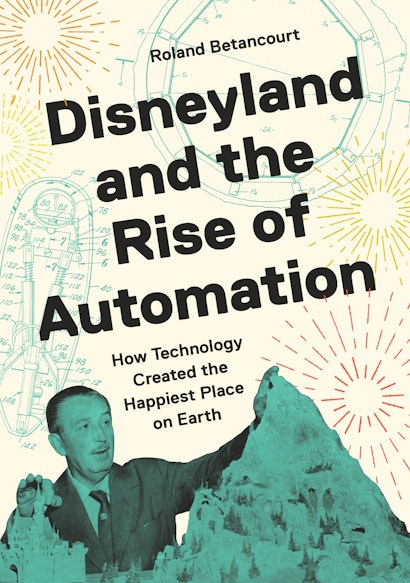
When Disneyland opened in Anaheim, California, in 1955, it promised visitors a glimpse of the future. What it delivered 鈥� through automated ride systems, Audio-Animatronic figures, and meticulously engineered environments 鈥� was something more consequential: a space where ordinary Americans learned to feel comfortable with machines of industrial automation. In Disneyland and the Rise of Automation, Roland Betancourt traces how the theme park became a proving ground for automation at the very moment the American public was most anxious about its consequences. Drawing on corporate archives, patents, operational manuals, and the visual and spatial design of the park itself, Betancourt reveals how Cold War military and industrial methods were aestheticized as entertainment 鈥� and, in the process, reshaped how a nation understood its technological future.
What is this book really about 鈥� and why Disneyland?
Roland Betancourt: This book is about how we learned to stop worrying and learned to love automation鈥攖he first time around. It鈥檚 a story about the way our entertainment or places of leisure acclimate us to massive technological change by dissolving the fear of the new into something fun, unthreatening, and trivial. In telling the story of how Disneyland adopted automation tech and systems into amusement rides, I am sharing with readers the history of the unseen systems that rule our daily lives and manufacture all our things, while also giving them the tools to recognize these systems鈥攊n the theme park and beyond. Ultimately, I want readers to see how wrapping technology in cartoon characters, narrative, and experiences made automation not just friendly and familiar, but enchanting and seductive.
There鈥檚 a deep irony at the heart of the book: Americans in the 1950s and 鈥�60s were terrified of automation eliminating their jobs, yet they paid admission to watch robots perform and to be entertained on automated rides. How do you explain that contradiction?
RB: Today, we are living in a mass panic about artificial intelligence. Teachers worry about plagiarism, coders are being made obsolete by the very programs they designed, corporate workers are being laid off by massive restructuring, and wars are being waged at the push of a button. Meanwhile, Americans rely on artificial intelligence to produce fanciful images of themselves, ask about relationship advice, restaurant recommendations, and just have casual, even amorous conversations with AI. As much as we might worry, artificial intelligence鈥攎ore than serving as a powerful work tool鈥攈as nestled itself into our lives as a source of entertainment and leisure. When new technologies, no matter how terrifying they might be, ultimately ingratiate themselves with us the minute they become a pastime. Disneyland鈥檚 automation history evidences the most powerful parallel to this story.
The history of technology tends to focus on factories, laboratories, and Silicon Valley. Why should we take amusement parks seriously as sites of technological change?
RB: You can take a tour of the Ford River Rouge Factory in Dearborn, Michigan or watch an episode of How It鈥檚 Madeor Unwrapped to get glimpse into the hidden worlds of the industrial automation systems that make our things, but there is no place beyond the factory floor where the full scale of automation technologies can be seen in our society鈥攅xcept at an amusement park. There, vehicles moving along a track are conveyed across a series of points, where sensors detect your presence, and take on some sort of action or response, before you are moved along to the next station. Every amusement ride is an assembly line, one where you get the POV of the object being manufactured. And throughout the modern history of the amusement park, new automation technologies have directly translated into new rides and new experiences. As such, the amusement park is a laboratory for how we understand this technology in our world, providing us a level of intimacy and access that you can find nowhere else outside the factory.
Disneyland opened in 1955. Why does this history matter now, when we鈥檙e in the middle of another massive wave of automation anxiety driven by AI?
RB: Disneyland presents a poignant historical precedent for the crisis around artificial intelligence that we face today. The reader that picks up this book will leave it with a new sensory awareness of how to spot, understand, and explain the automation technologies in our world today. That literacy is of prime importance because it is the first step in comprehending the unseen world around us. But the history of the rise of automation, particularly the foundations laid out in the book鈥檚 first section, will surprise and shock readers because the parallels are not just striking鈥攖hey are often identical echoes of one another. This book helps to combat a critical amnesia that has led us to forget that we鈥檝e been here before. There is a great payoff to this book, it shows us just how nontrivial Disneyland is, and it will change how you see the world around you.
What archives and sources did you work with? What does the evidentiary base for a history of Disneyland look like?
RB: For this project, I was not pursuing a conventional history of the art, architecture, or design of the theme park. I like to think of individual machines, systems, or technologies as the protagonists in the book. Each chapter serves as a mini biography of these starring characters. To tell these stories, therefore, I had to rely on sources and materials that went well beyond Disneyland alone, taking me to corporate, local, and governmental archives across the country. One week I was looking at declassified documents on nuclear missiles at the National Archives, the next I was looking through old employee photographs from the 1950s, and the next I was deep in the history of magnetic tape at 3M鈥檚 archive. This was also combined with extensive oral histories and conversations with engineers and operators that shared the human dimension to all these machines. Over seven years, this book came together through the weight of archival research and the commitment that the role of the historian is not just to tell the story of X, but to show why its texture and details matter in our broader history.
Your other major body of scholarship is in Byzantine art and culture. How do those two research programs relate to each other 鈥� or do they?
RB: To put it in theme park design terms, I am fundamentally interested in themed, immersive environments. My research on the Byzantine Empire has focused on the intersection of art, religion, and imperial power, examining how sensory experience, perception, and the imagination contour how we access realities鈥攍ike the divine鈥攖hat are not immediately present before us. This work has often been a history of science, meant to excavate how people in the past understood sensory experience and their mental faculties in perception. I see a Byzantine church or an illuminated manuscript as technologies for unsettling time and space, bringing us to loftier realities. In this capacity, it is difficult to see any difference at all between my work on the Byzantine Empire and my research on Disneyland鈥攖he only thing that changes are the stakes of the questions I ask and the sources I have to answer those questions.
You鈥檙e an art historian writing about theme parks and automation. What does art history bring to this subject that other disciplines miss?
RB: Being an art historian is central to how I see the role of storytelling and how we perceive technology. While many imagine that art historians spend their time looking at works in a museum, that is often only the first or final step in the process. As art historians, our role is to show you all the things you cannot see in the work of art that stands before you鈥攁nd to walk you through how to think historically about all that you can see. A motivating question in this book is what makes Disneyland more powerful a space to perceive automation than even the factory. The answer is the sublimation of automation at the theme park, the fact that it is camouflaged, just under the surface to make you think you cannot perceive it. But, through its jerky movements, its starts and stops, the sounds of brakes, pistons, and so on, automation is always making itself perceptible鈥攏ot just sight, but sound, feeling, and movement. As an art historian, I can use my skills to denude this technology鈥攖o force it back onto the surface鈥攁nd show you how to perceive it with all your senses.
Roland Betancourt is Chancellor鈥檚 Professor in the Department of Art History at the University of California, Irvine, and a 2023 Guggenheim Fellow. His books include the prize-winning Byzantine Intersectionality: Sexuality, Gender, and Race in the Middle Ages(快色直播) and Performing the Gospels in Byzantium: Sight, Sound, and Space in the Divine Liturgy.