
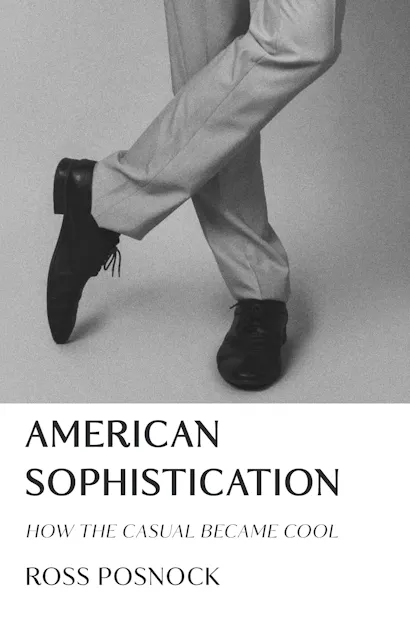
The title of my new PUP book—American Sophistication— names a contradiction in terms, an oxymoron. In Nature’s Nation, sophistication offends as anti-nature—public deportment that depends on style, artifice, theatricality—qualities that challenge our proud self-understanding as plain dealers, straight shooters. The sophisticated, that is, fail to pay sufficient respect to sincerity, the sacred tenet of our national (moral) nature. The tumultuous mid-1960s offer a number of examples of an emergent sophistication overthrowing virtue; in what follows I focus on two moments that, to my knowledge, have never been connected. Two caveats: treatment will not be equal and while my comments on the first figure stick to her biography, I discuss the second figure less as “himself” than as he is depicted in two films.
When in 1964 Susan Sontag made public an open secret—that “homosexuals, by and large, constitute the vanguard” of “camp taste,” and that the latter is “part of the history of snob taste”—what really struck a nerve was her candor about what this “taste” demands we abandon: “One is drawn to Camp when one realizes that ‘sincerity’ is not enough. Sincerity can be simple philistinism, intellectual narrowness.” This is from her famous debut book Against Interpretation, whose title is provocatively at odds with itself, for it collects her essays, densely analytical interpretations. Provocative too was the cover of the Dell paperback reprint which featured the author’s striking face. The New York Times gushed— she is “Uncommonly brainy and darkly beautiful, smart enough to tell America off and glamorous enough to make America like it.” Sontag quickly became an international icon—the hip arbiter of the “new sensibility,” whose first tenet is to banish high culture’s genteel solemnity; hence her “Notes on Camp”—quoted above—ignited instant notoriety. Accused of abusing high seriousness by taking the frivolous seriously, Sontag’s deeper offense was rudeness toward sincerity.
A year later sincerity suffered a new outrage: Bob Dylan made an explosive break with the Newport folk festival in 1965, an invented tradition started in 1959 to celebrate the socially progressive music of America’s heartland. Its raison d’être was “to fight a riptide of inauthentic shit,” as pioneering folk archivist Alan Lomax says of the enemy—rock and roll—in A Complete Unknown, the 2024 film of the singer’s early years (James Mangold, dir.) Dylan mocks Lomax as the “posse of purity” for insisting in effect that Dylan’s precocious mastery of the folk ballad obligated him to lifetime servitude to the form. Meanwhile, Dylan goes electric with Highway 61 Revisited, permanently alienating the earnest folk community that had nurtured him in his early (Greenwich) Village years. Sontag and Dylan each craft a momentous, stunningly influential sophistication, its cutting edge augmented by their chic bohemian hipster garb and stylized coolness. Work and appearance fuse into a ‘brand,’ to use current parlance. But whereas Sontag will flourish as an impeccable cosmopolitan, with occasional touchdowns for cultural work in global hotspots such as Bosnia, Dylan’s sophistication, enacted in the less rarefied world of popular culture, will ignite perennial contestation. His relation to sincerity and authenticity (think of authenticity as the truculent cousin of sincerity) will remain controversial, always unsettled, under suspicion. How could it be otherwise given that the songwriter found “freedom” in his “refusal to be fixed as a single self in a single voice” (Todd Haynes). Who else could inspire such disparate films as I’m Not There (2007) and A Complete Unknown, the latter a conventional (and beautifully observed) bio-pic, the former an audacious, polyphonic meditation by Todd Haynes, which features six Dylans (one is a thirteen year old Black actor; another is played by Cate Blanchett). For all their stark differences these films find common ground in their titles: each announces an irreducible absence, a blank where a name should be.
That absence preoccupies A Complete Unknown. It concludes with the Newport debacle but its main concern is to pursue Dylan’s elusive identity. Who are you?, Where do you come from? are the exasperated questions posed repeatedly by lovers and colleagues. “Stop hiding,” one implores. Dylan offers up the sketchiest answers—worked in a “carnival” is his most consistent response about origins. Rival and lover and occasional singing partner Joan Baez, for one, doesn’t buy it. But Dylan agrees when Baez tells him, “You’re kind of an asshole, Bob”; “yeah, I guess,” he blithely admits. And then he plays her a new song—“Blowing in the Wind.” Who are you, indeed? When he is getting to know Sylvie, eventually his girlfriend, she tells him of her involvement with CORE and he asks what that means. Not long after, as Sylvie watches on television the March on Washington, she is startled to see her unworldly Bobby singing “Only a Pawn in their Game” to the vast crowd.
Both moments open up a disparity or contradiction: the self-absorbed, self-protective, withdrawn songwriter, typically mumbling in inward creative revery, catches the conscience of a nation, while expressing little of the political and moral solidarity, the goodness, that the folk bard traditionally embodies. Somehow Dylan’s terminal disengagement as a person produces anthems of political engagement as an artist; this gap baffles and frustrates his folk circle: Lomax and Pete Seeger join Sylvie and Joan as “characters, well-intentioned and committed to social change,” who are left, writes Timothy Hampton in a January ’25 Ideas post, “disappointed and…empty-handed by Dylan’s overwhelming ambition.” A Complete Unknown, Hampton writes, is “about the failure of goodness” and the “death of community.”
But these terms—ambition vs. goodness and community—are too mundane: Dylan is not simply deserting communal warmth for cold careerism. He turns a refusal to be good into a basis for his art’s sophistication; foregoing moral virtue, he embraces high modernist formalism, with its insistence on autonomy, a logic enunciated by Dylan’s idol Rimbaud, one of the ‘Dylans’ in I’m Not There. Early on the poet declares: “a song is something that walks by itself.” Respecting the difference between art and life, keeping a distance, modernist aesthetics esteems an objectivity that implicitly rebukes the romantic national mandate of sincerity and authenticity which welds together artist and work. But Dylan’s sophistication also knows that these values, sanctified in public discourse, are themselves unstable, ungrounded, knows that the ludic is in command, what Ralph Ellison calls “the American compulsion to improvise upon the given.” Hence we are a country “obsessed with authenticity” while knowing “Authenticity [is] the perfect costume/ America the land of masks, costumes, self-transformation…America’s about false authenticity and creativity,” to quote Todd Haynes’ Ellisonian notebook jottings about I’m Not There. Dylan’s embrace of aesthetic autonomy and of the shape shifting offered by the slippery status of American authenticity have made him a “complete unknown,” or at least never quite “there.” To put it another way: Dylan has conducted a more than six decade experiment in living the oxymoron American Sophistication.
Ross Posnock retired as the Anna Garbedian Professor of the Humanities at Columbia University. He is the author of many books on American literature and culture, including Philip Roth’s Rude Truth: The Art of Immaturity (¿ìɫֱ²¥).