
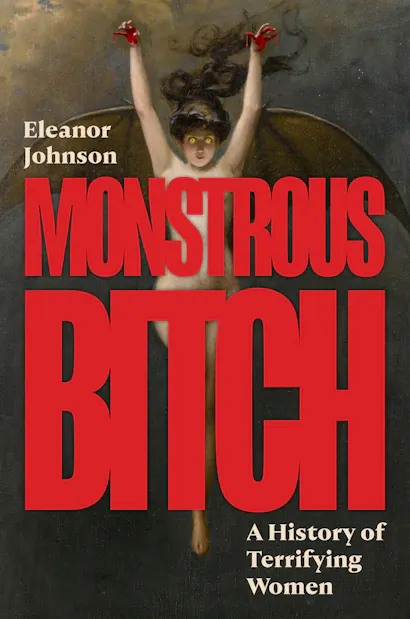
Recently, I watched Succubus (2024); I decided to watch it because, historically, the succubus tradition has some tangency with the tradition of female monstrosity that animates my forthcoming book, Monstrous Bitch, which is the tradition of the Lamia.
The tangency between these two traditions of female monstrosity are easy enough to spot: succubi and lamiae share a commitment to the idea that female monstrosity originates in female sexuality. The succubus, normally, functions as a demonic seductress, who penetrates into a man鈥檚 desires through his dreams, so that she can seduce him and drain his vital energy, often resulting in his death. By contrast, a lamia, while she is a seductress of men and women, is also a blood drinking cannibal who slays children and babies, and casts spells.[1] So lamiae and succubi are similar, though importantly different as well.
Even so, there is enough overlap between the succubus tradition and the lamia tradition to have gotten me interested in the conceit of the film. My initial interest was ramped up by my observation that the Internet had quite an interesting series of things to say about this film, most of them related. Online reviewers note that the film is better than it should be, or more interesting than they expected it to be, or that the scares land harder than they should. I often like an underdog film, so when I saw how many reviewers were assigning value to a film that they had approached assuming it would be of low value, my interest was significantly more piqued.
Here is the storyline. There is a man named Chris who has recently been separated from his wife. They have a small baby, and Chris is extremely stressed out, both because he wants to reunite with his wife and because he has overwhelming financial problems owing to his professional history as a failed app developer and tech startup guy. Chris reads as nerdy, insecure, I’m really kind hearted, a dedicated father, and a generally likeable guy. He has a big problem though, which is his bro-y friend Eddie. Eddie is very eager to get Chris laid, now that the shackles of marriage are temporarily loosed from his hands, feet, and most importantly gonads, so he encourages Chris to set up an online dating account on a website called 鈥渟tar crossed.鈥� It is a great title, of course, because being star crossed is generally not a good outcome for either the lover or the beloved; look no further than Romeo and Juliet for evidence of this. But Chris easily falls under the sway of his far more alpha friend, and he sets up an account and quickly meets a gorgeous, mostly naked woman named Adra. Things go sideways from there very rapidly, because she is, as you will not be surprised to hear given the film鈥檚 title, a succubus.
But the way this film deploys her succubus nature is very interesting鈥攁 clever and compelling modernization of the ancient paradigm of female seductresses. Rather than seducing him off the bat through his dream, she initially seduces him through video chats, the use of filters, and the steadily increasing deployment of her own physical and sexual charms through the medium of the computer and the Internet. Sooner rather than later, she manages to lure his soul out of his body and into a dark and mysterious and dangerous realm of seduction in a parallel universe over which she has jurisdiction. She does this by drawing him through the computer camera. His body, meanwhile, is left behind in his house with his baby, in a state of catatonia. His sentient mind is trapped in a shadow realm in which the succubus tries to seduce him, because what she most desires is to be able to infiltrate into his reproductive line by having him impregnate her, or having him impregnate his wife, but with seed that is contaminated by the succubus herself. The full extent of her commitment to impregnating the wife is not clear, however, until the ending of the film. And for those of you who read horror films with special attention on Sapphism, you will not be disappointed. The goal of this film, really, is to have the succubus use Chris as a vector for her own reproductive impetus into the womb of Chris鈥檚 wife, as well as of Chris鈥檚 wife鈥檚 best friend.
But I鈥檓 getting ahead of myself, and a little bit ahead of what I think is the real fire in the film. While watching this film, I realized that what it is about at its core is the fear of sexual trickery and seduction that contemporary reproductive aged and feel at the prospect of meeting women online. There was explicit discussion in the film about the possibility that Adra is catfishing Chris, which she both definitely is, in that she is using him with no real intention of forming a meaningful emotional bond with him, and which she also definitely is not, because part of the idea and, for men, horror of catfishing is that the man does not ultimately get to have sex with the woman in question, but instead is simply milked for his financial resources. In this film the problem for Chris is that he gets way too much sex, and sex of the wrong kind.
What I like most about this film, even more than its clever cross-fading of ancient ideas about female monstrosity with ultra-contemporary ideas about the dangers of the Internet catfishing, is the fact that the film does not lay the blame exclusively at the door of the female monster. Instead, the film is crystal clear throughout that, without Eddie鈥檚 revved up, alpha male intervention, Chris would have remained safe, and probably would have patched up his marriage to his wife. He would have had, that is, what he actually wanted. But Eddie intervened, convinced Chris that being a man entailed his engagement with online sex and seduction rituals, and ruined Chris鈥檚 life. He also ruined his own: Eddie, too, winds up having sex with the succubus. But because he is morally repugnant to her in a way that Chris is not, she winds up flaying him alive during sex. End of story for Eddie. The succubus is bad, but she does seem to have a code, and her code seems to be that she seduces and entraps good men to use as vectors for her own reproductive ambition, whereas she simply seduces and murders the alpha boys who don鈥檛 want any responsibilities.
So, a film that could be a two-hour long screed against female sexuality as something intrinsically dangerous, vile, monstrous, and worthy of male horror鈥攚hich is what succubus narratives have traditionally been in the western cannon and which, to be honest, is exactly what I expected when I started watching鈥攊nstead winds up being rather powerful condemnation of the kind of free-wheeling, consequence-free, internet-enabled sexual ambition of alpha males like Eddie.
So this film does something rather extraordinary. And before I say what that is, let me be clear that I do not actually recommend this film particularly warmly. There鈥檚 a lot that鈥檚 good in it, but there is also a lot that is unnecessarily gross, and a lot lies somewhere between mildly and aggressively stupid. But again, there is something extraordinary.
Often in horror films, the male characters either die early on, as in almost every slasher film I can think of, or wind up being the monster, as in, well, slasher movies again, but also classic films like The Shining, Rosemary鈥檚 Baby, The Stepford Wives.[2] Or, for that matter, as in the majority of straight-up monster films, like the Frankenstein mega-franchise, Dracula films, or werewolf films, or psychopath films (Silence of the Lambs, Night of the Hunter, you name it.) Finding horror films in which the male protagonist is the empathic center of the film throughout the film鈥檚 run-time isn鈥檛 easy. Get Out (2015) comes to mind, as does The Thing (1982), both of which are vastly superior films.
But even so, Succubus is a film that is exclusively focused on male vulnerability鈥攁nd specifically of male sexual vulnerability. It understands masculinity not as a condition of power, heroism, privilege, or superiority, but as a condition of intrinsic vulnerability to predation by the triple threat of male sexual ambition (Eddie), female reproductive ambition (Adra), and technological facilitation (Starcrossed.com). It is a film that understands horror only as opportunistically about female monstrosity, and far more deeply about the dangers that men drive each other into through their competitive jockeying for reproductive options in an Internet fueled a rage filled era. Put briefly, Adra only has power because the Eddies of the world are all over the Internet.
Honestly, I鈥檇 really like to know what Scott Galloway, the massively famous social commentator and entrepreneur who is obsessed with how technology and AI are ruining American men and masculinity itself, would say about this film.[3] I think he鈥檇 say that the film is preternaturally on point as a social critique: it sees the internet and other men as the main obstacles to male fulfillment and happiness, with women as men鈥檚 convenient and lame excuse.
In the end, while still possessed by Adra, Chris appears to recover himself somewhat, and he begins having sex with his wife. During the sex, he suddenly realizes that he will impregnate her with Adra鈥檚 seed if he ejaculates, so he pulls out, backs up, and castrates himself with a knife. It鈥檚 a very upsetting scene; I yelped when I watched it. Ironically, however, in the next scene, which is the end of the film, when Chris has become wheelchair-bound, IV-fed, and catatonic again, we find out that his wife and her friend both harvested sperm from Chris鈥檚 severed testes and used them to impregnate themselves with 鈥渉is鈥� children. Ostensibly, they鈥檙e doing this to give Chris more life, and more of a lineage, and because they themselves want children. But really, they鈥檙e doing this because they鈥檙e now unwittingly helping the Succubus self-propagate. Chris鈥檚 act of self-castration was not sufficient to stem the tide of horror unleashed by Eddie and the Internet.
Even more interesting than this dark and grotesque denouement, however, is the fact that Sharon (Chris鈥檚 wife) and Charlisse (her friend and also Eddie鈥檚 ex) appear to be, in their pregnancies, a little more than mere pregnancy buddies. That is, their impregnation by the Succubus鈥檚 seed seems to have converted them into lesbians: they are holding hands, gazing lovingly at each other, and planning to raise their children together in a new kind of family. Perhaps, then, this film seems to be saying, the ultimate casualty of the kind of unchecked alpha aggression of the Eddies of the world is the radical and spontaneous atrophy of female heterosexual desire. Sharon doesn鈥檛 seem at all sad that Chris is gone, nor does Charlisse seem to be upset about Eddie鈥檚 gory demise. The reason? They鈥檙e together, and they鈥檙e planning a family: the men have been cut up and cut out.
Scott Galloway has an interesting quote, in which he says that when men lack a sexual partner, they turn to porn and the internet; when women lack a sexual partner, they turn to female friendships and family. This film ends on exactly that same note. Except, of course, that it really does seem that Sharon and Charlisse have become more than just friends, now that they鈥檙e hot with Succubus seed. I am very curious to see whether this film will be the harbinger of a new genre of horror, which we might call the Male Loneliness Epidemic Horror Subgenre.
Although鈥aybe it鈥檚 not totally new. Her (2013) certainly fit the bill. And there are huge numbers of episodes of Black Mirror that tick the right boxes, too. So maybe what I should say is that I wonder if Succubus represents a surge in this genre, a surge that I have to assume will only accelerate as the real social losses entailed by AI become more and more apparent.
This is essay is adapted from a piece that originally published on .
Notes
[1] For more on lamias, see my forthcoming book from 快色直播, Monstrous Bitch! Expected publication fall 2026.
[2] For more on this, please see my book Scream with Me: Horror Films and the Rise of American Feminism, 1968-1980 (Simon and Schuster, 2025).
[3] See Galloway, Notes On Being a Man (Simon and Schuster, 2025).
Eleanor Johnson is professor of English and comparative literature at Columbia University. Her books include Scream with Me: Horror Films and the Rise of American Feminism (1968鈥�1980); Waste and the Wasters: Poetry and Ecosystemic Thought in Medieval England; Staging Contemplation: Participatory Theology in Middle English Prose, Verse, and Drama; and Practicing Literary Theory in the Middle Ages: Ethics and the Mixed Form in Chaucer, Gower, Usk, and Hoccleve.